
How to Grow Elderberry: Planting, Spacing, Care & Harvest
Quick answer
Plant actively growing container elderberry after danger of hard frost (USU). Dormant bare-root can go in very early spring (USU). Cook ripe berries — unripe fruit and plant parts are toxic (NC State Low).
Elderberry at a glance


Weeks relative to last frost (LF). Colored weeks show when our ZIP planner schedules each step.
Jump to
Updated
Planting dates for your ZIP: the ZIP planting planner counts each window from your local frost dates.
Organic pests and diseases: see also organic pest control. Use any product as the label directs.
Safety: NC State lists elderberry poison severity Low. “Unripe fruits are much more toxic than fully ripe fruits. Cooking helps inactivate the cyanogenic glycoside.” Do not eat raw or unripe berries, leaves, stems, or roots. (NC State Sambucus canadensis)
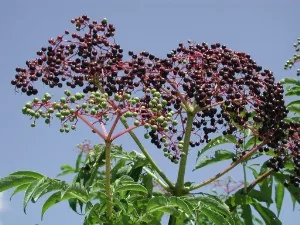

Planting timing
Utah State: “Dormant, bare root plants can be planted very early in the spring.” “Actively growing nursery container plants should not be planted until danger of hard frosts has past.” Establish before summer heat. (Utah State elderberry) The ZIP planner uses Transplant at last frost (0) for container plants. Bare-root “very early spring” has no sourced week offset, so it is not a separate planner row.
USU notes plants are partially self-fruitful; “having more than one cultivar will result in better pollination and higher yields.”
Depth and spacing
USU: allow about 4 feet in all directions (cultivar-dependent). In rows, plants 2 to 4 feet apart; multiple rows 6 to 8 feet apart. NC State: available space 6–12 feet; height 5–12 feet, width 6–12 feet. Spreads by root suckers into thickets if suckers are not removed. (NC State)
Sun, soil and water
USU: full sun for optimum production; tolerates some shade. Prefer somewhat fertile, well-drained soil high in organic matter and near-neutral pH; shallow roots — amend before planting; raised beds help on heavy clay. Plants can use 1 to 2 inches of water per week in summer heat; mulch. FAQ soil pH 5.5–7.0. NC: moist, slightly acidic soil; sun to partial shade; flowers and fruit best with more sun.
Care
USU dormant pruning (Feb/Mar): remove dead, damaged, or diseased wood; remove 3-year-old and older canes; tip weak canes. Fruit forms on current-year, 1-year, and some 2-year wood. Prefer soil test and compost over product rates. NC: when cutting back, leave some dead hollow stems 12–24 inches for stem-nesting bees.
Harvest
USU: Utah harvest windows run roughly early August–early October by location and type; individual plants ripen over about 3 weeks. Cut entire clusters; freezing eases destemming. Fruit is “bitter if eaten raw, but is excellent when processed”; flowers can be dried for tea. NC: fruit edible when cooked (pies, jellies, wine); display Aug–Sep.
Pests and diseases
Wisconsin on elderberry rust: prune galls 4–6 inches below; sanitize tools (for example 70% alcohol ≥30 sec); increase distance from sedge (Carex) alternate hosts; thin for airflow; prefer drip or soaker over sprinkler. Home fungicides are not recommended. (Wisconsin elderberry rust) NC also lists canker, powdery mildew, leaf spot, borers, spider mites, and aphids.
Related: ZIP planner · all grow guides · organic pest control
Frequently asked questions
When do I plant elderberry?
Container plants after hard frost. Dormant bare-root very early spring (USU).
Are raw elderberries safe?
No — NC State: cook ripe fruit; unripe fruit is more toxic; leaves, stems, and roots are also listed poison parts.
Do I need two plants?
USU: better yield with two or more different cultivars nearby.
More grow guides: All grow guides
Sources
- NC State Extension: NC State Sambucus canadensis
- Utah State University Extension: Utah State elderberry
- University of Wisconsin–Madison Extension: Wisconsin elderberry rust