
How to Grow Grapes (Bunch): Planting, Spacing, Care & Harvest
Quick answer
Plant potted grapevines after the threat of frost has passed (UMN). Dormant bare-root vines go in in late winter and early spring (Clemson) — no frost-week count is sourced for bare-root. Space vines about 8 feet apart in the row with rows about 10 feet (Clemson). This page is bunch grapes only, not muscadine.
Grapes at a glance


Weeks relative to last frost (LF). Colored weeks show when our ZIP planner schedules each step.
Jump to
Updated
Planting dates for your ZIP: the ZIP planting planner counts each window from your local frost dates.
Organic pests and diseases: see also organic pest control. Use any product as the label directs.
Bunch grapes (Vitis labrusca and American / French hybrids) — not muscadine. Keep muscadine on a separate page if one is sourced later.

Planting timing
UMN: “In Minnesota, spring planting is recommended…” Calendar line: “Plant potted grapevines after threat of frost has passed.” (UMN growing grapes) Clemson HGIC 1402: “Plant grapevines in late winter and early spring.” Vigorous 1-year-old plants; plant at the same depth or slightly deeper than in the nursery. (Clemson bunch grapes) Planner: Plant potted vines last frost 0. Dormant bare-root timing stays a calendar window (late winter / early spring) — no frost-week integer is sourced, so we do not invent one.
Depth and spacing
Clemson: space vines 8 feet apart in the row and rows 10 feet apart; plant the first and last vine 4 feet in from the end posts. UMN: each vine needs about 6 feet of space; keep the lowest bud just above the soil surface and spread the roots. Build and erect the trellis before the vines are planted (Clemson).
Sun, soil and water
Full sun most or all of the day; well-drained loam or clay loam; avoid low spots where cold air settles (Clemson). Soil pH about 5.8 to 6.5 (Clemson) — soil test; we omit printed fertilizer product rates. UMN generally does not recommend mulching (it can keep soil too cool).
Care
Annual dormant pruning is required. Clusters form on the current season’s shoot from buds on last year’s wood (Clemson). UMN: prune in spring before leaves emerge. Keep roots moist until planting (Clemson).
Harvest
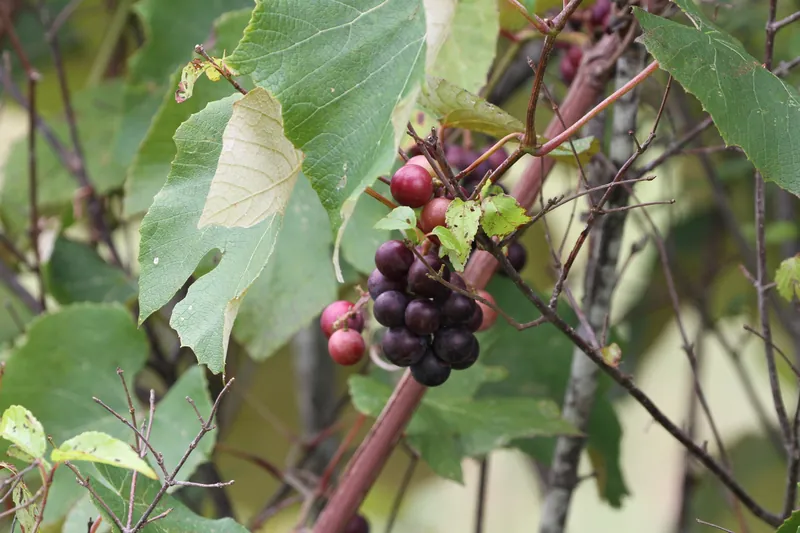
Clemson: for table use, taste is the main criterion; berries of black varieties lose their red color and white varieties change from green to golden yellow; ripe berries soften and seeds become brown.
Pests and diseases
Clemson notes Pierce’s disease in some regions, downy mildew, black rot, and grape root borer. Cultural for root borer: mound soil directly beneath the vines in late June or very early July to prevent adult emergence, or use landscape fabric as an alternative. UMN: a sunny site with air circulation reduces insect and disease pressure; clean up fallen leaves, fruit, and debris in fall. Prefer cultural controls first; use any product as the label directs.
Related: ZIP planner · organic pest control · raspberries · all grow guides
Frequently asked questions
When do I plant grapes?
Potted vines after the threat of frost has passed (UMN). Dormant bare-root in late winter and early spring (Clemson) — no week count sourced.
Bunch grapes vs muscadine?
Different crops. This page is bunch grapes only; muscadine would need its own sourced page.
How far apart?
About 8 feet in the row and 10 feet between rows (Clemson); UMN suggests about 6 feet of space per vine.
More grow guides: All grow guides
Sources
- University of Minnesota Extension: UMN growing grapes
- Clemson Cooperative Extension: Clemson bunch grapes