
Is Butterfly Bush Invasive? Where It’s Regulated, “Sterile” Cultivars and Native Alternatives
Quick answer
Yes, in many areas. Butterfly bush (Buddleja davidii) spreads by wind-blown seed into riverbanks and other open ground. Oregon and Washington allow only approved low-seed cultivars, and University of Maryland Extension says not to plant it. Its flowers feed adult butterflies, but its leaves don’t feed native caterpillars, so native plants such as buttonbush and summersweet are better pollinator choices.
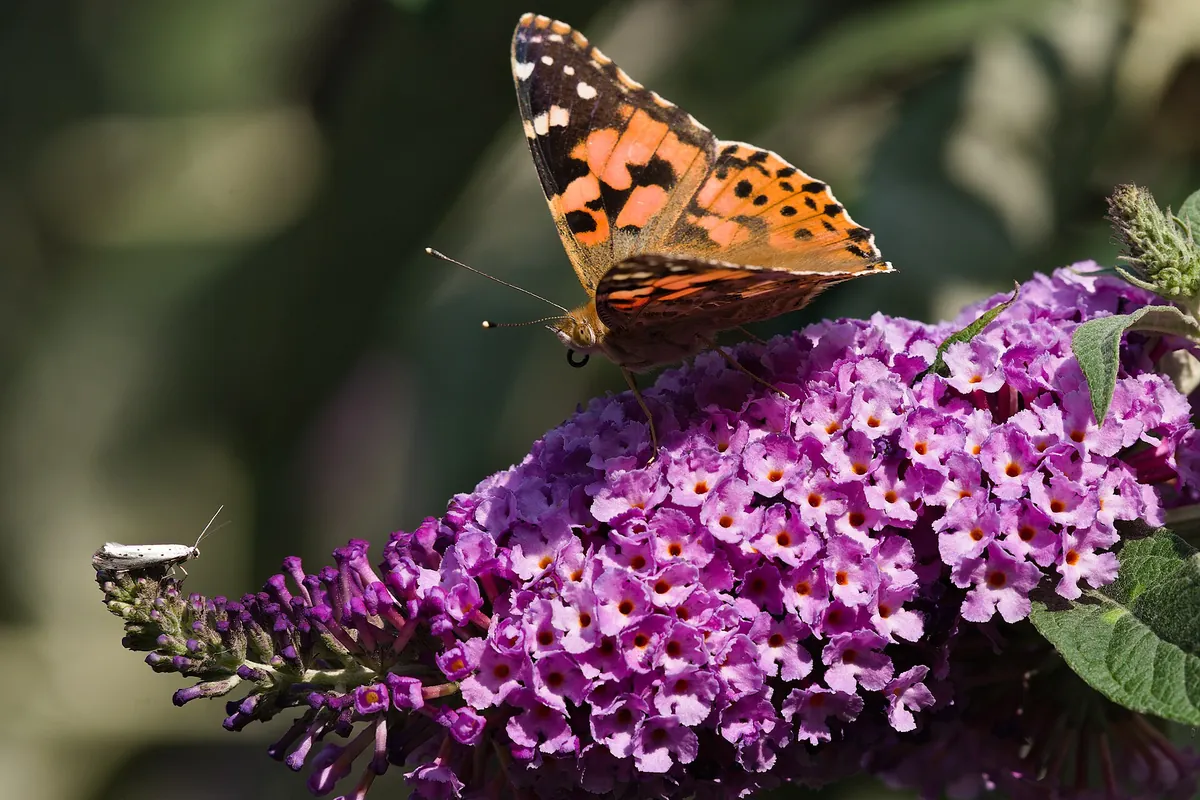
Butterfly bush (Buddleja davidii) is easy to grow and covered in butterflies in summer, which is why the invasive question surprises people. Here is where it spreads, where it’s regulated (as of Oct 18, 2026), what “sterile” cultivars mean, and native shrubs that do more for butterflies.
Where it’s invasive
- “Butterfly bush is an invasive species and spreads into natural areas by seed.” It’s native to Asia and was “introduced around 1900,” and it “grows best in sunny, disturbed sites with dry, well-drained soils” (University of Maryland Extension).
- It “escaped into uncultivated habitats in the Northeast, Southeast, and mid-Atlantic states, as well as scattered locations in the Midwest,” and is “found throughout southeastern Pennsylvania and in three counties in northern Virginia.” “The plant has the capacity to be invasive almost anywhere” (UMD Extension, Branching Out).
- It is “listed as invasive by the NC Invasive Plant Council in the Mountain and Piedmont regions of North Carolina,” “listed as a severe threat by the North Carolina Native Plant Society” and “reported as invasive in the Redwood National Park in California” (NC State Extension).
- “It forms dense thickets, especially along river banks and gravel bars, which crowd out native plants.” It “can colonize disturbed areas including roadsides, abandoned railroad tracks, pastures, riverbanks, and recently logged forests” (Washington State Noxious Weed Control Board).
- How it spreads: it “can produce seeds during its first year and seeds are viable 3 to 5 years.” “One cultivar produces an estimated 40,000 seeds per flower head,” and “Cut stems can sprout roots” (WA NWCB). NC State counts up to “40,000 seeds on a single panicle,” and the seeds “travel far by wind or water.”
Where it’s regulated (as of Oct 18, 2026)
| State | Status | Source |
|---|---|---|
| Oregon | “Only Oregon Department of Agriculture (ODA) approved seedless butterfly bush cultivars can be propagated, transported, or sold in Oregon.” Approved cultivars “produce two percent, or less, viable seed.” | Oregon Department of Agriculture |
| Washington | “Buddleja davidii (butterfly bush) is a quarantined species, except for ‘accepted sterile cultivars’, defined as those that produce less than 2% viable seed.” WAC 16-752-610 lists “Buddleia davidii (except accepted sterile cultivars).” “Interspecies crosses where Buddleja davidii is one parent are not quarantined or regulated.” | WA Noxious Weed Control Board; WAC 16-752-610 |
| Maryland | Not yet prohibited. “Butterfly bush is on a list of species prioritized for assessment in 2026” by the Maryland Department of Agriculture. If it’s listed, “MDA regulations apply to all cultivars of that species unless individual cultivars are later granted an exemption.” | UMD Extension |
| Ohio | Not on Ohio’s invasive plant list. Rule 901:5-30-01 lists 63 species, and Buddleja davidii isn’t one of them, though extension sources describe it as invasive in other eastern states. | Ohio Adm. Code 901:5-30-01 |
| Everywhere else | Rules differ by state and change over time, so check your state’s list before you buy. | — |
Oregon and Washington restrict the sale of non-approved plants; the sources don’t say existing plants must be removed. Our low-maintenance shrubs guide lists it among shrubs to skip where it’s regulated.
“Sterile” and seedless cultivars
Oregon’s approved cultivars produce two percent or less viable seed (Oregon Department of Agriculture):
- Buddleja 'Asian Moon'
- Buddleja 'Blue Chip'
- Buddleja 'Blue Chip Jr.'
- Buddleja 'Ice Chip' (Formerly 'White Icing')
- Buddleja 'Inspired Pink'
- Buddleja 'Pink Micro Chip'
- Buddleja 'Purple Haze'
- FLUTTERBY GRANDÉ™ Blueberry Cobbler Nectar Bush
- FLUTTERBY GRANDÉ™ Peach Cobbler Nectar Bush
- FLUTTERBY GRANDÉ™ Sweet Marmalade Nectar Bush
- FLUTTERBY GRANDÉ™ Tangerine Dream Nectar Bush
- FLUTTERBY GRANDÉ™ Vanilla Nectar Bush
- FLUTTERBY PETITE™ Snow White Nectar Bush
- FLUTTERBY™ Pink Nectar Bush
Oregon also lists Buddleja 'Lilac Chip', Buddleja 'Miss Molly', Buddleja 'Miss Ruby' and Buddleja 'Miss Violet' as non-regulated interspecific hybrids, but “The fertility of these cultivars have not been assessed.”
- NC State suggests considering “noninvasive butterfly shrubs like ones from the Lo & Behold® series, developed by North Carolina State University” (NC State Extension).
- UMD: “Some cultivars of butterfly bush are marketed as sterile.” It still advises: “Do not plant butterfly bush, and replace existing specimens when possible” (University of Maryland Extension).
Our take: if you grow one, choose a cultivar on Oregon’s approved list, check your own state’s rules, and consider a native shrub first.
Is it good or bad for butterflies?
Adult butterflies do visit the flowers; that’s the plant’s appeal. Its popularity also came from its “resistance to many gardening challenges, including deer, drought, heat, humidity, and salt” (NC State). But “the larvae (caterpillars) of native butterflies cannot feed on its leaves. They need plants native to North America for sustenance,” and “Butterfly bush can outcompete native species in natural areas, thus negatively impacting the butterflies” (NC State). UMD adds: “Butterflybush leaves provide no nutrition for these caterpillars,” and “Birds such as chickadees that rely on caterpillars to feed to their young, will also be impacted” (UMD Extension, Branching Out).
Quick facts
- Deer resistant? Rutgers rates butterfly bush (Buddleia sp.) Rarely Damaged (A) and notes “no plant is deer proof” (Rutgers). NC State also lists deer resistance.
- Native? No. It’s native to “Tibet and Central and South China” (NC State).
- Size: “a deciduous shrub with arching branches that can reach 15 feet in height” (WA NWCB); it “grows 3-15 feet tall in a single season” (UMD).
- Hardiness: NC State lists USDA zones 5a–9b. “In Zones 5 and 6, the shrub will die back to the ground, but it will have vigorous growth in the spring.”
- Evergreen? No, it’s deciduous (WA NWCB, UMD).
- Toxic to pets? We found no qualifying source, so we make no claim. Ask your veterinarian.
If you keep one: limit the seed
“At a minimum, regularly prune off spent flowers before they ripen and disperse seeds” (UMD). “Flower heads should be cut off before seeds form” (WA NWCB). Flowers form on new growth, so “it is best to prune this plant in early spring” (NC State); see when to prune flowering shrubs.
Removing one
“Dig out plants and dispose of them” (UMD). Seedlings “can be hand-picked and adult plants can be dug up,” but “butterfly bush thrives in recently disturbed areas, so be aware that these methods of removing plants may actually promote the growth of new seedlings” (WA NWCB). Watch for seedlings afterward.
Native alternatives for butterflies
UMD: “Several native or non-invasive shrub and perennial species have flowers highly attractive to butterflies and other pollinators.”
| Plant | Type | USDA zones (NC State Plant Toolbox) | Why |
|---|---|---|---|
| Buttonbush (Cephalanthus occidentalis) | Shrub | 5a–9b (NC State) | On UMD’s list of butterfly-attracting candidates. Good for wet sites |
| Summersweet, or sweet pepperbush (Clethra alnifolia) | Shrub | 3a–9b (NC State) | On UMD’s list. Profiled in our low-maintenance shrubs guide |
| New York ironweed, New England aster, Joe-Pye weed, butterfly weed (Asclepias tuberosa), blazing star (Liatris spicata), mountain-mint | Perennials | — | On UMD’s list |
In the West, the Washington State Noxious Weed Control Board says “There are many suitable alternatives for butterfly bush”; see its butterfly bush page. When to plant a replacement: shrub planting dates by zone.
Frequently asked questions
Is butterfly bush invasive?
Yes, in many regions, according to University of Maryland Extension and NC State Extension. It is regulated in Oregon and Washington.
Is it illegal to plant butterfly bush?
Oregon and Washington restrict the sale of non-approved plants, allowing only approved low-seed cultivars. Ohio doesn’t list it. Check your own state’s rules.
Are sterile butterfly bush varieties OK?
Oregon and Washington allow approved cultivars that produce under 2% viable seed. University of Maryland Extension still recommends native plants instead.
Is butterfly bush deer resistant?
Rutgers rates it Rarely Damaged (A), and notes that no plant is deer proof.
Sources
- University of Maryland Extension: Butterfly Bush (revised Jan 2026); Invasives in Your Woodland: Butterflybush (updated 2025)
- NC State Extension: Buddleja davidii; Cephalanthus occidentalis; Clethra alnifolia
- Washington State Noxious Weed Control Board: Butterfly bush
- Oregon state government: Butterfly Bush Approved Cultivars
- Washington State Legislature: WAC 16-752-610, Noxious weed seed and plant quarantine, regulated articles
- Ohio Revised Code: Ohio Administrative Code 901:5-30-01, Invasive plants
- Rutgers NJAES Cooperative Extension: Landscape Plants Rated by Deer Resistance