
Low-Maintenance Shrubs for Every Zone (and the Ones to Avoid)
Easy shrubs matched to your zone, light, soil and deer pressure, from university extension research
A low-maintenance shrub is one that fits its spot: the right size, the right light, the right soil, and no habit of escaping into the woods. Below are 23 North American native shrubs profiled from extension sources, sorted by USDA zone and by site, with fall planting dates for your zone and a list of invasive shrubs to skip.
Sun or shade, wet or dry, deer or not. Use the site picker.
A shrub that fits its space rarely needs cutting back.
No shrub is maintenance-free until its roots grow out.
Barberry, burning bush and privet are regulated in several states. See the list.
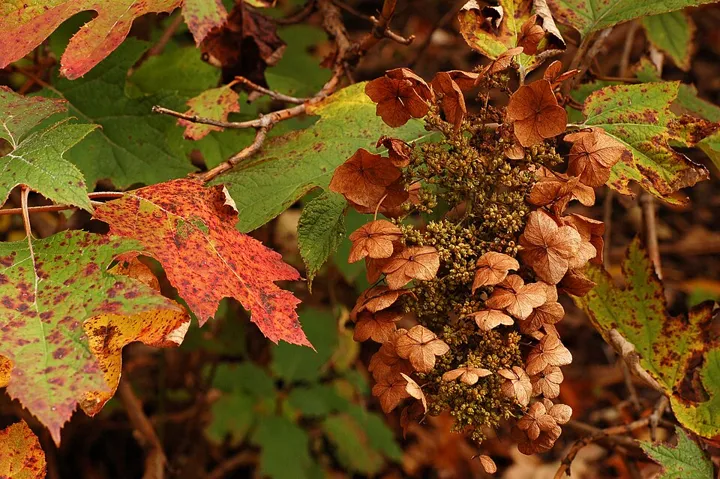

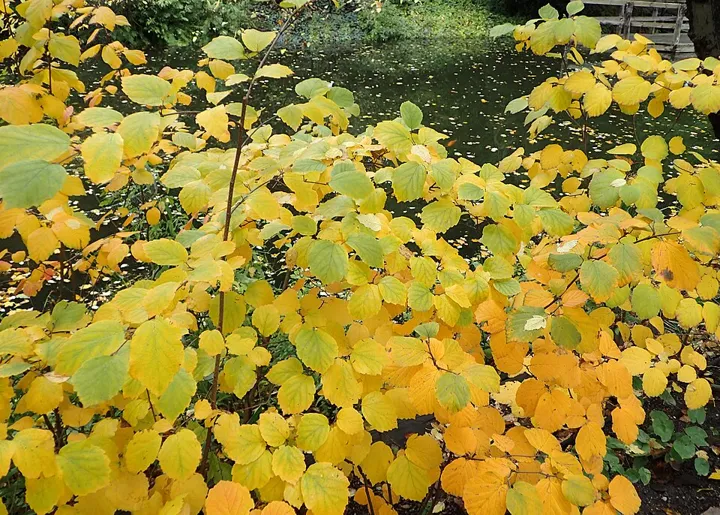

What “low maintenance” really means
- Right plant, right place. UMass Extension says to check sun, shade and wind, and to ask “What size is the space you want the plant to fill?” Its top picks have “no significant pest problems, drought tolerance, no invasive tendencies, and beauty in at least two seasons” (UMass).
- Mature size saves the most pruning. A shrub that fits its space at full size seldom needs cutting. NC State says of inkberry, for example, that plants “generally need minimal pruning unless used as a hedge.”
- Year one takes work. Every establishment guide calls for regular watering until roots grow out. Clemson: “Many plants die from too little or too much water during the first few months after planting” (Clemson).
- Easy is regional. Shrubby cinquefoil struggles in Southeast humidity, Texas sage dislikes humidity and wet soil, and arrowwood viburnum is easy only where viburnum leaf beetle isn’t present (NC State, UMass).
- Suckering is a trade-off. Black chokeberry, red-osier dogwood, Virginia sweetspire, inkberry, fragrant sumac, bush honeysuckle and yaupon spread by suckers or underground stems. That’s great on a slope or in a mass planting, and extra work in a tidy foundation bed.
- Some need a partner to fruit. Winterberry, inkberry, yaupon and wax myrtle have separate male and female plants, so plant a male nearby for berries.
Pick by zone
Zones are USDA Plant Hardiness Zones as each extension source gives them. Not sure of yours? Find it on our zone map. A shrub can appear in more than one band.
Most of these also grow into zones 6 to 8.
Black chokeberry · Red-osier · Common ninebark · Shrubby cinquefoil · Northern bush honeysuckle · Fragrant sumac · Winterberry · Northern bayberry · Smooth hydrangea · Summersweet · Skunkbush
Everything in the cold band that reaches zone 6 or 7, plus these.
Virginia sweetspire · Inkberry · Oakleaf hydrangea · Dwarf fothergilla · Large fothergilla · Arrowwood viburnum · American beautyberry
Plus the cold- and middle-band shrubs that reach zone 8 or 9.
Yaupon holly · Wax myrtle · Texas sage · Firebush · Toyon
Pick by site: sun, shade, wet, dry and deer
Tap the conditions in your yard, and pick your zone, to narrow the list. Tap a shrub’s name to jump to its profile.
Showing all 23 shrubs.
| Shrub | USDA hardiness zones (from extension sources) | Typical mature size in feet (height × width) | Light | Soil | Deer (Rutgers rating) | Native region |
|---|---|---|---|---|---|---|
| Black chokeberry | 3 to 8 | 3–10 × 3–6 | Sun, part shade | Wet or dry | Not rated | East |
| Red-osier (red-twig) dogwood | 2 to 7 | 5–9 × 5–10 | Sun, part shade | Wet or dry | B | North, West |
| Common ninebark | 2 to 8 | 5–8 × 4–6 | Sun, part shade | Dry | Not rated | Central, East |
| Shrubby cinquefoil | 2 to 7 | 2–4 × 3–5 | Sun, part shade | Dry | A | North, West |
| Northern bush honeysuckle | 3 to 7 | 3–5 × 3–5 | Sun, part shade, shade | Dry | Rarely browsed in landscapes (UMN) | Northeast, Midwest, Appalachians |
| Fragrant sumac | 3 to 9 | 2–6 × 6–10 | Sun, part shade | Dry | A | East, Midwest, Plains, TX |
| Winterberry | 3 to 9 | 3–15 × 3–12 | Sun, part shade, shade | Wet | B (some browsing) | East |
| Northern bayberry | 3 to 7 | 6–8 × 5–10 | Sun, part shade | Wet or dry | A | Northeast, Mid-Atlantic, OH |
| Smooth hydrangea | 3 to 9 | 3–5 × 3–5 | Part shade (sun only with steady moisture) | Average, moist | C | East, South-central |
| Summersweet (coastal sweetpepperbush) | 4 to 9 | 5–10 × 4–6 | Sun, part shade, shade | Wet (short drought only) | B | East, Gulf coast |
| Skunkbush (threeleaf) sumac | 3 to 8 | 2–8 × about 6 | Sun, part shade | Dry (no wet soil) | Not rated | West, Plains |
| Virginia sweetspire | 5 to 9 | 4–8 × 3–6 | Sun, part shade | Wet or dry | B | Southeast, lower Midwest |
| Inkberry | 4 to 9 | 5–10 × 5–8 (compact: 3–5) | Sun, part shade | Wet | B (some browsing) | Atlantic and Gulf coastal plain |
| Oakleaf hydrangea | 5 to 9 | 4–8 × 4–10 | Sun, part shade | Medium moisture, well drained | C | Southeast |
| Dwarf fothergilla | 5 to 8 | 1.5–3 × 2–4 | Sun, part shade | Wet | NC State: resistant | Southeast coastal plain |
| Large fothergilla | 4 to 8 | 6–12 × 6–10 | Sun, part shade | Average, moist | Not rated | Southeast mountains |
| Arrowwood viburnum | 2 to 8 | 5–10 × 6–10 | Sun, part shade | Wet or dry | A (some browsing) | East to TX |
| American beautyberry | 6 to 10 | 3–8 × 3–6 | Sun, part shade | Wet or dry | B (some browsing) | Southeast, South-central |
| Yaupon holly | 7 to 9 | 10–20 × 8–12 (dwarfs 4–5) | Sun, part shade, shade | Wet or dry | NC State: resistant | Southeast, TX, OK |
| Wax myrtle | 7 to 10 | up to 20–25 × 8–10 | Sun, part shade, shade | Wet or dry | NC State: resistant | Southeast coast |
| Texas sage (cenizo) | 8 to 11 | 6–12 × 6–12 | Sun, part shade | Dry (no wet soil) | NC State: resistant | SW Texas |
| Firebush | 9 to 11 | 6–12 × 5–8 | Sun, part shade | Wet or dry | Not rated | South Florida |
| Toyon | California | 8–12 × 4–6 | Sun, dappled shade | Dry (needs winter drainage) | Not rated | California |
How to read this table: zones and sizes are the ranges given by the extension sources for each shrub (see the profiles below). Deer letters are from Rutgers’ Landscape Plants Rated by Deer Resistance: A = rarely damaged, B = seldom severely damaged, C = occasionally severely damaged. Rutgers compiled it for northern New Jersey and says “no plant is deer proof.” “Some browsing” means another extension source reports deer eating it. “NC State: resistant” means the NC State Extension Plant Toolbox lists deer resistance but Rutgers doesn’t rate it. Filters show shrubs that match every condition you pick.
Shrub profiles
Each profile lists the shrub’s zones, size, light, soil, why it’s easy, what to watch for, how deer treat it and where it’s native, with the source for each.
Cold band: zones 3 to 5
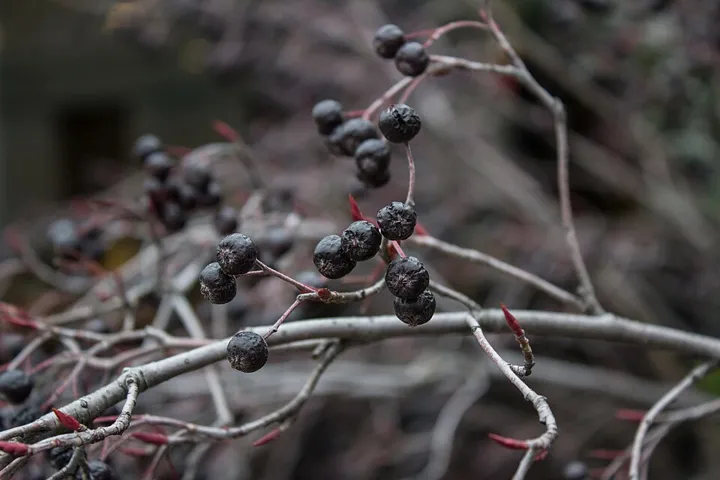

Black chokeberry
Aronia melanocarpa
- USDA zones
- 3 to 8
- Size
- 3–10 ft tall × 3–6 ft wide
- Light
- Full sun to part shade (2 to 6 hours of direct sun)
- Soil
- Clay to sand, acid to alkaline; it “tolerates a wide variety of soil types including wet boggy soils” and resists drought.
- Why it’s easy
- “No serious problems,” and NC State rates its maintenance Low.
- Watch for
- It “spreads freely and suckers profusely” and can get leggy with age.
- Deer
- Not rated (Rutgers rates only red chokeberry; NC State doesn’t list deer resistance).
- Native range
- Eastern North America.
Sources: NC State
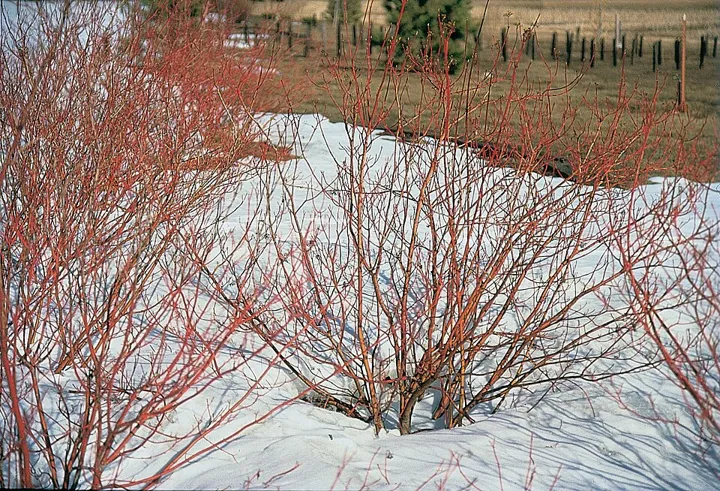

Red-osier (red-twig) dogwood
Cornus sericea
- USDA zones
- 2 to 7
- Size
- 5–9 ft tall × 5–10 ft wide
- Light
- Full sun to part shade; it “can become stressed in full sun during our hot southern summers” (NC State).
- Soil
- Wet or dry sites and heavy clay; best in consistently moist, organic soil. Handles occasional flooding.
- Why it’s easy
- A tough wet-site shrub with red winter stems. NC State rates maintenance Medium because the brightest color is on young stems, so it advises cutting older stems in early spring.
- Watch for
- It “spreads by underground stems to form a colony.”
- Deer
- Rutgers B (seldom severely damaged); NC State lists deer resistance.
- Native range
- Most of North America, including the West and Alaska.
.jpg)
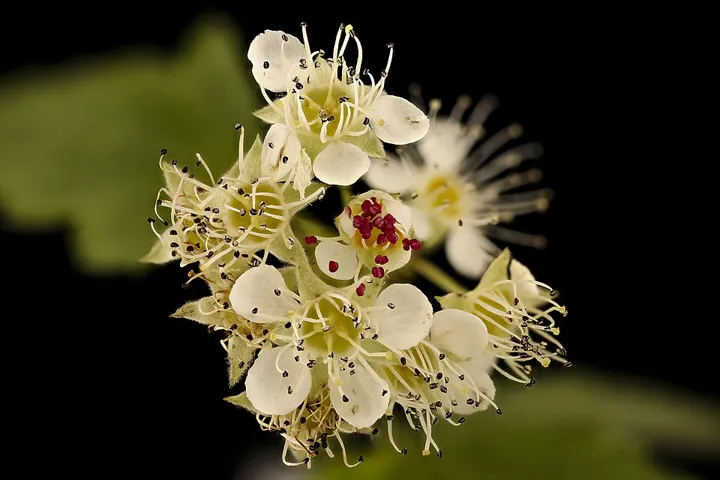
Common ninebark
Physocarpus opulifolius
- USDA zones
- 2 to 8
- Size
- 5–8 ft tall × 4–6 ft wide (dwarf cultivars are smaller)
- Light
- Full sun to part shade; it “appreciates some shade in its southernmost locations.”
- Soil
- “Tough and adaptable”: slightly acidic, dry to medium, well-drained soil, and drought resistant.
- Why it’s easy
- “Relatively trouble free,” with peeling bark for winter interest.
- Watch for
- It “can be susceptible to powdery mildew and fireblight.” It flowers on old wood, so prune just after bloom, “no later than mid-August.” NC State rates maintenance Medium.
- Deer
- Not rated by Rutgers or NC State.
- Native range
- Central and eastern North America.
Sources: NC State
_Dasiphora_fruticosa_ssp._Goldstar_-_Les_Martels,_Giroussens_Tarn.jpg)
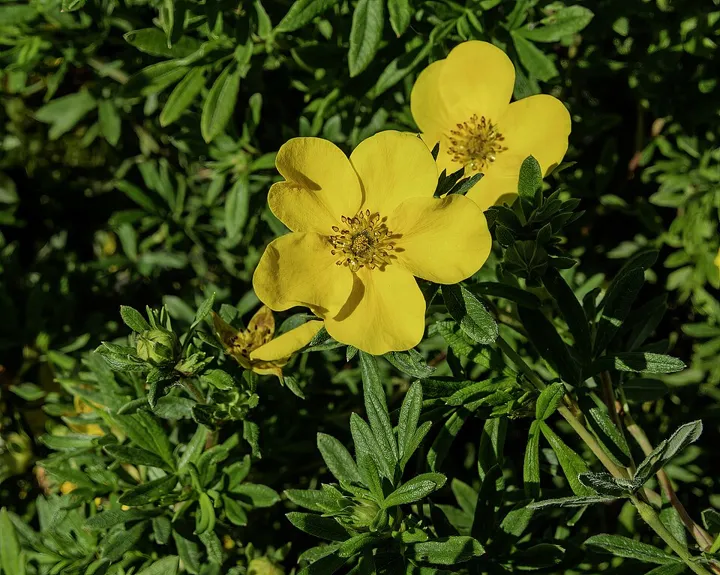
Shrubby cinquefoil
Dasiphora fruticosa (often sold as Potentilla fruticosa)
- USDA zones
- 2 to 7 (best in 3 to 7)
- Size
- 2–4 ft tall × 3–5 ft wide
- Light
- Full sun for the best bloom; tolerates part shade.
- Soil
- A wide range of well-drained soils; drought tolerant, and it handles poor soil and urban conditions.
- Why it’s easy
- “An easy plant to grow” with “no significant insect pests or diseases” (NC State, maintenance Low). Colorado State lists it among its xeriscape shrubs.
- Watch for
- It “struggles in the high-humidity conditions of the southeastern United States,” where mildew, leaf spot and spider mites can show up.
- Deer
- Rutgers A (rarely damaged); NC State lists deer resistance.
- Native range
- The northern US, the West and Canada.
Sources: NC State, Rutgers, Colorado State
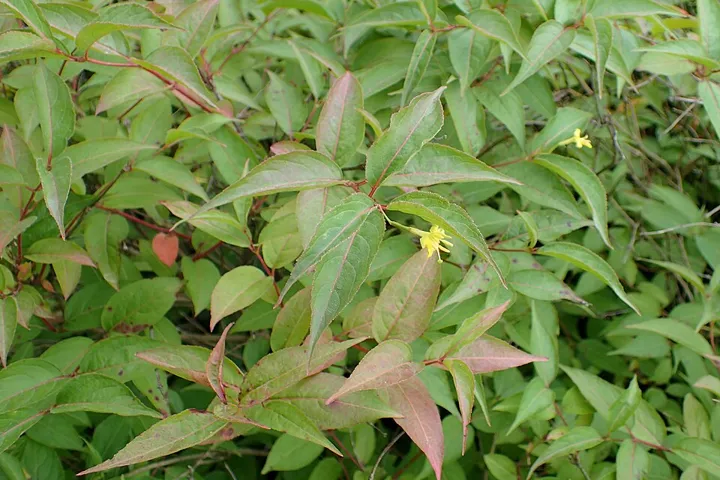

Northern bush honeysuckle
Diervilla lonicera (not a true honeysuckle)
- USDA zones
- 3 to 7
- Size
- 3–5 ft tall × 3–5 ft wide
- Light
- “Does well in sun to full shade.”
- Soil
- Sand, loam or clay; dry to moist and well drained. Tolerates drought and compacted soil, and suits slopes and erosion control.
- Why it’s easy
- University of Minnesota Extension calls bush honeysuckles “low-maintenance and versatile” with “no serious pests.”
- Watch for
- It spreads by suckers, and leaf spot and powdery mildew may occur. Don’t confuse it with the invasive Asian bush honeysuckles (Lonicera) in the skip list below.
- Deer
- Deer browse it in the wild but “rarely feed on the plant in landscape plantings” (UMN). Not rated by Rutgers.
- Native range
- Newfoundland to Georgia, west to Saskatchewan and Alabama.
Sources: University of Minnesota Extension
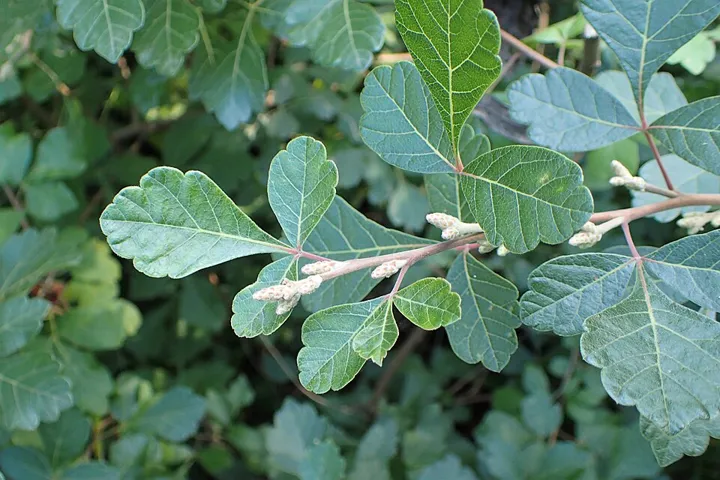

Fragrant sumac
Rhus aromatica
- USDA zones
- 3 to 9
- Size
- 2–6 ft tall × 6–10 ft wide (low and spreading)
- Light
- Full sun to part shade.
- Soil
- Clay, loam, sand or shallow rocky soil; acid. Resists drought, dry soil and black walnut.
- Why it’s easy
- “No serious insect or disease problems” (NC State, maintenance Low), and “excellent for stabilizing banks and slopes.”
- Watch for
- It spreads by root suckers into thickets, and it is “reportedly susceptible to vascular wilt.”
- Deer
- Rutgers A (rarely damaged); NC State lists deer resistance.
- Native range
- Eastern Canada to Mexico: eastern, Midwest, Plains and Texas states. In the West, see skunkbush sumac.
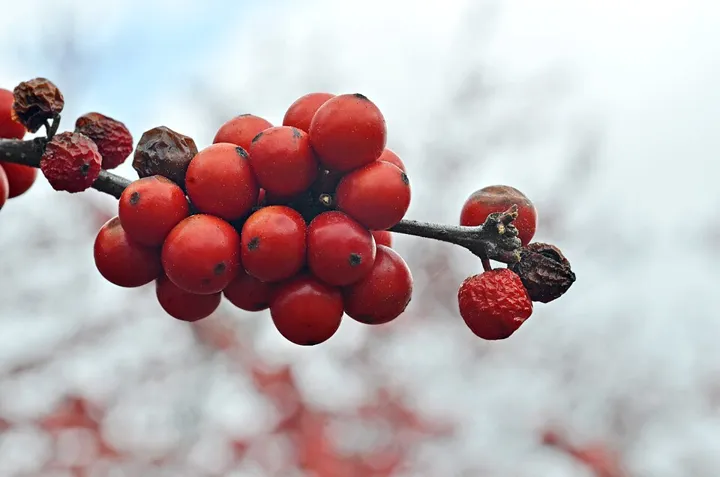

Winterberry
Ilex verticillata
- USDA zones
- 3 to 9
- Size
- 3–15 ft tall × 3–12 ft wide (pick a cultivar by size)
- Light
- Full sun to deep shade.
- Soil
- Moist and acidic; tolerates occasionally wet soil, heat and compaction, but it “may abort fruit set in dry soil.”
- Why it’s easy
- NC State rates maintenance Low. It grows slowly and carries red berries into winter.
- Watch for
- Plants are male or female. For berries, plant “one male (per 10 to 20 females) within 50 feet of female plants,” with a matching bloom time.
- Deer
- Rutgers B (seldom severely damaged). NC State lists deer resistance but also notes that deer eat the foliage, so expect some browsing.
- Native range
- Eastern North America.
.jpg)
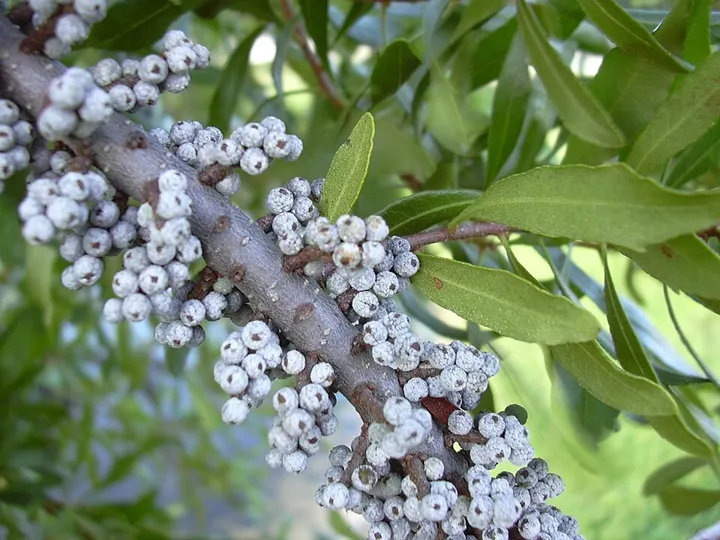
Northern bayberry
Morella (Myrica) pensylvanica
- USDA zones
- 3 to 7
- Size
- 6–8 ft tall × 5–10 ft wide
- Light
- Full sun to part shade.
- Soil
- Acid to alkaline, occasionally dry or wet, and poor soil. Salt tolerant, so it suits salted roadsides and coasts.
- Why it’s easy
- “No serious insect or disease problems” (NC State, maintenance Low).
- Watch for
- No serious problems listed. Plan for its 5–10 ft spread.
- Deer
- Rutgers A (rarely damaged); NC State lists deer resistance.
- Native range
- Eastern Canada to the eastern US.
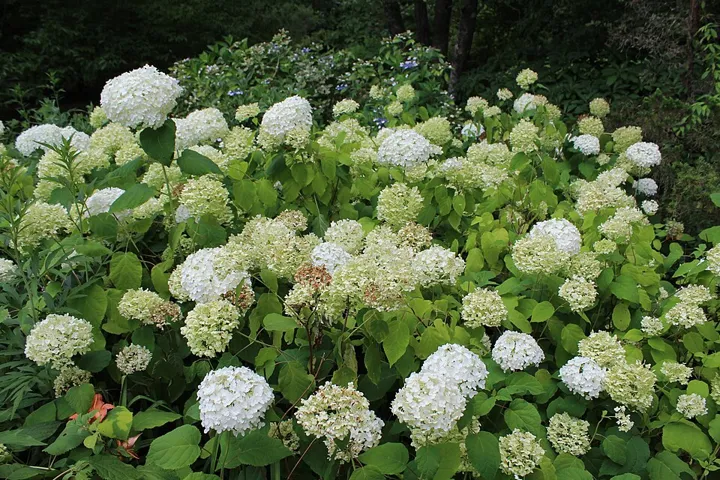

Smooth hydrangea
Hydrangea arborescens
- USDA zones
- 3 to 9
- Size
- 3–5 ft tall × 3–5 ft wide
- Light
- Part shade is best; it “will tolerate full sun only if grown with consistent moisture.”
- Soil
- Neutral to acidic and well drained, with steady moisture.
- Why it’s easy
- NC State rates maintenance Low. It blooms on new wood, so it “can be pruned back close to the ground in late winter” without losing flowers.
- Watch for
- Easy in part shade with steady moisture, but not problem-free: heavy blooms flop after rain, and NC State lists several possible diseases, including leaf spots and powdery mildew. NC State also flags it as poisonous to people, cats, dogs and horses.
- Deer
- Rutgers C (occasionally severely damaged), so skip it where deer pressure is high.
- Native range
- New York to Florida, west to Iowa, Missouri, Oklahoma and Louisiana.
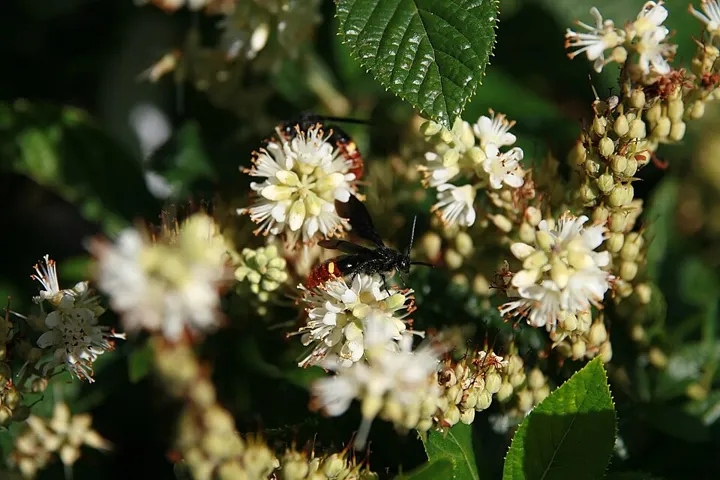

Summersweet (coastal sweetpepperbush)
Clethra alnifolia
- USDA zones
- 4 to 9 (zone 3 uncertain)
- Size
- 5–10 ft tall × 4–6 ft wide
- Light
- Full sun to part shade; NC State also lists heavy shade. It “will not tolerate a hot, dry site.”
- Soil
- Moist to sometimes wet, acidic and organic. Once established it handles short droughts, flooding and salt.
- Why it’s easy
- NC State rates maintenance Low; fragrant late-summer flowers feed pollinators.
- Watch for
- It suckers into small thickets in good conditions. NC State’s zone list starts at zone 3, but the same page says dormant plants are hardy to about -22°F, which is zone 4b, so we list it from zone 4.
- Deer
- Rutgers B (seldom severely damaged); NC State lists deer resistance.
- Native range
- Maine to Florida and west to Texas.
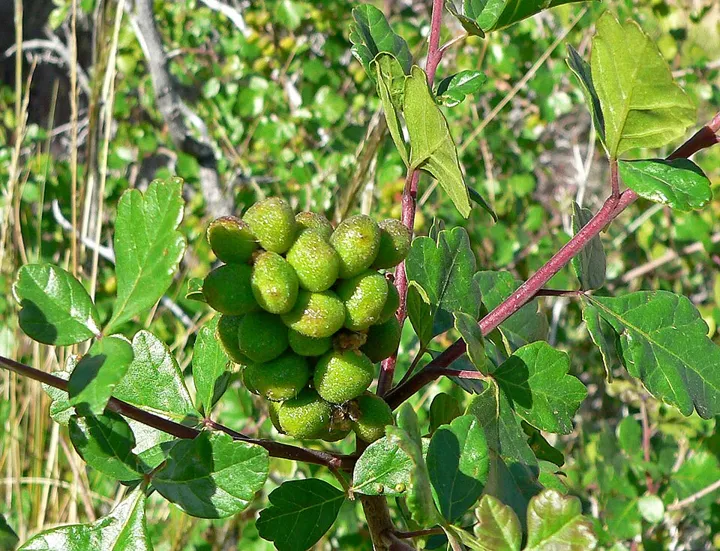

Skunkbush (threeleaf) sumac
Rhus trilobata
- USDA zones
- 3 to 8
- Size
- 2–8 ft tall (more compact in the Southwest, taller in the North) × about 6 ft wide
- Light
- Sun or part shade.
- Soil
- Anything from “nearly bare rock to sand and heavy clay”; drought resistant, but “intolerant of flooding and high water tables.”
- Why it’s easy
- Drought resistant once established, with orange to red fall color. Colorado State lists it as a xeriscape shrub.
- Watch for
- Give it drainage; it won’t take wet ground.
- Deer
- Not rated. Utah State says it “provides some browse for deer, elk, and pronghorn when other more preferred forage is unavailable.”
- Native range
- Western North America, from western Canada to California and Texas.
Sources: University of Minnesota, Utah State, Colorado State
Middle band additions: zones 6 to 7
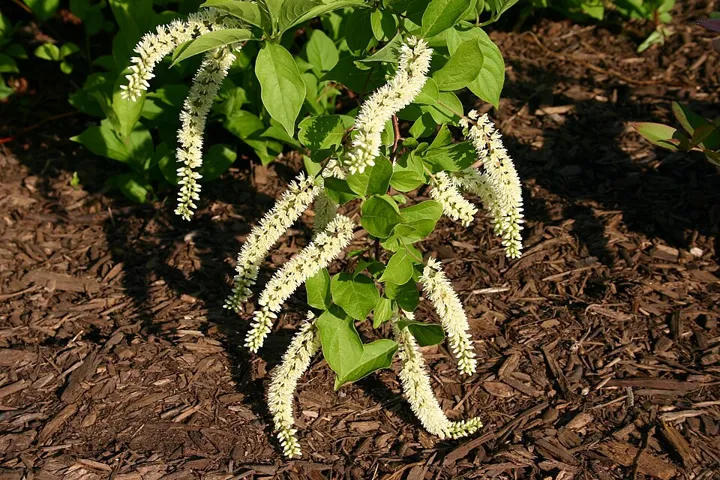

Virginia sweetspire
Itea virginica
- USDA zones
- 5 to 9
- Size
- 4–8 ft tall × 3–6 ft wide
- Light
- Sun to part shade; full sun gives the best flowers, fall color and density.
- Soil
- A wide range of soils and pH, including frequent standing water. Also resists drought.
- Why it’s easy
- A very adaptable wet-site shrub. NC State’s only care note is “avoid over fertilization.”
- Watch for
- It forms dense colonies from root suckers, and NC State tags it “weedy.” It blooms on last year’s wood, so prune after flowering.
- Deer
- Rutgers B (seldom severely damaged); NC State lists deer resistance.
- Native range
- New Jersey to Florida, west to Missouri, Louisiana and East Texas.
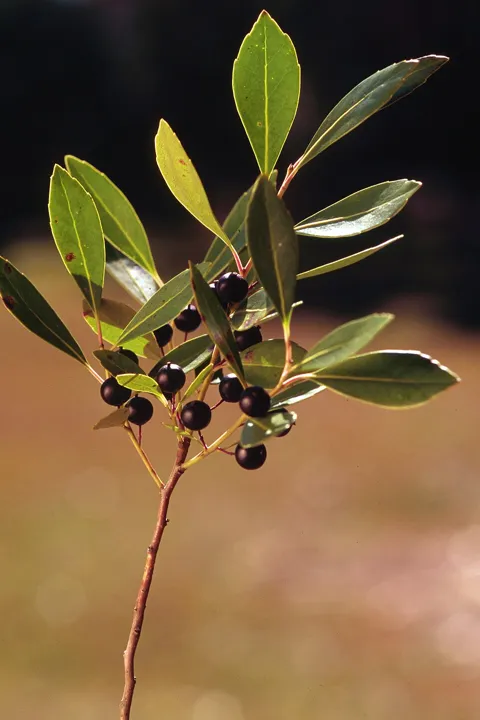

Inkberry Evergreen
Ilex glabra (broadleaf evergreen)
- USDA zones
- 4 to 9
- Size
- 5–10 ft tall × 5–8 ft wide; compact cultivars such as ‘Shamrock’ are 3–5 ft
- Light
- Full sun to part shade.
- Soil
- Clay or sandy acidic soil; tolerates occasionally wet soil and moderate salt.
- Why it’s easy
- NC State rates maintenance Low: “plants generally need minimal pruning unless used as a hedge.” NC State calls some compact cultivars a “good Boxwood alternative.”
- Watch for
- It suckers, needs male and female plants for berries, and NC State rates it highly flammable. NC State’s zone list runs to zone 11; we show 4 to 9 until a Florida source confirms the warm end.
- Deer
- Rutgers B (seldom severely damaged), but NC State says “leaves are eaten by white-tailed deer and rabbits,” so expect some browsing.
- Native range
- The Atlantic and Gulf coastal plain, Nova Scotia to Florida to Louisiana.
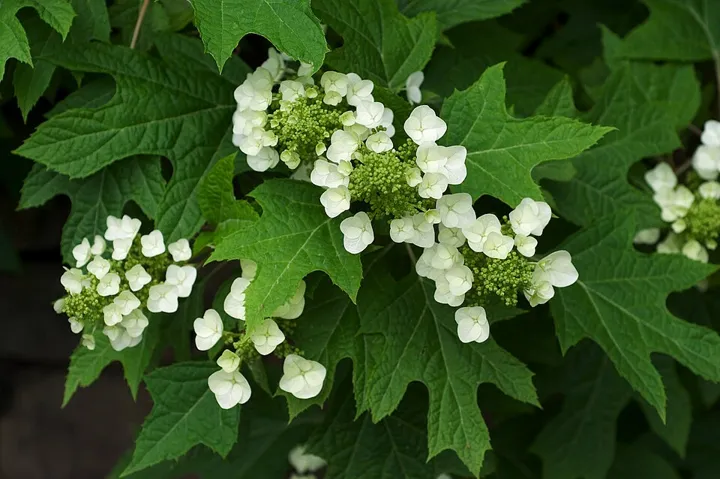

Oakleaf hydrangea
Hydrangea quercifolia
- USDA zones
- 5 to 9
- Size
- 4–8 ft tall × 4–10 ft wide; compact cultivars are about 3–4 ft
- Light
- Full sun to part shade; it needs some sun to bloom.
- Soil
- Organically rich, well drained, medium moisture; resists drought once established.
- Why it’s easy
- “No significant problems” (NC State, maintenance Low), with interest in all four seasons: flowers, leaves, fall color and peeling bark.
- Watch for
- Some leaf blight, powdery mildew, aphids and spider mites. It blooms on old wood: it forms next year’s flower buds in late summer and fall, and they wait on the stems through winter. It needs little pruning. If you must shorten it, do it right after the flowers fade in summer, and no later than midsummer, so new buds have time to form. Cutting it back in fall, winter or early spring removes next year’s flowers. Dead or winter-damaged stems can come out in spring once the leaves appear (UMD, Clemson, Iowa State).
- Deer
- Rutgers C (occasionally severely damaged), so skip it where deer pressure is high.
- Native range
- The southeastern US.
Sources: NC State, Rutgers, UMD, Clemson, Iowa State
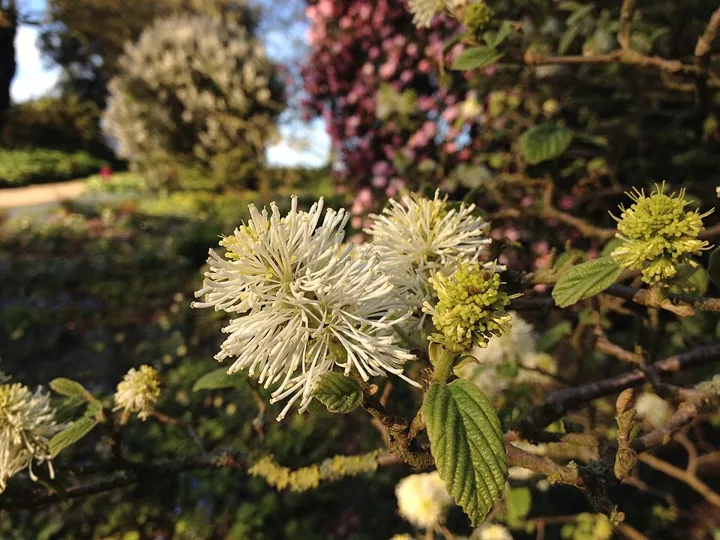

Dwarf fothergilla
Fothergilla gardenii
- USDA zones
- 5 to 8
- Size
- 1.5–3 ft tall × 2–4 ft wide
- Light
- Full sun to part shade.
- Soil
- Acid soil; tolerates occasional flooding and compaction.
- Why it’s easy
- NC State describes it as “low maintenance” with “no significant problems.”
- Watch for
- Needs acid soil. Fothergillas are native shrubs and are not listed as invasive or noxious anywhere (USDA PLANTS). Both species are uncommon in the wild, so buy nursery-propagated plants and never dig them from the wild. Fothergilla blooms in spring on last year’s wood and rarely needs pruning. If you need to shape it, prune right after it flowers (Clemson).
- Deer
- Not rated by Rutgers; NC State lists deer resistance.
- Native range
- The coastal plain of the southern US.
Sources: NC State, USDA PLANTS, Clemson, Clemson (May)
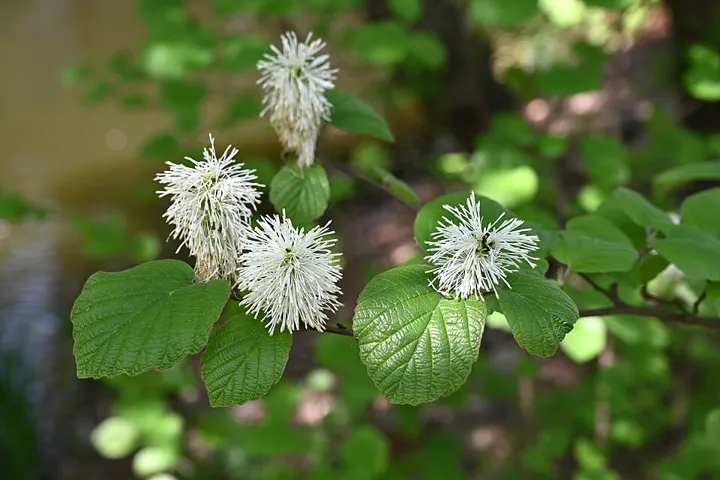

Large fothergilla
Fothergilla major
- USDA zones
- 4 to 8
- Size
- 6–12 ft tall × 6–10 ft wide
- Light
- Full sun to part shade.
- Soil
- Acid soil.
- Why it’s easy
- The larger species, for spaces that need filling; for small beds, choose dwarf fothergilla.
- Watch for
- Needs acid soil and room to grow. Fothergillas are native shrubs and are not listed as invasive or noxious anywhere (USDA PLANTS). Both species are uncommon in the wild, so buy nursery-propagated plants and never dig them from the wild. Fothergilla blooms in spring on last year’s wood and rarely needs pruning. If you need to shape it, prune right after it flowers (Clemson).
- Deer
- Not rated by Rutgers, and NC State doesn’t list deer resistance for this species.
- Native range
- The mountains of the Southeast.
Sources: NC State, USDA PLANTS, Clemson, Clemson (May)
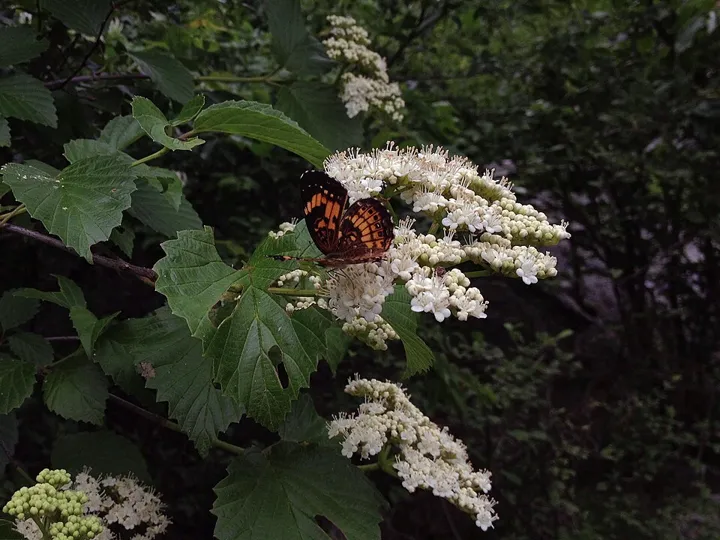

Arrowwood viburnum
Viburnum dentatum
- USDA zones
- 2 to 8
- Size
- 5–10 ft tall × 6–10 ft wide
- Light
- Full sun to part shade; tolerates shade with occasional drought or flooding.
- Soil
- A wide variety of soils, acid to neutral; resists black walnut.
- Why it’s easy
- NC State rates maintenance Low with “no serious pests or diseases.”
- Watch for
- Viburnum leaf beetle. In the Northeast, the Great Lakes states and the Upper Midwest (reported from New England and New York west through Pennsylvania, Ohio, Michigan, Wisconsin, Illinois and Minnesota), and in Washington State, arrowwood is a favorite food of this invasive beetle, which can strip the leaves. UMass Extension lists arrowwood among the viburnums “most heavily preferred by VLB” and notes that “2-3 years of complete defoliation weakens the plant to the point where it may be killed.” In those areas, choose a different shrub or be ready to scout for larvae in spring. Mild winters may limit the beetle’s spread south. Prune after flowering.
- Deer
- Rutgers A (rarely damaged), but NC State notes its twigs and leaves are browsed by white-tailed deer.
- Native range
- Most of the eastern US, along the coast to Texas.
Sources: NC State, Rutgers, UMass, Minnesota Dept. of Agriculture, Michigan State
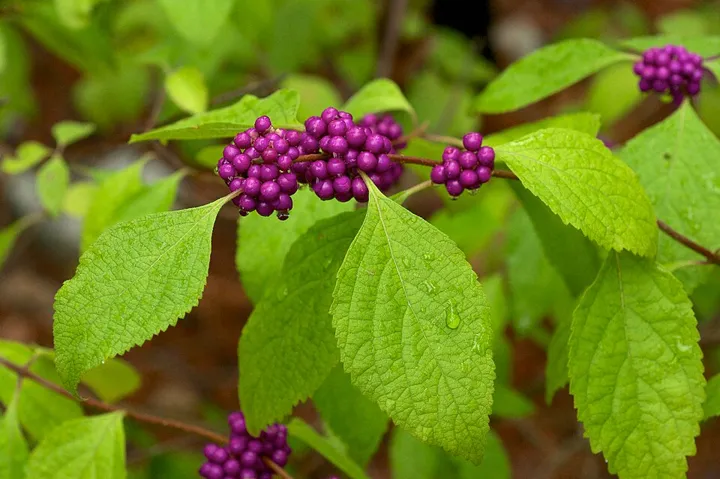

American beautyberry
Callicarpa americana
- USDA zones
- 6 to 10
- Size
- 3–8 ft tall × 3–6 ft wide
- Light
- Full sun to part shade; “intolerant of deep shade.”
- Soil
- Any soil that drains well; resists drought, heat and periodic wet soil.
- Why it’s easy
- “No significant problems” (NC State, maintenance Low). Flowers and purple fruit form on new shoots, so NC State says to “prune in late winter to 1 foot high.”
- Watch for
- Buy it by its botanical name, Callicarpa americana, since other beautyberry species are also sold.
- Deer
- Rutgers B (seldom severely damaged; rated as Callicarpa), but NC State notes deer browse the leaves in summer.
- Native range
- The central and southeastern US.
Warm band additions: zones 8 to 11
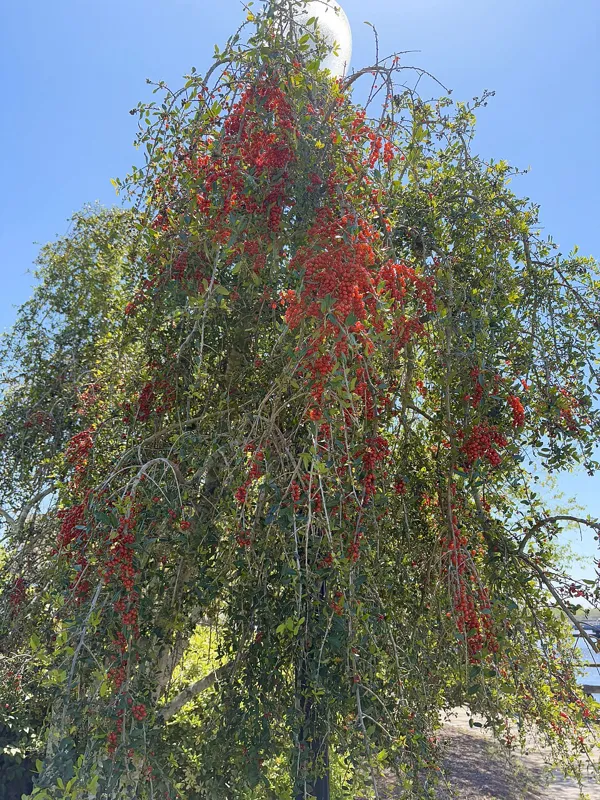

Yaupon holly Evergreen
Ilex vomitoria (broadleaf evergreen)
- USDA zones
- 7 to 9
- Size
- 10–20 ft tall × 8–12 ft wide for the species; dwarf cultivars are much smaller (‘Bordeaux’ is 4–5 ft × 5–6 ft)
- Light
- Full sun to deep shade (more fruit and a denser plant in sun).
- Soil
- A wide range; withstands drought, salt spray and occasional flooding, and is “resistant to Phytophthora root rot.”
- Why it’s easy
- It takes heavy pruning and transplants easily. The dwarf cultivars are the low-maintenance choice for foundation beds.
- Watch for
- It “will form thickets unless the suckers are removed,” needs male and female plants for berries, and NC State flags ‘Stokes Dwarf’ as highly flammable.
- Deer
- Not rated by Rutgers; NC State lists deer resistance.
- Native range
- The Southeast from Virginia to Texas and Oklahoma.
Sources: NC State
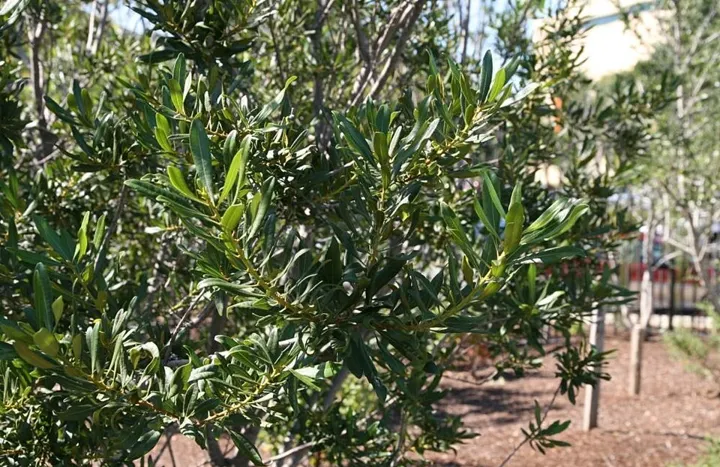

Wax myrtle Evergreen
Morella (Myrica) cerifera
- USDA zones
- 7 to 10
- Size
- Usually well under its maximum of 20–25 ft tall × 8–10 ft wide; a large shrub or small tree
- Light
- Sun to part shade; it “even grows in the elusive dry shade.”
- Soil
- Wet and swampy to dry; tolerates salt spray, wind and urban sites.
- Why it’s easy
- One of the most site-tolerant evergreens on this list.
- Watch for
- It suckers into colonies, needs male and female plants for berries, and is “only semi-evergreen in the northern zones.” NC State says these shrubs “are considered to be potential fire hazards in some areas” and should not be planted in the defensible space around buildings.
- Deer
- Not rated by Rutgers; NC State lists deer resistance.
- Native range
- New Jersey to Central America and the Caribbean. USDA PLANTS lists it as introduced in Hawaii.
Sources: NC State, USDA PLANTS
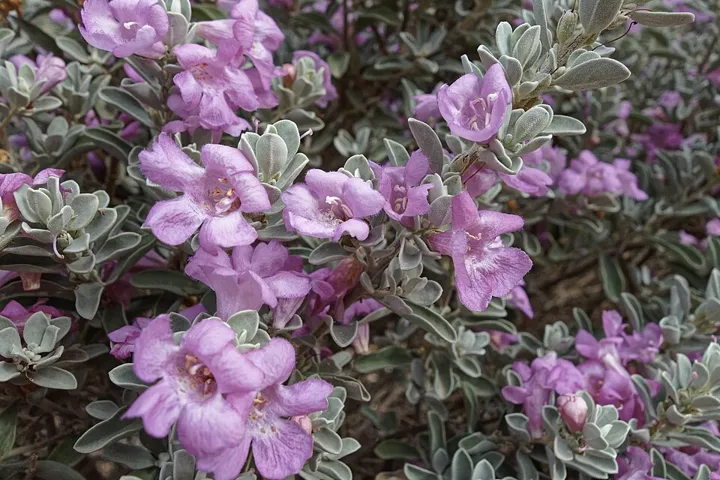

Texas sage (cenizo)
Leucophyllum frutescens (evergreen)
- USDA zones
- 8 to 11
- Size
- 6–12 ft tall × 6–12 ft wide
- Light
- Full sun (tolerates part shade).
- Soil
- Well-drained, alkaline soil; “excellent tolerance for drought and heat.” “Do not fertilize plants. Once established, plants require minimal maintenance.”
- Why it’s easy
- Built for hot, dry, alkaline sites.
- Watch for
- “Humidity and high night temperatures can be a problem,” and overwatering or poor drainage “can lead to cotton root rot.” In high-rainfall areas, NC State suggests raised beds.
- Deer
- Not rated by Rutgers; NC State lists deer resistance.
- Native range
- Southwest Texas and Mexico.
Sources: NC State
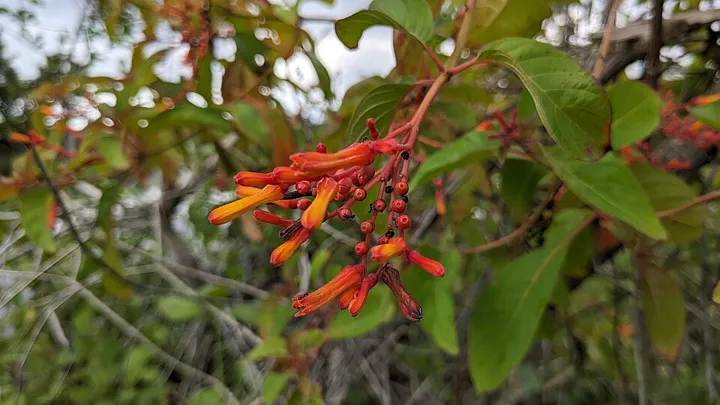

Firebush
Hamelia patens
- USDA zones
- 9 to 11 (UF/IFAS)
- Size
- 6–12 ft tall × 5–8 ft wide; grown as a 2–3 ft annual farther north
- Light
- Full sun to part shade; in shade “flowering is much reduced.”
- Soil
- Sand to clay, acid or alkaline, occasionally wet; moderate drought tolerance and poor salt tolerance.
- Why it’s easy
- UF/IFAS says “no serious pests are normally seen on the plant” and that the species is “not known to be invasive.” “Fertilize this plant sparingly.”
- Watch for
- It is “quite tender and can be killed to the ground during a freeze,” then regrows quickly from the roots. NC State lists zones 9 to 10; we follow UF/IFAS for Florida. The native firebush is Hamelia patens var. patens, with red to orange-red flowers and slightly hairy leaves. Plants sold as “dwarf,” “compact” or “African” firebush are usually a different, non-native variety (var. glabra), with yellow-orange flowers and smooth leaves. If you want the native plant, check the label for var. patens or ask the nursery.
- Deer
- Not rated.
- Native range
- Florida (from Sumter County south), the West Indies, Mexico, and Central and South America.
Sources: UF/IFAS, UF/IFAS Gardening Solutions, UF/IFAS Leon County, HortScience, NC State
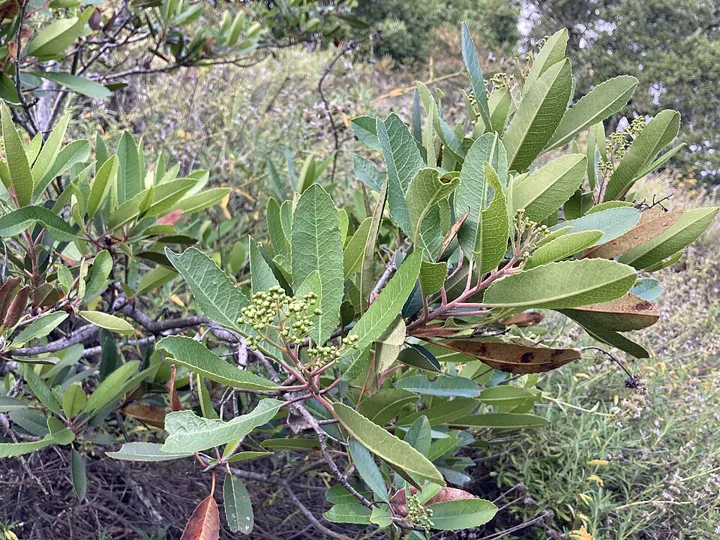

Toyon
Heteromeles arbutifolia (California)
- USDA zones
- California (no USDA zone range confirmed)
- Size
- Normally 8–12 ft tall × 4–6 ft wide; may reach 15–20 ft
- Light
- Full sun for the best flowers and berries; tolerates dappled shade.
- Soil
- “Tolerates most soil types as long as the planting area drains easily in winter.” “Naturally drought tolerant” once established, though it “thrives most beautifully when lightly irrigated” in hot inland areas.
- Why it’s easy
- A drought-tolerant California native with winter berries.
- Watch for
- It can get fireblight. Unripe fruit and all seeds are poisonous (UC Plant Safely). Young plants may need protection from deer.
- Deer
- Not rated; young plants may need protection from deer.
- Native range
- California. USDA PLANTS lists it as introduced in Hawaii.
Sources: UC ANR, UC Plant Safely
When to plant shrubs: dates by zone
Fall is shrub-planting season in most of the country. Three rules from extension services:
- Six weeks or more before the first frost. WVU: “Planting should be done about two months, and a minimum of six weeks, before the first average frost date.” UMass and UC Master Gardeners count six weeks back from when the ground freezes, which comes later, so WVU’s rule is the cautious one (WVU, UMass, UC Master Gardeners). UNH adds that “the chance of plant failure increases the later in the season you wait” (UNH).
- Deciduous shrubs are the fall stars; evergreens go in earlier or in spring. UMass: “Most deciduous shrubs will establish easily in the fall,” but wait until spring for broadleaf and needled evergreens. Evergreens lose water through their leaves all winter (UNH). Massachusetts CZM: deciduous plants “can be planted anytime the ground is workable,” and evergreens “before mid-October” (Mass CZM). That applies to inkberry, yaupon and wax myrtle in the colder part of their ranges.
- Warm zones: fall and winter. Clemson calls fall “the best season to plant shrubs” in South Carolina, because roots keep growing through winter “since the soil does not freeze,” starting in mid-September (Clemson). In Florida, “shrubs can be established during any season,” with regular watering, ideally at the start of the rainy season (UF/IFAS). Frost-tender shrubs such as firebush go in from spring through summer (UF/IFAS).
| USDA zone | Typical first fall frost (32°F) | Finish fall planting by (6 weeks before) | Ideal (8 weeks before) | Typical first hard freeze (28°F, context only) | If you missed the date |
|---|---|---|---|---|---|
| Zone 3223 ZIPs | Sep 2380% of ZIPs: Sep 7 – Oct 1 | Aug 12range across ZIPs: Jul 27 – Aug 20 | Jul 29 | Oct 1 | Hardy deciduous shrubs can still go in until the ground freezes, with steady watering, but the risk rises the later you plant. Evergreens should wait for spring. |
| Zone 41,950 ZIPs | Sep 3080% of ZIPs: Sep 19 – Oct 7 | Aug 19range across ZIPs: Aug 8 – Aug 26 | Aug 5 | Oct 9 | Hardy deciduous shrubs can still go in until the ground freezes, with steady watering, but the risk rises the later you plant. Evergreens should wait for spring. |
| Zone 54,869 ZIPs | Oct 780% of ZIPs: Sep 26 – Oct 18 | Aug 26range across ZIPs: Aug 15 – Sep 6 | Aug 12 | Oct 19 | Hardy deciduous shrubs can still go in until the ground freezes, with steady watering, but the risk rises the later you plant. Evergreens should wait for spring. |
| Zone 69,140 ZIPs | Oct 1980% of ZIPs: Oct 5 – Oct 28 | Sep 7range across ZIPs: Aug 24 – Sep 16 | Aug 24 | Oct 30 | Hardy deciduous shrubs can still go in until the ground freezes, with steady watering, but the risk rises the later you plant. Evergreens should wait for spring. |
| Zone 77,068 ZIPs | Oct 2880% of ZIPs: Oct 17 – Nov 8 | Sep 16range across ZIPs: Sep 5 – Sep 27 | Sep 2 | Nov 7 | Hardy deciduous shrubs can still go in until the ground freezes, with steady watering; the risk rises the later you plant. Plant evergreens early in fall or wait for spring where your zone is near the cold end of their range. |
| Zone 85,253 ZIPs | Nov 1080% of ZIPs: Oct 31 – Nov 20 | Sep 29range across ZIPs: Sep 19 – Oct 9 | Sep 15 | Nov 22 | Hardy deciduous shrubs can still go in until the ground freezes, with steady watering; the risk rises the later you plant. Plant evergreens early in fall or wait for spring where your zone is near the cold end of their range. In the Southeast, Clemson calls fall the best season for shrubs because roots keep growing through winter where the soil doesn’t freeze. |
| Zone 93,241 ZIPs | Dec 380% of ZIPs: Nov 17 – Dec 26 | No fall deadline. Hardy shrubs can be planted through fall and winter, since the soil rarely freezes (Clemson). Plant frost-tender shrubs such as firebush in spring and summer instead of fall (UF/IFAS). The typical first hard freeze (28°F) is Dec 16, and about 17% of zone 9 ZIPs rarely reach 28°F. | |||
| Zone 101,265 ZIPs | No planting deadline. Frost is occasional (70% of zone 10 ZIPs rarely see 32°F) and a hard freeze is rare in 90% of them. In Florida, UF/IFAS says shrubs can be established in any season with regular irrigation, ideally at the start of the rainy season. Plant frost-tender shrubs such as firebush from February to December. | ||||
| Zone 11135 ZIPs | No planting deadline. Frost is rare in 100% of zone 11 ZIPs. Plant in any season and water regularly while roots establish (UF/IFAS). | ||||
Where these dates come from: for each USDA zone (2023 USDA map, PRISM ZIP data), we matched each ZIP code to its nearest NOAA NCEI 1991–2020 Climate Normals station. “Typical first fall frost” is the median, across the zone’s ZIPs, of each station’s 50%-probability first 32°F date, so in half of years frost comes earlier. The “80% of ZIPs” range runs from the 10th to the 90th percentile. “Finish by” subtracts 6 weeks, WVU Extension’s minimum, and “Ideal” subtracts 8 weeks, its “about two months.” Zone 9 has no fall deadline: hardy shrubs go in through fall and winter, and frost-tender shrubs go in during spring and summer. The hard-freeze column is the median first 28°F date, shown only where 28°F happens in at least half of years; it is context, since no source ties a shrub-planting rule to 28°F. ZIPs is the number of ZIP codes in the zone. These are the same zone medians used in our frost guide. For your own address, use the ZIP planner.
Planting in spring? In spring, plant dormant shrubs as soon as the soil has thawed and is workable, which in most areas is before your last frost date ("+a("isushrub","Iowa State")+"). Shrubs that have already leafed out in a warm nursery are more tender: in cold areas, wait until after your typical last frost to plant them ("+a("csumtn","Colorado State")+"). Aim to finish spring planting before summer heat arrives, and plant broadleaf evergreens in spring rather than fall. Your zone’s typical last spring frost is in the zone guides.
Planting and first-year watering
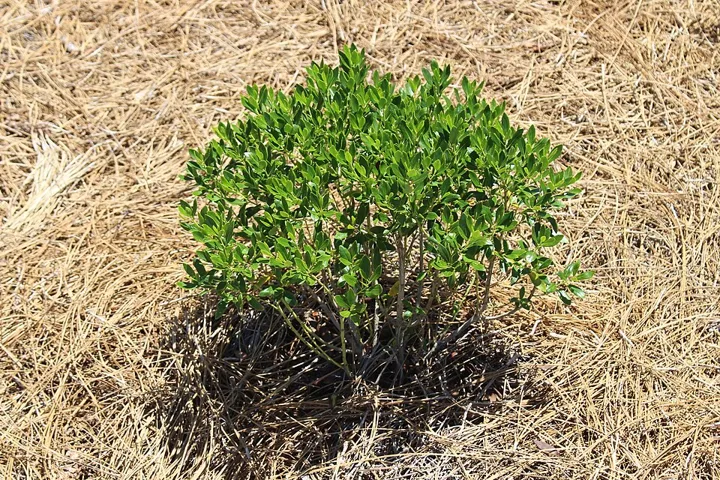

- Dig wide, not deep. Dig only as deep as the root ball, measured from the trunk flare, and 2 to 3 times as wide. Set the flare at or 1 to 2 inches above the soil. Loosen circling roots, remove wire and string and the top half of any burlap, backfill with the native soil, and water halfway through and again at the end (UMass). “Planting too deeply may cause the plant to die!”
- Keep the root flare visible. Clemson warns that burying it too deep “will eventually kill the plant” (Clemson).
- North and middle zones: moisten the soil “to a depth of eight to ten inches at least once a week” and “continue watering until freezing temperatures arrive” (UNH). In a dry fall, WVU suggests about an inch of water a week.
- Southeast: for the first year, water the root ball itself, since roots haven’t spread into the surrounding soil yet. Keep it evenly moist, not soggy (Clemson).
- Florida (3-gallon shrubs): 1 gallon every 8 days north of Orlando and every 4 days south of Orlando kept plants alive in UF/IFAS research. For faster growth, water every 2 to 4 days in north and central Florida, or every 2 days in south Florida. “Applying a volume greater than one gallon per irrigation event does not increase survival or growth.” Roots typically reach the canopy edge in 20 to 28 weeks (UF/IFAS EP391).
- Dry West: water during establishment, “then gradually reduce irrigation”; many plants need at least two growing seasons to establish. To test drainage, dig an 18 × 18 inch hole and fill it with water. Water still standing after 30 minutes means poor drainage (Colorado State).
- How long? It depends on climate: about 20 to 28 weeks in Florida, at least two growing seasons in Colorado, and through the first fall until freeze-up in New England.
Mulching
Spread 2 to 3 inches of organic mulch, such as pine needles, shredded bark, wood chips or partly shredded leaves, over the planting area. Keep it a hand’s width back from the stems, and keep it thin or absent over the root ball itself. Mulch piled against stems “increases the chances of stem rot” (Clemson). Mulch suppresses weeds, holds moisture, evens out soil temperature, and in fall slows soil cooling so roots keep growing longer (Clemson, Clemson Carolina Yards, UF/IFAS, WVU). Fallen leaves and pine needles are free mulch. Mulch also keeps down the weeds in our weed guide.
Minimal pruning
- Once the size fits, pruning is mostly removing dead, damaged or diseased wood, which can be done any time (Rutgers FS1221).
- Skip routine pruning from mid-August through leaf fall. Our fall cutback guide explains why.
- Blooms on old wood (prune right after flowering, if at all): ninebark, Virginia sweetspire, arrowwood viburnum, oakleaf hydrangea (UMD, Clemson) and fothergilla (Clemson). Some general pruning charts list oakleaf hydrangea with late-winter shrubs; hydrangea-specific extension guidance says to prune it after flowering, and no later than midsummer.
- Blooms on new wood (prune in late winter): smooth hydrangea, and American beautyberry, which NC State says can go to about 1 foot.
- Inkberry: if needed, “prune in early spring just before new growth begins” (NC State). Red-osier dogwood: cut older stems in early spring for brighter red (NC State).
- Suckering shrubs: pull or cut suckers to keep them in bounds (NC State, UMN).
Shrubs to skip: invasive or regulated
Some of the best-selling shrubs are invasive. Rules vary by state and change over time, and none of these is banned nationwide, so check your state’s list before you buy. Deer-resistance and drought lists sometimes include these plants; that isn’t a recommendation to plant them where they’re regulated. Virginia’s list is educational, not a regulation.
| Skip this | Where it’s regulated or listed | Native swaps from this guide |
|---|---|---|
| Japanese barberryBerberis thunbergii | Pennsylvania Class B noxious weed: it can’t be sold, transported, planted or propagated (sale enforcement began Oct 9, 2023; certain sterile cultivars are exempt) (PA Dept. of Agriculture, PA Bulletin). Massachusetts prohibits sale, propagation and import, including all cultivars, varieties and hybrids (MDAR). Virginia’s invasive list: Medium (Virginia DCR). | Black chokeberry, fragrant sumac |
| Burning bush (winged euonymus)Euonymus alatus | Pennsylvania Class B noxious weed since 2022 (PA Bulletin). Massachusetts prohibits sale, propagation and import, including all cultivars, varieties and hybrids (MDAR). Virginia’s invasive list: High. | Fothergilla, Virginia sweetspire, fragrant sumac, black chokeberry (fall color) |
| PrivetsLigustrum species | Pennsylvania lists Japanese privet as Class A and Chinese, European and border privet as Class B (PA Dept. of Agriculture). Ohio lists common privet, and its sales exemption ended Jan 1, 2026 (Ohio rule 901:5-30-01). Massachusetts prohibits border privet (MDAR). Virginia’s invasive list: Chinese privet High, border privet Medium. | Inkberry, dwarf yaupon, wax myrtle, northern bayberry (hedges) |
| Butterfly bushBuddleja davidii | Oregon: a B-listed noxious weed; only state-approved seedless cultivars may be propagated, transported or sold (Oregon Dept. of Agriculture). Washington: a state-listed Class B noxious weed and on the state’s plant quarantine list, so only accepted sterile cultivars may be sold (WAC 16-752-610, WA Noxious Weed Control Board). Virginia’s invasive list: Low. | Summersweet, Virginia sweetspire, bush honeysuckle, American beautyberry (pollinators) |
| Invasive bush honeysucklesLonicera maackii, L. morrowii, L. tatarica, L. × bella and others | Pennsylvania Class B. Ohio lists Amur, Morrow’s and Tatarian honeysuckle. Massachusetts prohibits Amur, Morrow’s, Tatarian and Bell’s honeysuckle (MDAR). Virginia’s invasive list: Amur and Morrow’s High, Tatarian Medium. These are not the native Diervilla bush honeysuckles. | Northern bush honeysuckle (Diervilla) |
| Autumn oliveElaeagnus umbellata | On Ohio’s invasive plant list and the Massachusetts Prohibited Plant List. Virginia’s invasive list: High. | Northern bayberry, wax myrtle |
| Callery (Bradford) pearPyrus calleryana | A tree, but it comes up in shrub shopping. Ohio prohibits sale, propagation and distribution (since Jan 7, 2023). Pennsylvania Class B noxious weed since Dec 2021 (PA Bulletin). Massachusetts is phasing it out, with all sales ending Dec 31, 2028. Virginia’s invasive list: Medium. | A native small tree; ask your local extension office |
| Japanese spireaSpiraea japonica | Virginia’s invasive list: Medium. | Virginia sweetspire, dwarf fothergilla |
| Linden viburnumViburnum dilatatum | Virginia’s invasive list: Medium. | Arrowwood viburnum, where viburnum leaf beetle isn’t a problem |
| Nandina (heavenly bamboo)Nandina domestica | Listed as invasive on Virginia’s invasive plant list (Low) (Virginia DCR). Rules differ by state, so check your state’s list before planting it. | Winterberry, inkberry, dwarf yaupon, fothergilla, Virginia sweetspire |
Regional notes
- Pacific Northwest Red-osier dogwood and shrubby cinquefoil are both native to Oregon and Washington (NC State). Your state extension service can suggest more regional natives.
- Desert Southwest Skunkbush sumac and Texas sage handle heat and drought. Give both excellent drainage.
- California Toyon is a drought-tolerant native that needs good winter drainage (UC ANR).
- Alaska and Hawaii Red-osier dogwood and shrubby cinquefoil are native in Alaska (USDA PLANTS). Hawaii: the shrubs on this page aren’t suited to Hawaii, and some, including wax myrtle and toyon, are not native there (USDA PLANTS). For native shrubs that are easy to keep in Hawaii landscapes, see the University of Hawaii CTAHR guide “Best Native Plants for Landscapes” (2008).
Frequently asked questions
What is the most low-maintenance shrub?
There’s no single answer, because it depends on your zone, light and soil. Good starting points: black chokeberry or northern bush honeysuckle in cold zones, Virginia sweetspire or inkberry in the middle zones, and dwarf yaupon or wax myrtle in the warm Southeast. Choosing a shrub whose mature size fits the space saves the most work.
What shrubs are deer resistant?
No plant is deer proof (Rutgers). On this list, the shrubs Rutgers rates A (rarely damaged) are shrubby cinquefoil, fragrant sumac, northern bayberry and arrowwood viburnum, though NC State notes deer do browse arrowwood and arrowwood is vulnerable to viburnum leaf beetle.
What shrubs grow in wet soil?
Red-osier dogwood, Virginia sweetspire, summersweet, winterberry, black chokeberry, inkberry and wax myrtle all tolerate wet soil, according to NC State Extension.
What low-maintenance shrubs grow in shade?
Northern bush honeysuckle grows in sun to full shade (University of Minnesota). Winterberry, yaupon holly and summersweet also tolerate heavy shade (NC State).
When is the best time to plant shrubs?
Fall in most zones. WVU Extension advises planting at least six weeks, and ideally about two months, before the average first frost. At the median location that six-week date is about Aug 19 in zone 4, Aug 26 in zone 5, Sep 7 in zone 6, Sep 16 in zone 7, Sep 29 in zone 8. Plant evergreens earlier or wait for spring. In the Southeast, fall through winter works well because the soil rarely freezes (Clemson).
How often should I water a new shrub?
In the North, soak the soil 8 to 10 inches deep at least once a week until freezing temperatures arrive (UNH). In Florida, UF/IFAS research on shrubs from 3-gallon containers found 1 gallon every 8 days north of Orlando and every 4 days south of Orlando kept plants alive, with more frequent watering for faster growth.
Which shrubs should I avoid?
Japanese barberry, burning bush, privets, invasive Asian bush honeysuckles, autumn olive, and butterfly bush where it’s regulated, such as Oregon and Washington. Nandina is on Virginia’s invasive plant list. Rules differ by state and change over time, so check your state’s list before you buy.
Sources & further reading
- NC State Extension Gardener Plant Toolbox
- Rutgers NJAES: Landscape plants rated by deer resistance
- Rutgers NJAES: Pruning flowering shrubs (FS1221)
- UMass Amherst Extension: Fall planting for trees and shrubs
- UNH Extension: Fall is a good time to plant trees and shrubs
- WVU Extension: Which is best, fall planting or spring planting?
- UC Master Gardeners of Tuolumne County: fall planting (PDF)
- Massachusetts Office of Coastal Zone Management: Fall planting on the coast
- Clemson Cooperative Extension HGIC: Planting shrubs correctly
- Clemson Cooperative Extension HGIC: This month in your garden, September 2025
- Clemson Cooperative Extension HGIC: It’s shrub and tree planting time, mind your roots
- Clemson Extension Carolina Yards: Mulch matters
- UF/IFAS EP391: Shrub establishment (irrigation)
- UF/IFAS FP237: Hamelia patens, firebush
- UF/IFAS Gardening Solutions: Planting shrubs
- Colorado State University Extension: Xeriscaping, trees and shrubs
- UMass Amherst Extension: Pruning shrubs
- University of Minnesota Extension: Bush honeysuckle
- University of Minnesota UFOR Nursery & Lab: Skunkbush sumac
- Utah State University Extension: Skunkbush sumac
- UC ANR: Toyon (Heteromeles arbutifolia)
- UC ANR Plant Safely: Heteromeles arbutifolia
- USDA NRCS PLANTS Database
- Pennsylvania Department of Agriculture: Controlled plant and noxious weed lists
- Pennsylvania Bulletin, Vol. 52, No. 22 (Japanese barberry)
- Pennsylvania Bulletin, Vol. 52, No. 46 (burning bush)
- Pennsylvania Bulletin, Vol. 51, No. 50 (Callery pear)
- Massachusetts Department of Agricultural Resources: Massachusetts Prohibited Plant List
- Ohio Administrative Code 901:5-30-01: Invasive plants
- Virginia DCR: Virginia Invasive Plant Species List, 2024 (PDF)
- Oregon Department of Agriculture: Butterfly bush
- Washington Administrative Code 16-752-610: Noxious weed seed and plant quarantine, regulated articles
- Washington State Noxious Weed Control Board: Butterfly bush
- University of Maryland Extension: Pruning hydrangeas
- Clemson Cooperative Extension HGIC: Pruning hydrangeas
- Iowa State University Extension: Pruning hydrangeas
- Clemson Cooperative Extension HGIC: Fothergilla
- Clemson Cooperative Extension HGIC: This month in your garden, May 2024
- USDA PLANTS: Fothergilla gardenii
- USDA PLANTS: Fothergilla major
- UF/IFAS Gardening Solutions: Firebush
- UF/IFAS Extension Leon County: Native firebush and the non-native variety
- Armstrong et al., HortScience 39(6):1224: The identity of the African firebush (Hamelia) in the ornamental nursery trade
- UMass Amherst Extension: Viburnum leaf beetle
- Minnesota Department of Agriculture: Viburnum leaf beetle
- Michigan State University Extension: Keep your eyes open for the viburnum leaf beetles
- Colorado State University Extension: Trees and shrubs for mountain areas
- Iowa State University Extension: How to plant shrubs
- University of Hawaii CTAHR OF-40: Best native plants for landscapes (PDF)
- Washington Administrative Code 16-750-011: Class B noxious weeds
- Shrub profiles: NC State Extension Gardener Plant Toolbox pages for each species, linked in each profile.
- Frost dates: NOAA NCEI U.S. Climate Normals 1991–2020; zones: USDA 2023 Plant Hardiness Zone Map ZIP data (PRISM Climate Group, Oregon State University).
More guides
Cut back perennials in fall · Protect plants from frost · Planting peonies in fall · Frost dates · All planting calendars · Weed guide