
When to Plant Garlic: Fall Planting Dates by Zone, Depth and Care
Quick answer
Plant garlic cloves in fall, from about two weeks before to three weeks after your typical first fall frost, once the soil has cooled (about 50°F at 4 inches deep is ideal) and before the ground freezes. By our zone medians that’s roughly September to October in zones 3 to 5, October to early November in zone 6, mid-October to November in zones 7 and 8, and late fall to early winter in Florida (UF/IFAS).
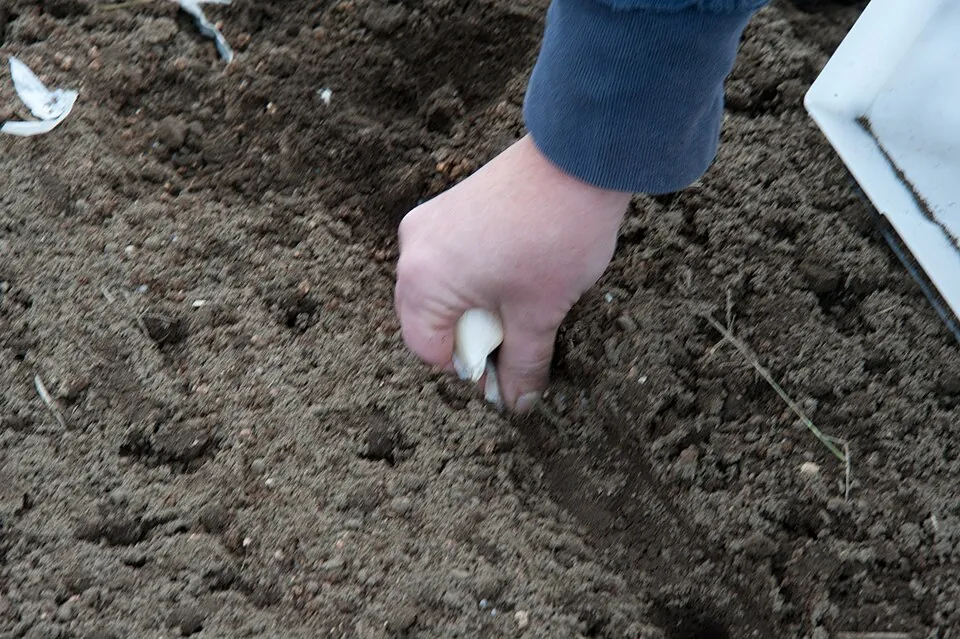
Garlic is planted in fall as cloves, so the roots can grow before winter and the cold can do its work. Here is the timing rule, the planting window for your USDA zone, which type to grow, and how deep to plant.
Why fall
- “Garlic bulbs need a cooling period prior to bulb formation; therefore, a fall planting is ideal” (Illinois Extension).
- “Garlic is planted late in the fall, before the soil freezes”; over winter “the cold treatment stimulates it to split into individual cloves” (SDSU Extension).
- Garlic “may be planted early in Virginia (March or April),” but “to permit full development, fall planting is recommended” (Virginia Tech).
The timing rule
- Soil: “Wait until the soil has cooled before planting garlic; 50 degrees Fahrenheit at four-inches deep is ideal” (about 50°F at 4 inches). “If planted too early, the bulb may be more susceptible to winter damage, and if planted too late, the roots will not have time to establish.” In South Dakota, SDSU plants “Two or three weeks after the first frost, or mid-October, depending on the year.”
- Illinois: “Plant ... within two weeks of a killing frost.”
- Virginia Tech publishes zone dates (in the table) that start about a month before its own first-frost dates (VCE 426-331).
- Our rule, used in the planner and zone calendars and built from SDSU, Illinois and Virginia Tech: plant from 2 weeks before to 3 weeks after your typical first fall frost.
| USDA zone | Typical first fall frost (32°F) | Sow & Sprout garlic window | Virginia Tech published fall dates |
|---|---|---|---|
| Zone 3 | Sep 23 | Sep 9 to Oct 14 | n/a |
| Zone 4 | Sep 30 | Sep 16 to Oct 21 | n/a |
| Zone 5 | Oct 7 | Sep 23 to Oct 28 | n/a |
| Zone 6 | Oct 19 | Oct 5 to Nov 9 | 6a and 6b: Sept 1 to Oct 1 |
| Zone 7 | Oct 28 | Oct 14 to Nov 18 | 7a and 7b: Oct 1 to Oct 30 |
| Zone 8 | Nov 10 | Oct 27 to Dec 1 | 8a and 8b: Oct 15 to Nov 15 |
| Zone 9 | Dec 3 | Nov 19 to Dec 24 | n/a |
| Zone 10 | Frost rare (no frost in 70% of zone 10 ZIP codes) | Use the Florida guidance below | n/a |
About this table: first fall frost = the median across each zone’s ZIP codes of the nearest NOAA NCEI 1991–2020 Climate Normals station’s 50%-probability 32°F date (data/zonefrost.json; NCEI). Planting window = that date minus 14 days to plus 21 days (Sow & Sprout planner rule). Virginia Tech column copied from VCE 426-331, Tables 2–4; it covers Virginia only. Enter your ZIP in the planner for the dates at your nearest NOAA station.
The sources don’t fully agree. Virginia Tech’s window runs earlier than ours in zones 6 and 7: it ends near its own first-frost dates (zone 6a frost “Oct 5-15”). SDSU plants later, after the first frost. Both are extension guidance; earlier is fine as long as the soil has cooled.
Is it too late? In mid-October, zones 3 to 5 are at or past the end of the window: plant as soon as possible while the soil can still be worked, and mulch well. Zones 6 to 9 are in or before the window.
Hardneck or softneck
- “Hardneck garlic is more cold-hardy and the most common type grown in Illinois”; “Softneck garlic has a more subtle flavor, performs better in regions with mild winters and hot summers” (Illinois).
- Hardnecks give “four to five large, easy to peel cloves” per head; “Softneck varieties store well and are the kind used for garlic braids” (SDSU).
- Grocery-store garlic is “not recommended as planting stock because they are usually soft neck varieties and not well suited for Illinois’s cold winters” (Illinois).
- In the South: “Look for soft-necked garlic varieties like Artichoke or Creole that are well suited for Florida gardens” (UF/IFAS).
Florida and the Gulf Coast
Garlic “can be planted in Florida from late fall through early winter” (UF/IFAS). “Plant cloves 1-2 inches deep and 4-6 inches apart with the pointed side up toward the sky” (UF/IFAS Extension Pasco County).
How to plant
- Pick big cloves: “The larger cloves will result in stronger plants.” Don’t peel: “Peeling the cloves will expose them to fungal diseases and rot if the soil gets too wet, so leave as much skin as practical” (SDSU).
- Rotate: “do not plant where onions or garlic have been grown in the past three years” (SDSU).
Depth and spacing by climate, in each source’s own numbers. Colder winters mean deeper planting.
| Source (climate) | Depth | Spacing |
|---|---|---|
| SDSU (South Dakota, zones 4a-5a) | 4 to 6 in | 4 to 5 in apart in all directions |
| Illinois (zones 5b-7a) | 2 to 3 in, pointed end up | 3 to 6 in apart in rows |
| Virginia Tech (zones 6-8) | About 1 in, upright | 3 to 5 in apart |
| UF/IFAS Pasco County (Florida) | 1 to 2 in, pointed side up | 4 to 6 in apart |
About this table: zone ranges for South Dakota and Illinois are Sow & Sprout data (USDA 2023 zones, 5th to 95th percentile of each state’s ZIP codes, data/statezones.json); Virginia Tech’s zones come from its own tables.
Mulch and winter care
“When the soil has frozen, put six-to-eight inches of straw or leaf mulch on top. This will prevent frost heave if there are freeze/thaw cycles” (SDSU). Straw or leaf mulch also helps “by suppressing weed growth, preserving soil moisture, and moderating temperature fluctuations” (Illinois).
Spring and harvest
“In the late spring, hardneck varieties will produce scapes (flower stalks), which should be removed.” Harvest “when about half of the leaves have turned yellow,” then “Cure harvested bulbs by holding them in a warm, dry, well-ventilated location for several weeks” (Illinois). In Florida, harvest “when about half of the leaves have dried and bent towards the ground” (UF/IFAS).
Not covered here: California and the desert Southwest, where no qualifying source was found. Zone 9 and 10 readers can use the frost-rule window or the Florida guidance.
Your garlic row by zone: Zone 3 Zone 4 Zone 5 Zone 6 Zone 7 Zone 8 Zone 9 ZIP planner frost dates
Frequently asked questions
Is it too late to plant garlic in late October or November?
In zones 6 to 9, late October and November fall in or before our window (2 weeks before to 3 weeks after the typical first frost). In zones 3 to 5 the window has usually closed by mid-October, so plant as soon as possible while the soil can still be worked, and mulch well.
Can I plant garlic from the grocery store?
Illinois Extension doesn’t recommend it: grocery garlic is usually softneck and not suited to cold winters. In Florida, UF/IFAS recommends softneck types such as Artichoke or Creole.
How deep do I plant garlic?
It depends on your winters: 4 to 6 inches in South Dakota (SDSU), 2 to 3 inches in Illinois, about 1 inch in Virginia (Virginia Tech) and 1 to 2 inches in Florida (UF/IFAS).
Hardneck or softneck for my zone?
Hardneck is more cold-hardy and the most common type in Illinois; softneck does better where winters are mild and summers hot (Illinois Extension).
Sources
- University of Illinois Extension: Ready, Set, Garlic!
- South Dakota State University Extension: Planting Garlic
- Virginia Cooperative Extension (Virginia Tech): Onions, Garlic, and Shallots (SPES-788); Virginia’s Home Garden Vegetable Planting Guide (426-331), Tables 1–4
- NOAA National Centers for Environmental Information: U.S. Climate Normals 1991–2020
- UF/IFAS Extension: Garlic; Growing Garlic in Florida (Sep 18, 2026)