
How to Dig Up and Store Dahlias, Cannas and Gladiolus for Winter: Timing by Zone
Quick answer
Dig dahlias and cannas after the first frost blackens the leaves but before a hard freeze (about 28°F) can damage the roots. Cut the stems back to a few inches, dry the clumps for a day or so, and store them in peat moss, vermiculite or wood shavings at about 40 to 50°F. Gladiolus corms store cooler, at 35 to 45°F.
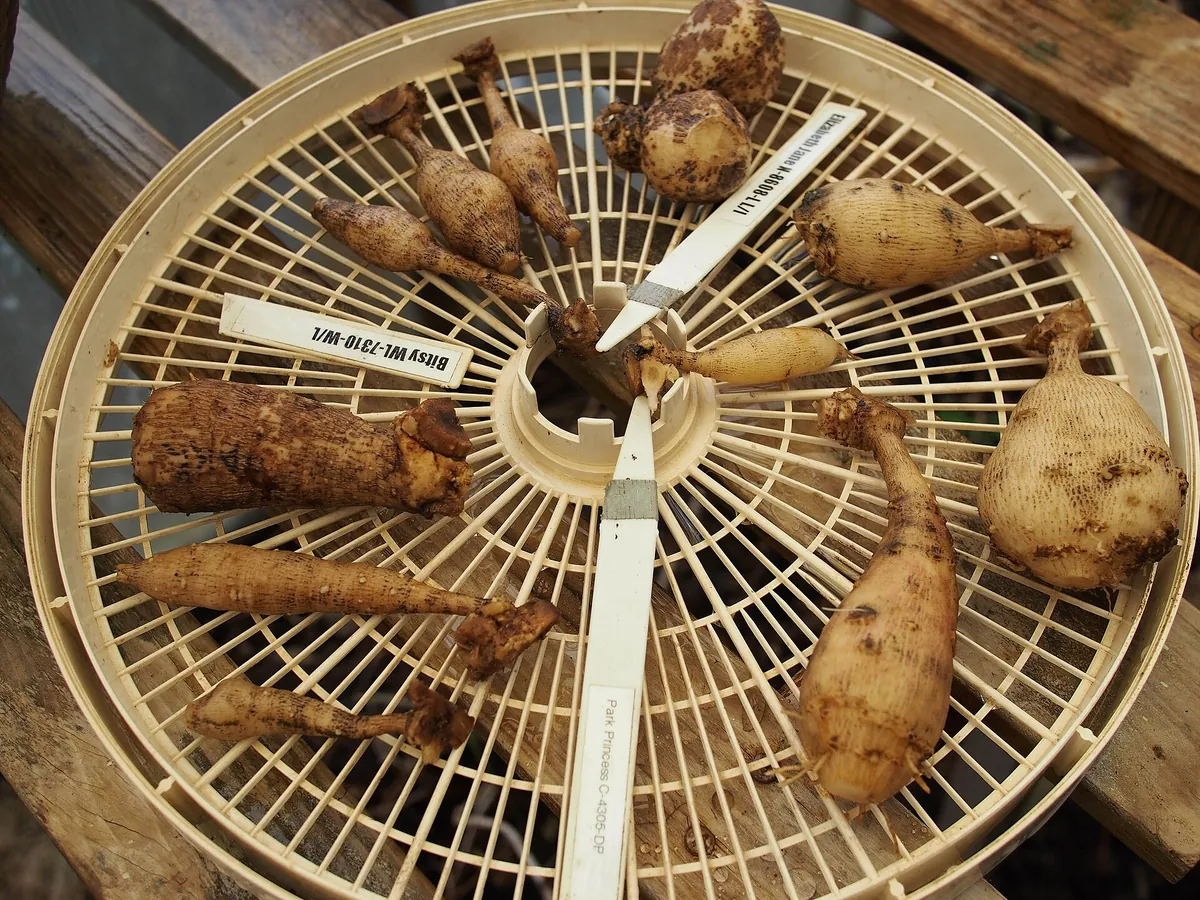
Dahlias, cannas and gladiolus aren’t winter hardy in cold zones. Lift them between the first frost and the first hard freeze, dry them, and store them cool through winter. Here is the timing by USDA zone and the step-by-step method for each, from university extension services.
Which “bulbs” need digging, and where
- Tender “bulbs” such as dahlias, cannas, gladiolus and tuberous begonias “are not winter hardy.” You can treat them as annuals or “dig them up and store them in a frost-free area over the winter” (Penn State Extension, Chester County Master Gardeners).
- Dahlias: NC State lists dahlias for USDA zones 7a–10b. “To grow dahlias as perennials in zones below 7, dig up the tubers in fall.” “In zones 7 to 10, mulch over in winter” (NC State).
- Cannas: NC State lists the genus for zones 6a–10b, but “Gardeners in hardiness zones 6a and 6b should cut the plants to the ground immediately after the first frost and lift the rhizome clumps for winter storage,” and says to “Mulch in Zone 8” (NC State). For common garden canna (Canna × generalis), zones 8a–11b: “In warmer zones, the rhizomes may be left in the soil to over winter” and “In colder zones, dig up the rhizomes” (NC State).
- Utah State says cannas in “protected areas such as next to a brick wall, fence or other heat-absorbing areas... can stay put all winter,” but digging ensures survival (Utah State Extension).
When to dig, by USDA zone
The rule: dig between the first frost and the first hard freeze. For dahlias, Wisconsin Extension says “Dig before a hard freeze, or let the tops die back from a light frost.” For cannas, “Allow frost to kill the tops, but do not let them be subjected to a hard freeze, which will turn the stem to mush” (Wisconsin Extension).
| USDA zone | Typical first frost (32°F), median | Typical first hard freeze (28°F), median | Dig window (typical) | Leave in ground? |
|---|---|---|---|---|
| Zone 3 | Sep 23 (Sep 7–Oct 1) | Oct 1 (Sep 19–Oct 13) | Sep 23 – Oct 1 | No. Dig |
| Zone 4 | Sep 30 (Sep 19–Oct 7) | Oct 9 (Sep 29–Oct 18) | Sep 30 – Oct 9 | No. Dig |
| Zone 5 | Oct 7 (Sep 26–Oct 18) | Oct 19 (Oct 5–Oct 29) | Oct 7 – Oct 19 | No. Dig |
| Zone 6 | Oct 19 (Oct 5–Oct 28) | Oct 30 (Oct 17–Nov 6) | Oct 19 – Oct 30 | No. Dig. NC State says zone 6 should lift cannas (NC State) |
| Zone 7 | Oct 28 (Oct 17–Nov 8) | Nov 7 (Oct 28–Nov 20) | Oct 28 – Nov 7 if digging | Dahlias: mulch over (NC State). Cannas: depends on type; dig common garden canna (zones 8–11; NC State) |
| Zone 8 | Nov 10 | Nov 22 | Usually not needed | Mulch (NC State, dahlia and canna) |
| Zones 9–10 | Frost late or rare | — | Not needed | Mulch over (NC State, dahlia zones 7–10) |
About this table: typical dates are medians across each zone’s ZIP codes, using the nearest NOAA NCEI 1991–2020 U.S. Climate Normals station’s 50%-probability first-fall date for 32°F (data/zonefrost.json) and 28°F (data/zonefreeze28.json); ranges in parentheses run from the 10th to the 90th percentile of ZIP codes. Half of years see these temperatures earlier. Frost can come earlier at your site, so use the first frost that blackens the leaves as your signal. NOAA NCEI normals. Enter your ZIP in the planner for the dates at your nearest NOAA station.
Sources differ on how long to wait. Iowa State cuts dahlias back “several days after a hard frost” and cannas “a few days after a hard, killing frost” (Iowa State). Wisconsin says to dig before a hard freeze. Both use frost-blackened leaves as the signal, so dig promptly once you see them.
Dahlias, step by step
- Wait for the signal. Tuberous roots “are ready to remove from the garden when the plant is darkened by frost” (University of Kentucky Extension, Daviess County).
- Cut back to a few inches (2–6 in.). Iowa State says “to within 2 to 4 inches of the ground”; the Kentucky article says “4 to 6 inches.”
- Lift carefully. The roots “can bruise easily” (Wisconsin).
- Remove loose soil gently. Sources differ on washing: Iowa State says “Wash the tuberous roots to remove any remaining soil,” while NC State says “dry carefully (do not wash).”
- Dry them. Until “dry to the touch (usually about one day)” (Iowa State). Wisconsin: “dry for several hours before placing in storage.”
- Pack them. “Place the dahlia clumps upside down in boxes or other containers and cover them with vermiculite, peat moss, or wood shavings” (Iowa State). NC State uses “vermiculite or dry sand.”
- Store cool. A “cool (40 to 50°F), dry location” (Iowa State). NC State gives “35 to 45 degrees F.”
- Divide in spring. In fall “the eyes or buds are easier to see,” but “it is best to wait until spring to prevent spoilage in storage” (Wisconsin). If you do divide, “Each tuberous root must have at least one bud” (Kentucky).
- Check monthly. “Check monthly for dehydration and mist lightly, if necessary” (Wisconsin).
Cannas
- Cut back “within 4 to 6 inches of the ground” (Iowa State). The Kentucky article says leave “3 to 4 inches of stem.”
- Dig with some soil: “Leave a small amount of soil around the cannas. Allow them to dry for one to two days” (Iowa State).
- Store “in large boxes, crates, or mesh bags. Store in a cool (40 to 50°F), dry location” (Iowa State). Wisconsin wraps them in newspaper or peat moss “at 45 to 50 °F.” Kentucky: a spot that “will not exceed 50 degrees F. Do not allow rhizomes to freeze.”
- Iowa State calls cannas “one of the most straightforward of the tender perennials to overwinter.”
- Divide in spring: “Wait until spring to divide. When dividing, make sure there are at least 3 eyes per division” (Wisconsin).
Gladiolus
- When: “after the first frost” (Kentucky), or “late summer/early fall” (Iowa State). Let corms “mature as fully as possible before digging” (Kentucky).
- Cut foliage “1 to 2 inches above the corms” (Iowa State).
- Cure “2 to 3 weeks in a warm, dry, well-ventilated location” (Iowa State). Kentucky gives “80 to 85 degrees F for two to three weeks.”
- Then “remove and discard the old, dried-up mother corms” (Iowa State).
- Store in mesh bags or old nylon stockings, hung in a cool, dry, ventilated spot. “Storage temperatures should be 35 to 45°F” (Iowa State).
Storage checklist
- A cool basement works. Check periodically and “discard those that show signs of rotting” (Kentucky).
- Too dry? Utah State suggests packing in “peat moss, vermiculite, sawdust or shredded paper in a ventilated box, then place a bowl of water with them to increase the humidity.” Its optimal storage temperature is “between 45 and 50 F. (Make sure they do not freeze.)” (Utah State)
Related: first hard freeze dates by zone frost vs. hard freeze planting tulips and daffodils fall cutback guide ZIP planner
Frequently asked questions
Can I leave dahlias in the ground?
In zones 7 to 10, NC State says to mulch over them in winter. Colder than zone 7, dig them up in fall.
Do I wait for frost before digging dahlias?
Yes. The first frost that darkens the foliage is the signal, and you should dig before a hard freeze (Wisconsin Extension, University of Kentucky Extension).
What temperature should I store dahlia tubers at?
About 40 to 50°F, according to Iowa State. NC State gives 35 to 45°F. Keep them from freezing.
Sources
- Penn State Extension: Chester County Master Gardeners, Bulbs, Corms, Rhizomes and Tubers
- NC State Extension: Dahlia; Canna; Canna × generalis
- Utah State University Extension: How to Store Summer Flower Bulbs
- University of Wisconsin–Madison Extension: Storing Tender “Bulbs” for Winter
- NOAA National Centers for Environmental Information: U.S. Climate Normals 1991–2020
- Iowa State University Extension: How to Overwinter Tender Perennials
- University of Kentucky Extension: Daviess County, Digging and Storing Tender Bulbs Protects them from Freezing Temperatures (Oct 12, 2024)