
Holiday Plants Care: Poinsettia, Christmas vs Thanksgiving Cactus, and Pets
Quick answer
Give poinsettias and holiday cacti bright light, keep them away from drafts and heat vents, and water only when the soil surface is dry; soggy soil rots their roots (University of Minnesota Extension). Poinsettias like 65 to 70°F and are damaged below 50°F. Christmas and Thanksgiving cacti bloom after about 6 weeks of cool or long, dark nights; pointed stem edges mean Thanksgiving cactus (Clemson). For pets, poinsettias are low risk and Christmas cactus is rated non-toxic, but amaryllis, paperwhites and mistletoe are not safe (Penn State).
Jump to
- Poinsettia care indoors
- How to keep a poinsettia alive after Christmas (and get it to rebloom)
- Christmas cactus vs Thanksgiving cactus vs Easter cactus
- Christmas cactus care
- How to get a Christmas cactus to bloom
- Why is my Christmas cactus dropping buds?
- Amaryllis and paperwhites
- Holiday plants toxic to pets (and which are safe for cats and dogs)
- More guides
- Frequently asked questions
Updated
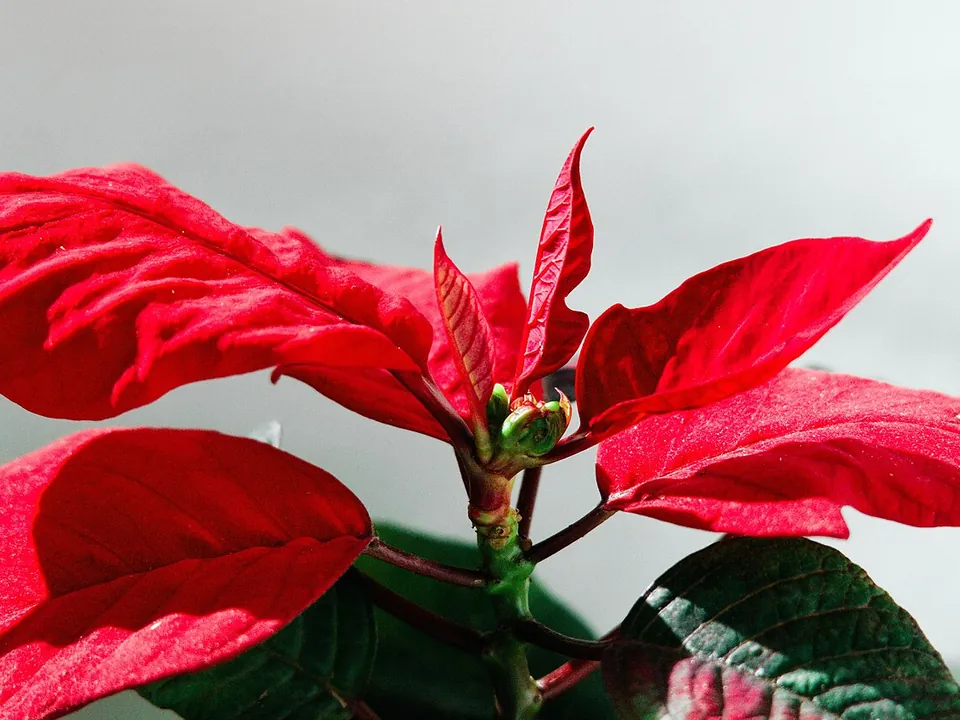

Holiday plants care comes down to the same few things for poinsettias and holiday cacti: bright light, steady temperatures and careful watering. This hub covers poinsettia care and how to keep a poinsettia alive after Christmas, how to tell a Christmas cactus from a Thanksgiving cactus and get it to bloom, and which holiday plants are toxic to pets, all from university extension guides.
Jump to: Poinsettia care After Christmas Christmas vs Thanksgiving cactus Christmas cactus care Getting it to bloom Bud drop Amaryllis and paperwhites Pets
Poinsettia care indoors
- Light. University of Minnesota Extension: “Put in a south, east or west window where the plant will receive bright daylight.” Mississippi State University Extension says it can take direct sun, but it will need more water and the flowers won’t last as long.
- Temperature. “Indoor temperatures of 65 to 70 degrees Fahrenheit are ideal.” “Poinsettias will suffer damage if they are exposed to temperatures below 50 degrees Fahrenheit.” (UMN)
- Drafts and heat. UMN says to keep it away from cold drafts, heat ducts, fireplaces, fans and space heaters. Mississippi State adds: “Avoid letting the bracts touch cold windowpanes because the transfer of outdoor temperatures can cause damage.”
- Watering. UMN: water when the soil surface feels dry to a light touch or the pot feels light, and “Remove from decorative foil or outer pot before watering.” Never let the pot sit in water: “Constant wetness will rot plant roots.” Mississippi State: “Overwatering is a major cause of early leaf and bract drop in poinsettias.”
- No fertilizer while it blooms. “Do not fertilize the plants when in flower.” (Mississippi State) UMN: “You do not need to fertilize your poinsettia during the holidays.”
- The colored “flowers” are leaves. UMN says the colorful parts are bracts, modified leaves, and the true flowers are the tiny yellow cyathia in the center.
How to keep a poinsettia alive after Christmas (and get it to rebloom)
Be realistic. Mississippi State University Extension: with yearlong care, “it is possible—although very challenging—for some varieties of poinsettias to reflower the following Christmas”, and for most people it is easier to buy a new plant. “Single-stemmed poinsettias, which are nonbranching, do not reflower well.” Kept as a green houseplant, it needs the same light and watering as above.
University of Minnesota Extension lays out a holiday-to-holiday calendar:
| Holiday | What to do (University of Minnesota Extension) |
|---|---|
| New Year’s Day | Fertilize if you see new growth; keep up light and water for a longer bloom. |
| Valentine’s Day | Check for insects such as whitefly. If the plant is long and leggy, cut it back to about 5 inches tall. |
| St. Patrick’s Day | Prune off faded and dried parts; keep it in a bright, sunny window. |
| Memorial Day | Trim 2 to 3 inches off the branches to promote side branching; repot if you are keeping it in a container. |
| Father’s Day | Move it outside for the summer in indirect light, or plant it in the garden. |
| Fourth of July | Trim again, move it into full sun, and increase water and fertilizer. |
| Labor Day | Move indoors to a spot with at least 6 hours of direct light; cut fertilizer to one-quarter strength as new growth begins. |
| Fall equinox (about Sept. 21) | Start 16 hours of total darkness and 8 hours of bright light every day, with nights in the low 60s°F. |
| Thanksgiving | Stop the darkness treatment; give at least 6 hours of direct light; reduce water and fertilizer. |
About this table: Summarized from University of Minnesota Extension. UMN fertilizes with an all-purpose houseplant fertilizer at half strength every 3 to 4 weeks once new growth starts.
The darkness treatment: sources differ. Long, completely dark nights are what turn the bracts colorful again. UMN: the drop in light “changes the bracts to red, pink or white, depending on the poinsettia variety.” During the dark period, UMN says, “the plant cannot receive even the slightest bit of light at any time”. The schedules don’t match, so here are all three:
| Source | Start | Darkness each night | How long |
|---|---|---|---|
| University of Minnesota Extension | On or near Sept. 21 | 16 hours, uninterrupted | Until Thanksgiving |
| Mississippi State University Extension (publication) | Oct. 1 | 14 continuous hours | Until blooming (a 7- to 10-week period) |
| Mississippi State University Extension (2025 column) | Early October | 12 to 14 hours | About 6 to 8 weeks |
About this table: From University of Minnesota Extension, the Mississippi State University Extension publication and a 2025 Mississippi State University Extension column. Mississippi State also says to give 6 to 8 hours of bright sunlight during the treatment, and “Do not pinch or prune after September 1 because this can impact or delay flowering.”
- Summer outdoors. UMN moves the plant outside around Father’s Day and back in by Labor Day. Mississippi State waits until “all danger of frost has passed and night temperatures average 55 degrees or above”, and brings it in as frost approaches, to a spot with nights of at least 60°F. UMN: “Freezing temperatures will kill poinsettias.”
- Your dates. Look up your last spring and first fall frost in frost dates by ZIP, or see when to bring potted plants inside.
Christmas cactus vs Thanksgiving cactus vs Easter cactus
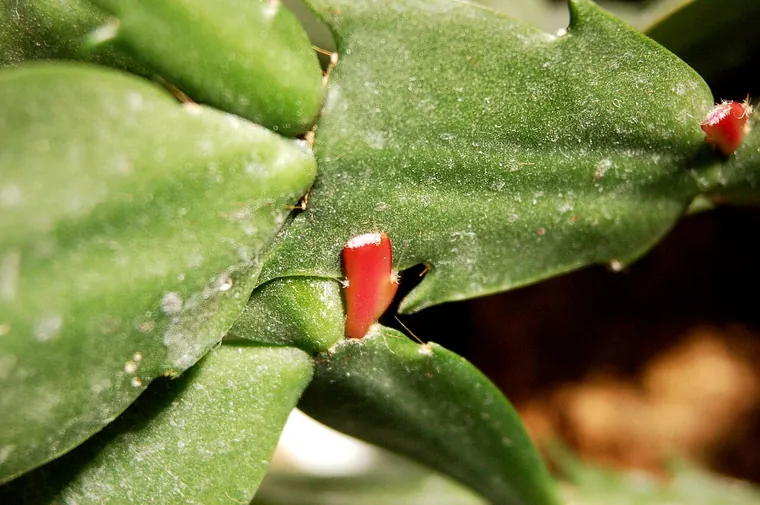
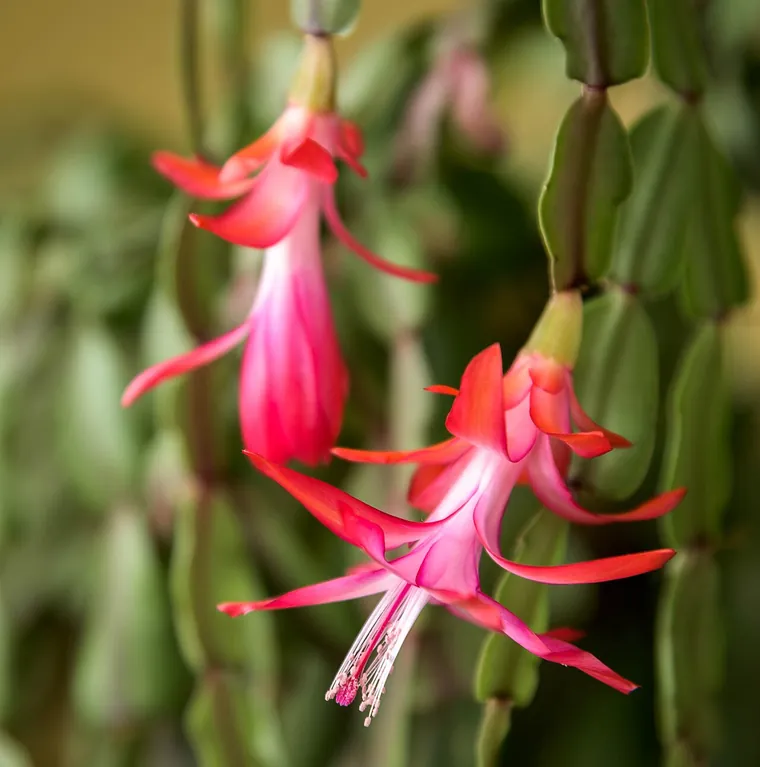
The three holiday cacti are named for when they tend to bloom, and the names get mixed up in stores. Illinois Extension: “Most of the ‘Christmas cactuses’ sold are actually Thanksgiving cacti.” SDSU Extension agrees that “Most of the cacti sold during the early portion of the holiday season are actually Thanksgiving cacti.” The fastest check is the edge of a stem segment (they have no true leaves; the flat green pads are stems called phylloclades, per Clemson). Clemson HGIC: Thanksgiving cactus segments have “2 to 4 saw-toothed serrations or projections along the margins”, and “The stem margins on the Christmas cactus are more rounded.” In bloom, check the anthers: “The anthers of the Thanksgiving cactus are yellow, whereas the anthers on the Christmas cactus are purplish-brown.”
| Feature | Thanksgiving cactus | Christmas cactus | Easter cactus |
|---|---|---|---|
| Scientific name | Schlumbergera truncata | Schlumbergera × buckleyi (UMN uses S. bridgesii; Illinois lists both) | S. gaertneri (UMN, SDSU); Rhipsalidopsis gaertneri (Illinois); Hatiora gaertneri (Clemson) |
| Stem segment edges | 2 to 4 saw-toothed points along each edge (Clemson HGIC); “sharply toothed” (SDSU Extension) | More rounded or scalloped (Clemson, Illinois) | Very rounded (SDSU, Illinois) |
| Anthers (pollen parts) | Yellow (Clemson, Illinois) | Purplish-brown (Clemson, Illinois) | n/a |
| Flower shape | Tubular (Illinois) | Tubular (Illinois) | Star-shaped (Illinois Extension, SDSU) |
| Typical bloom | Late November to late December (Illinois Extension) | Late December to March (Illinois) | March to May (Illinois) |
About this table: From Clemson HGIC, Illinois Extension, SDSU Extension and University of Minnesota Extension. Bloom times are typical, and Illinois notes plants can be forced to bloom at other times. Scientific names differ between sources; this page uses Schlumbergera × buckleyi for Christmas cactus, as Clemson and SDSU do.


Christmas cactus care
- A rainforest cactus. University of Minnesota Extension: “Although true cacti, these plants are native to rainforests.” They need bright but filtered light and fairly moist soil most of the year, and they can live over 100 years (UMN).
- Temperature. UMN: days of 65 to 70°F and nights of 55 to 65°F in a cool, bright spot indoors. SDSU recommends the same range and an east-facing window or a bright room.
- Watering. Let the soil dry between waterings, water in the sink so it drains, and empty saucers and decorative pots; excess water can cause bud drop, wilting and root rot. UMN: “Root rot (loss of roots due to overly wet soil) is one of the most common causes of death in these plants.”
- Pot and soil. “Holiday cacti bloom best when kept somewhat pot-bound.” Healthy plants may need repotting only every three years. UMN’s mix: 1 part sterile potting soil, 2 parts peat moss and 1 part sharp sand or perlite. Illinois and Clemson use 60 to 80% potting soil with 40 to 20% perlite.
- Fertilizer timing. UMN: monthly from June through August with a balanced houseplant fertilizer at half strength, then in fall, while buds form, a low-nitrogen fertilizer higher in phosphorus and potassium.
How to get a Christmas cactus to bloom
Christmas and Thanksgiving cacti are short-day plants that also need cool nights. UMN says they bloom after about 6 weeks of short days. Two ways to get there, per University of Minnesota Extension:
- Cool nights. At night temperatures of 55°F they bloom in about 5 to 6 weeks, sometimes regardless of day length.
- Or long, dark nights. At 60 to 65°F nights, they need at least 12 hours of complete darkness every night for about 6 weeks. “Plants are unlikely to bloom if exposed to night temperatures above 65 degrees Fahrenheit.”
- Other sources ask for more darkness. Clemson HGIC: “Fourteen hours or more of continuous darkness each day is required before flower bud set will occur.” Clemson starts long nights about mid-September for at least 6 weeks. Illinois Extension gives at least 12 hours for 5 to 6 weeks and says buds won’t set if the darkness is interrupted for 2 hours or more. A spare room with no lights on at night works.
- Start them outdoors, then bring them in before it gets cold. UMN: “Initiate buds by leaving plants outdoors in a protected location until just before frost danger.” Illinois Extension: “Once temperatures start getting into the low 50s°F at night in the fall, they should be brought indoors.” Clemson says not to leave them out if temperatures will drop below 50°F. Check your first fall frost in frost dates by ZIP or enter your ZIP in the planner, and look the plant over for pests before it comes in.
Why is my Christmas cactus dropping buds?
“Once flower buds have started to develop, holiday cacti do not like to be disturbed.” UMN says buds can drop from drafts or sudden changes in temperature or humidity, and from changes in light. If the plant has to go to a warmer room, move it as soon as the buds appear. Illinois adds that letting the soil get too dry while it blooms can make it drop flowers.
| Problem | Likely cause (UMN) | What to do |
|---|---|---|
| No blooms | Room too warm; not enough darkness; low nutrients | Nights 55 to 65°F; at least 12 hours of total darkness; half-strength, low-nitrogen fertilizer in fall |
| Buds drop | Temperature changes or drafts; more buds than the plant can carry | Keep it away from drafts, heaters and vents; keep up steady care |
| Wilted, but the soil is wet | Too much water; roots rotting | Let it dry out; make sure the pot and mix drain freely |
| Brown, corky base | Normal aging | No action needed once you rule out scale insects |
About this table: Adapted from the common-issues table in University of Minnesota Extension.
Pruning and rooting cuttings
- After flowering, cut where two stem segments join with a small, sharp pruner or knife; each cut makes 1 to 2 new segments and a bushier plant (UMN).
- Cuttings root in damp builder’s sand or a well-drained mix in bright light at 70 to 80°F; check for roots after 2 weeks (UMN). Clemson takes cuttings of 3 to 5 segments in May or June.
Amaryllis and paperwhites
For the two holiday bulbs, see when to plant paperwhites and amaryllis for Christmas: planting dates counted back from Dec. 25, forcing paperwhites in water or gravel, keeping them from flopping, and getting an amaryllis to bloom again.
Holiday plants toxic to pets (and which are safe for cats and dogs)
- Poinsettia: low risk. Penn State Extension: “Reports of its toxicity have been greatly exaggerated over the years.” Its milky sap can irritate a pet’s stomach, but the symptoms should resolve on their own. Purdue Plant and Pest Diagnostic Lab: poinsettias are “not harmful to household pets unless the leaves and bracts are eaten in very large quantities”. Cornell’s vet college says it can irritate a dog’s mouth and stomach, causing drooling, vomiting and diarrhea.
- Christmas cactus: rated non-toxic. Penn State: “The ASPCA rates Christmas cacti as non-toxic to cats and dogs.”
- Amaryllis and paperwhites: toxic. Penn State says amaryllis is “poisonous to cats and dogs”; the toxic compound lycorine is in all parts but concentrated in the bulb, and paperwhites are similar. Keep bulbs where pets can’t chew them.
- Holly: low toxicity. Penn State cites the ASPCA: the leaves and berries have low toxicity; watch for vomiting, diarrhea and depression. Cornell adds that the spiky leaves can injure a dog’s mouth.
- Mistletoe: keep it away from pets. Penn State says its toxins, especially in the white berries, can cause vomiting, diarrhea, low blood pressure, difficulty breathing and a low heart rate.
- Christmas tree water. “Penn State recommends only fresh water to maintain your cut tree and discourages the use of any additives.”
If your pet eats a plant and seems ill, call your veterinarian. Cornell University College of Veterinary Medicine lists the ASPCA Poison Control Center (888-426-4435) and the Pet Poison Helpline (855-764-7661).
More guides
All flower and bulb guides Paperwhites and amaryllis for Christmas When to bring potted plants inside Frost dates by ZIP ZIP planner
Frequently asked questions
How do I keep a poinsettia alive after Christmas?
Keep it in a bright south, east or west window at 65 to 70°F, away from drafts and heat vents, and water only when the soil surface feels dry, never letting the pot sit in water (University of Minnesota Extension). Don’t fertilize while it is in flower (Mississippi State). Once new growth starts, feed it at half strength every 3 to 4 weeks. Getting it to color again takes weeks of long, dark nights in fall, and Mississippi State calls reblooming possible but very challenging.
How do I get a poinsettia to turn red again?
Give it long, completely dark nights in fall. University of Minnesota Extension starts on or near Sept. 21 with 16 hours of uninterrupted darkness and 8 hours of bright light every day until Thanksgiving. Mississippi State Extension gives 14 hours from Oct. 1 in one publication and 12 to 14 hours from early October for about 6 to 8 weeks in another. Even a little light during the dark period can stop it.
Is my plant a Christmas cactus or a Thanksgiving cactus?
Look at the edges of the flat stem segments. Thanksgiving cactus has 2 to 4 pointed, saw-toothed projections along each edge; Christmas cactus edges are rounded or scalloped. In bloom, Thanksgiving cactus anthers are yellow and Christmas cactus anthers are purplish-brown (Clemson, Illinois Extension). Most plants sold as Christmas cactus are actually Thanksgiving cactus.
Why won’t my Christmas cactus bloom?
Usually the room is too warm at night or the nights aren’t dark enough. University of Minnesota Extension says plants are unlikely to bloom with night temperatures above 65°F; at 55°F nights they bloom in about 5 to 6 weeks, and at 60 to 65°F they need at least 12 hours of complete darkness every night for about 6 weeks. Low nutrients can also be a cause.
Why is my Christmas cactus dropping buds?
Drafts or sudden changes in temperature, light or humidity, moving the plant after buds form, or more buds than the plant can carry (University of Minnesota Extension). Overwatering and letting the soil get too dry while blooming can also cause bud drop (Illinois Extension).
Are poinsettias poisonous to cats and dogs?
Not very. Penn State Extension says reports of poinsettia toxicity have been greatly exaggerated; the milky sap can irritate a pet’s stomach, but symptoms should resolve on their own. Purdue says poinsettias are not harmful to pets unless large amounts of leaves and bracts are eaten. Keep them out of reach anyway.
Which holiday plants are safe for cats and dogs?
Penn State Extension says the ASPCA rates Christmas cacti as non-toxic to cats and dogs, and poinsettia’s toxicity is greatly exaggerated. Amaryllis and paperwhites are poisonous to cats and dogs, especially the bulbs, and mistletoe can cause serious symptoms. Holly has low toxicity but can still cause vomiting and diarrhea.
Sources
- University of Minnesota Extension: Growing and caring for poinsettia; Holiday cacti
- Mississippi State University Extension: Selecting and Maintaining Poinsettias; Year-round care lets poinsettias rebloom (Southern Gardening, 2025)
- University of Illinois Extension: How to identify and care for holiday cacti and get them to rebloom
- South Dakota State University Extension: A Cactus for Every Holiday: Caring for This Popular Indoor Plant
- Clemson Cooperative Extension: Thanksgiving & Christmas Cacti (HGIC 1554)
- Penn State Extension: Holiday Plants and Pets
- Purdue University Plant and Pest Diagnostic Lab: Poinsettia: Is it Poisonous to Pets?
- Cornell University College of Veterinary Medicine: Holiday hazards for dogs