
Clover-Like Weeds With Yellow Flowers: Black Medic, Hop Clover or Woodsorrel?
Quick answer
Small, low lawn weeds with three leaflets and yellow flowers are usually black medic, hop clover or yellow woodsorrel. Single, open, five-petaled flowers mean woodsorrel. Tight, round yellow heads mean black medic or hop clover: if old heads turn brown and keep their petals, it’s hop clover; if they drop petals and show black, coiled pods, it’s black medic (Penn State; Michigan State). Thicken the lawn, pull small patches, and spot-treat young weeds with a lawn herbicide labeled for clover and your grass type.
Jump to
- Which one is it? Three quick checks
- Black medic vs hop clover vs woodsorrel: how to tell them apart
- How to get rid of black medic, hop clover and woodsorrel
- Weed killers for black medic and yellow clover in lawns
- When to treat clover-like weeds with yellow flowers
- More weed guides
- Frequently asked questions
Updated
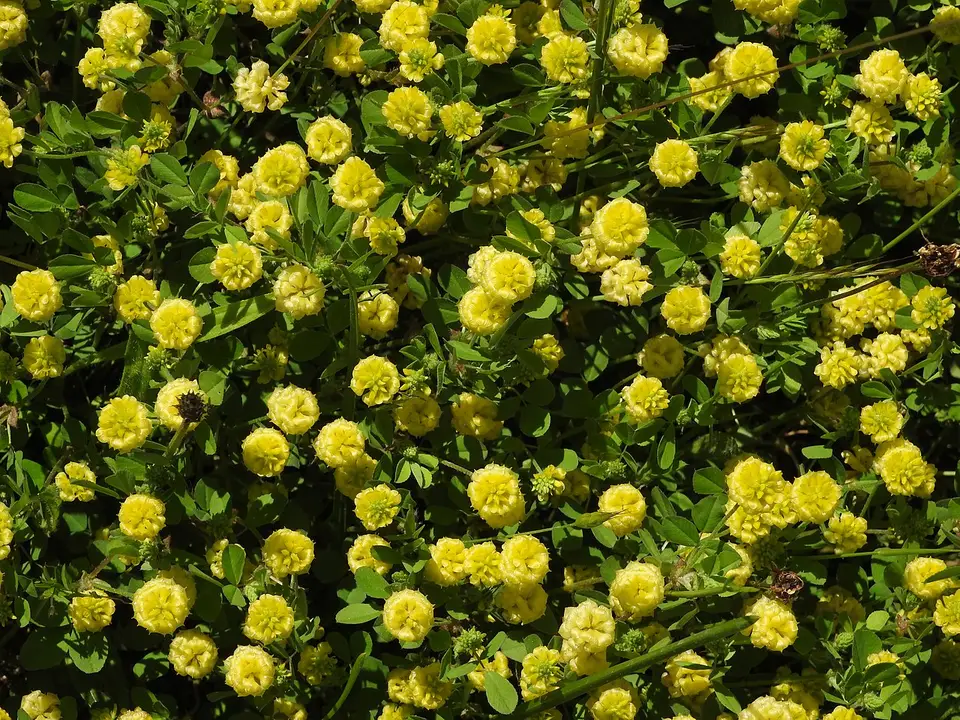

Which one is it? Three quick checks
If your lawn has small, low, clover-like weeds with yellow flowers, it is almost always one of three plants: black medic, hop clover or yellow woodsorrel. Penn State Extension groups black medic and yellow woodsorrel with white clover as the three-leaflet look-alikes most often found in lawns, and Michigan State University Extension lists hop clover and the woodsorrels as the weeds most like black medic (Penn State Extension; Michigan State University Extension). Here’s how to tell them apart, why they move in, and what works on each.
Black medic vs hop clover vs woodsorrel: how to tell them apart
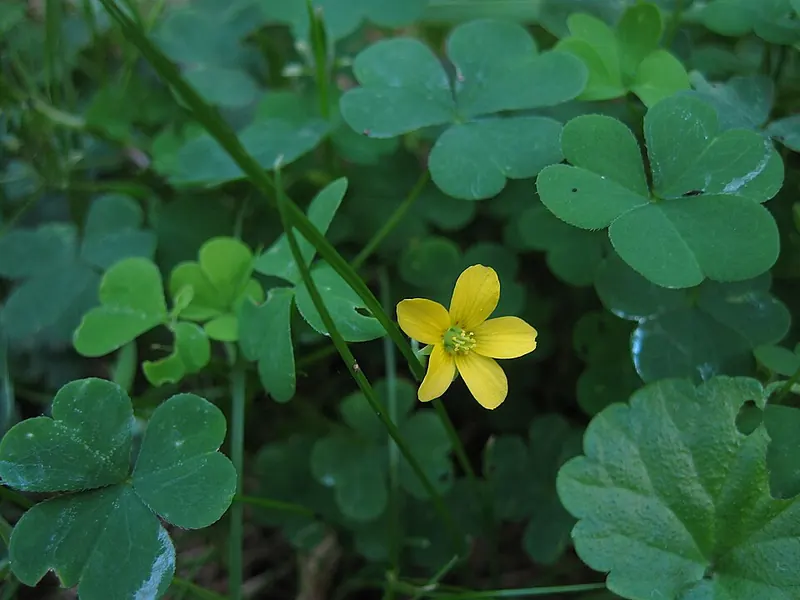
- Woodsorrel is the odd one out. Its flowers are single and “distinctly 5-petaled, open”, and its leaflets “lack a pointed tip, and all 3 are attached directly to the petiole” (University of Maryland Extension). UC IPM adds that oxalis leaves “lack a stipule and generally have a more pronounced indentation at the top of each leaflet” (UC IPM). Full details are on our oxalis (woodsorrel) guide.
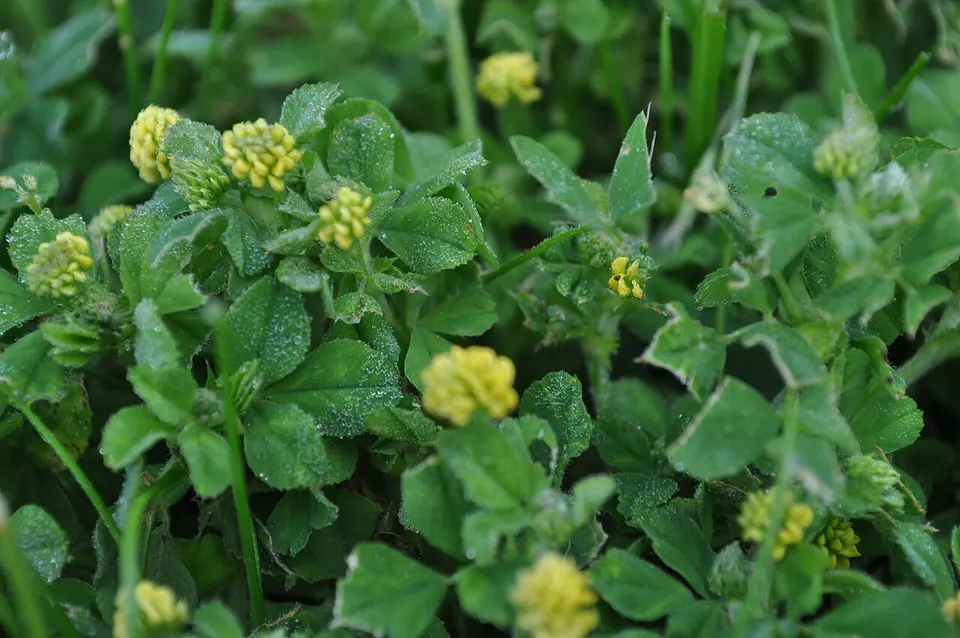
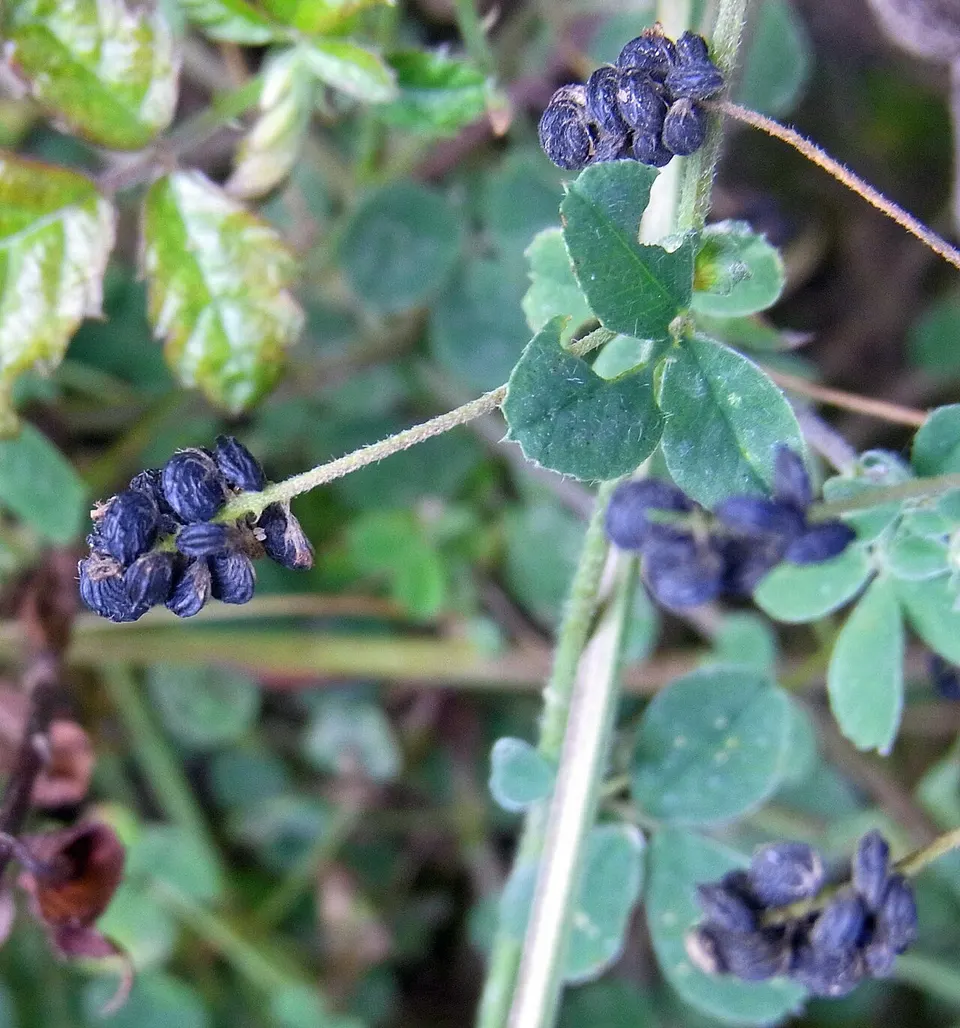
- Black medic and hop clover both make little round yellow heads. Michigan State says hop clover has similar habits, foliage and yellow flowers, “but the leaves and flowers are larger than black medic”. The surest check is an old flower head: hop clover’s petals stay on and turn brown, while black medic’s “drop off, revealing a cluster of pods that turn black at maturity” (Michigan State University Extension).
- Black medic’s other clues: each leaflet ends in a “short but distinct point”, the stems trail but “do not root as they creep”, and seeds sit in a “kidney-shaped black pod” (University of Maryland Extension).
- Small hop clover (Trifolium dubium, also called lesser trefoil) is a close relative: an annual with tiny yellow flowers, 3 to 15 per head, from late spring to early fall, and it “handles foot traffic and mowing well” (NC State Extension). NC State notes that the hop clovers look alike and respond similarly to herbicides (NC State Extension).
- The common names overlap. NC State’s Plant Toolbox lists “hop clover” and “yellow trefoil” among the common names for black medic itself (NC State Extension), so check the flowers and pods rather than the name.
| Feature | Black medic (Medicago lupulina) | Hop clover (Trifolium campestre) | Yellow woodsorrel (Oxalis stricta) |
|---|---|---|---|
| Flowers | Many very small yellow flowers in dense, mostly globe-shaped clusters (Michigan State University Extension); 15 to 50 per head (NC State Extension) | Bright yellow, many flowers in each cluster (NC State Extension) | Single, cup-shaped, five petals, ¼ to ½ inch across (Penn State Extension) |
| After bloom | Petals drop off, revealing a cluster of pods that turn black (Michigan State University Extension); kidney-shaped black pods (University of Maryland Extension) | Petals “turn brown and remain attached” (Michigan State University Extension) | Ridged, hairy, cylinder-shaped seed capsules, ½ to 1 inch long (Michigan State University Extension) |
| Leaflets | Three oval leaflets, each tipped with a small point; a pair of stipules where the leaf meets the stem (Penn State Extension; University of Maryland Extension) | Three leaflets with prominent veins (NC State Extension) | Three heart-shaped leaflets with a deep notch at the tip; they fold up at night (Penn State Extension) |
| Life cycle | Usually a summer annual; sometimes a winter annual or biennial (University of Maryland Extension) | Winter annual or biennial (NC State Extension) | Annual or perennial (Penn State Extension) |
| Roots | Taproot, but it can be pulled out at the crown (Penn State Extension) | Fibrous (NC State Extension) | Taproot (Penn State Extension); spreads by rhizomes (Michigan State University Extension) |
| Family | Legume (fixes nitrogen) | Legume (clover genus, Trifolium) | Not a legume: woodsorrel family (Penn State Extension) |
About this table: Features from Penn State Extension, University of Maryland Extension, NC State Extension, NC State Extension and the Michigan State University Extension weed ID guide (pp. 112–114 and 145). Black medic and hop clover are both legumes; UC IPM counts black medic among the “annual clovers” (UC IPM).



Why they show up in your lawn
- Black medic: “favors sunny, dry areas with sparse, struggling turfgrass”, especially under-fertilized lawns short on nitrogen, bare soil, and compacted spots such as the joints between pavers (University of Maryland Extension).
- Hop clover: like other winter annual weeds, it and its relatives “quickly invade thin turf areas especially where there is good soil moisture”. NC State adds that shade may also encourage them (NC State Extension).
- Yellow woodsorrel: adapts to moist or dry, sunny or shady, poor or rich sites (Penn State Extension).
- Why they stay green: clovers fix their own nitrogen, and UC IPM notes that “yellow turf and green clover is a good indication of low nitrogen fertility” (UC IPM).
How to get rid of black medic, hop clover and woodsorrel
Start with the lawn. Penn State says improving turf density reduces all three look-alikes (Penn State Extension). NC State: “A dense, vigorous turf is the best way to reduce the encroachment of winter annual weeds.” University of Maryland Extension’s list: fertilize as recommended for the season and grass type, mow high, overseed cool-season lawns each fall, and core-aerate compacted soil (University of Maryland Extension).
- Pull or dig small patches. For black medic, remove the whole plant “including the central root system”, by hand or with a weeding tool; moist soil makes it easier (University of Maryland Extension). Woodsorrel is “easy to pull from the lawn, especially when the soil is moist” (Penn State Extension). UC IPM says annual clovers can be hand-pulled before seeds form, repeated as new seedlings come up (UC IPM).
- Expect a few seasons. Clover seed has a hard coat, and UC IPM says “clover seeds can germinate over many years, making the control of these plants an ongoing effort” (UC IPM).
- In flower beds: annual clovers are easily controlled by hand-pulling, hoeing or cultivation, and a 4-inch layer of organic mulch put down before the seeds germinate can keep them from establishing (UC IPM). See also how to prevent weeds in flower beds.
Weed killers for black medic and yellow clover in lawns
- Spot-treat with a lawn broadleaf herbicide while the weeds are actively growing. For black medic, University of Maryland Extension says to look for one or more of these active ingredients: 2,4-D, MCPP (mecoprop), dicamba or triclopyr (University of Maryland Extension).
- 2,4-D alone won’t do it. UC IPM: “The herbicide 2,4-D is not effective for clover control; it will injure the plant but does not control it.” So pick a product labeled for clover, usually a mix that includes mecoprop or dicamba (UC IPM).
- Match the product to your grass. UC IPM says warm-season grasses such as bermudagrass, zoysiagrass and kikuyugrass tolerate mecoprop and dicamba but not triclopyr, while cool-season grasses tolerate all of the clover herbicides (UC IPM). Clemson’s table for warm-season lawns lists black medic among the weeds controlled by 2,4-D + dicamba + quinclorac products on bermudagrass and zoysiagrass (Clemson HGIC). Clemson: “Read the product label to be sure the herbicide is labelled for use on the specific turfgrass in the lawn!”
- Protect trees and shrubs. “Do not spray herbicides containing dicamba over the root zone of desirable trees and shrubs.” Check local pesticide rules before you buy (University of Maryland Extension).
- Woodsorrel is not a clover (Penn State); for its control options see the control section of our oxalis guide. For white clover, see the clover guide.
- Use only products labeled for lawns and for your grass type, as the label directs.
When to treat clover-like weeds with yellow flowers
The quick fix Clemson recommends: treat young weeds in spring or fall on a mild day. Clemson: “Most broadleaf weeds are best treated in the spring or fall when air temperatures are between 65 and 85° F.” “Best results occur when weeds are young.” (Clemson HGIC)
- Hop clover sprouts now. NC State says winter annual broadleaf weeds such as hop clover “germinate in the fall or winter”, grow during warm spells, set seed in spring and die as temperatures rise in late spring and early summer (NC State Extension).
- Black medic mostly sprouts in spring. It is typically a summer annual that germinates in spring and blooms in summer, though some plants germinate in autumn (University of Maryland Extension).
- Small is easier. UC IPM says that once annual clovers reach 3 to 4 inches tall, “control with herbicides is more difficult” (UC IPM). UC IPM also says clovers begin to germinate in fall when soil temperatures are in the 50s °F, written for California conditions.
- For fall spray timing and cut-off temperatures where you live, see fall lawn weed control; for local frost dates, see frost dates by ZIP and state or enter your ZIP in the planner.
More weed guides
White clover Oxalis (woodsorrel) Fall lawn weed control Wild garlic vs wild onion Henbit Weed identification guide
Frequently asked questions
What is the small clover-like weed with yellow flowers in my lawn?
Usually black medic, hop clover or yellow woodsorrel. Woodsorrel has single, open, five-petaled flowers and heart-shaped leaflets; black medic and hop clover have tiny flowers packed into round yellow heads (Penn State, University of Maryland, Michigan State).
Is black medic a clover?
Not a true clover, but a close relative. Black medic is Medicago lupulina, a legume like the clovers (genus Trifolium), and UC IPM counts black medic among the annual clovers that are troublesome in lawns.
What is the difference between black medic and hop clover?
Look at old flower heads. Hop clover’s petals turn brown and stay attached, while black medic’s petals drop off to show a cluster of pods that turn black. Hop clover’s leaves and flowers are also larger (Michigan State University Extension).
Black medic vs wood sorrel: how do I tell them apart?
Woodsorrel (oxalis) has single, open flowers with five petals and heart-shaped leaflets with no pointed tip. Black medic has many tiny flowers in a round cluster and leaflets that end in a small point (University of Maryland Extension; Penn State).
Is yellow clover the same as black medic?
The names overlap. NC State’s Plant Toolbox lists “hop clover” and “yellow trefoil” as common names for black medic, while hop clover is also a separate plant (Trifolium campestre). Check the seed heads: black pods mean black medic.
What kills yellow clover in a lawn?
A lawn broadleaf herbicide labeled for clover and for your grass type, applied to young, actively growing weeds. University of Maryland Extension lists 2,4-D, MCPP (mecoprop), dicamba or triclopyr for black medic, and UC IPM says 2,4-D alone does not control clover. Warm-season grasses do not tolerate triclopyr (UC IPM).
When is the best time to spray black medic or hop clover?
Clemson says most broadleaf weeds are best treated in spring or fall when air temperatures are 65 to 85°F, and that results are best when weeds are young. Hop clover is a winter annual that sprouts in fall or winter (NC State).
Why do I have so much black medic in my lawn?
Black medic favors sunny, dry areas with thin turf, under-fertilized lawns short on nitrogen, and compacted soil (University of Maryland Extension). Fertilizing as recommended, mowing high, overseeding cool-season lawns in fall and core aeration help the grass crowd it out.
Sources
- Penn State Extension: Three Weeds with Three Leaflets: Trifoliate Look-Alikes
- Michigan State University IPM: An IPM Pocket Guide for Weed Identification in Nurseries and Landscapes (MSU Extension E2982, 2020)
- University of Maryland Extension: Black Medic: Identification and Management
- University of California Agriculture and Natural Resources (UC ANR): Pest Notes: Clovers (Pub. 7490)
- NC State Extension: Trifolium dubium (lesser hop clover); Hop Clover (TurfFiles); Medicago lupulina (black medick)
- Clemson Cooperative Extension: Managing Weeds in Warm Season Lawns (HGIC 2310)
Organic options Growing without synthetic sprays? See our organic gardening guides: pest control and fertilizer.