
How to Protect Fig Trees in Winter
Quick answer
Fig stems are often injured when temperatures stay below 20°F for a long stretch, even though the roots usually survive. Where winters get that cold, protect in-ground figs after the leaves drop: cut tall stems back to 4 to 5 feet, then wrap, bury or cage the plant with insulation such as leaves or straw. Move potted figs into an unheated garage or cool basement when the leaves start to turn or before a hard frost. Take protection off in spring after the danger of frost has passed (University of Maryland Extension, Rutgers Master Gardeners, UNH Extension).
Jump to
- Do fig trees need to be covered in winter?
- When to wrap a fig tree for winter, and when to unwrap
- How to wrap a fig tree for winter: four methods
- Watch for voles under the insulation
- Potted fig tree winter care
- Site and care choices that reduce winter injury
- Checking a fig for winter damage in spring
- More winter protection guides
- Frequently asked questions
Updated
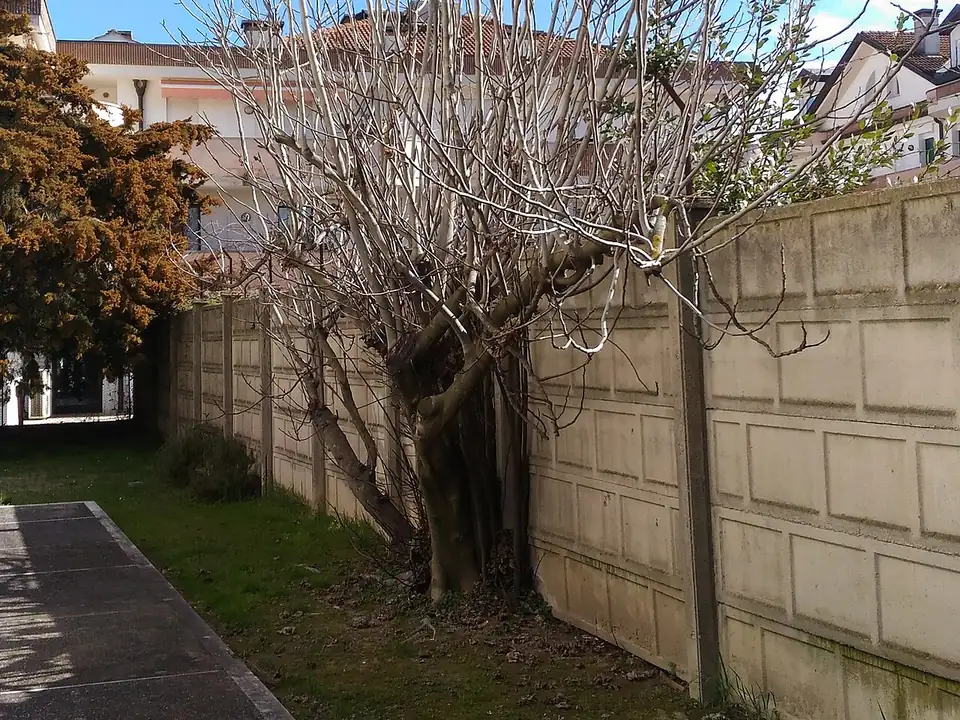

Figs are worth the trouble in cold-winter areas, but their stems are tender. Whether a fig needs covering depends on how cold your winters get and whether the plant is in the ground or in a pot. Here is when to protect it, four ways to wrap or cover an in-ground fig, how to store a potted fig, and how to check for damage in spring.
Jump to: Does it need covering? When to wrap and unwrap How to wrap a fig tree Voles Potted figs Site and care Spring damage check
Do fig trees need to be covered in winter?
- Below 20°F for long stretches, yes. Unprotected fig plants, excluding the roots, are often injured by sustained temperatures below 20°F. New shoots then sprout from the roots but rarely ripen fruit that season. Minimal to moderate stem injury still allows a modest crop the next summer; severe injury may take two growing seasons to recover from (University of Maryland Extension).
- By zone. Figs grow well in USDA zones 7 to 10. In zone 6, plants usually die back significantly in cold winters (UNH Extension).
- Very cold areas. In Iowa, common figs are not reliably cold hardy and are best grown in large containers and overwintered in a cool spot such as an attached, unheated garage or cool basement (Iowa State University Extension).
- Warm regions. In the Southeast, figs often grow as bushes because cold kills back the trunk and main limbs (UF/IFAS (MG214)).
Fig cold-tolerance figures, side by side
Sources describe fig cold tolerance in different ways, so the figures are shown as each source states them rather than merged into one number.
| Cold-tolerance figure | Source |
|---|---|
| Unprotected fig stems (not roots) are often injured by sustained temperatures below 20°F | University of Maryland Extension |
| Fully dormant, properly cold-conditioned trees can withstand 15°F to 20°F without severe damage; dormant buds are more sensitive than wood | UF/IFAS (MG214) |
| ‘Chicago Hardy’ stems hardy to 10°F; its roots hardy to 15 to 20 degrees below zero | Iowa State University Extension |
| Early frosts around 25°F to 27°F make the tree drop its leaves | Rutgers Master Gardeners of Hunterdon County |
About this table: Figures quoted from University of Maryland Extension, UF/IFAS (MG214), Iowa State University Extension and Rutgers Master Gardeners of Hunterdon County. They measure different things (sustained cold on unprotected stems, fully dormant trees, one cultivar, and leaf drop), so do not average them.
When to wrap a fig tree for winter, and when to unwrap
- Put protection on after leaf drop. Apply winter protection after the leaves have fallen and the plant is dormant, typically around Thanksgiving in many areas (Rutgers Master Gardeners of Hunterdon County).
- A November task. University of Maryland lists insulating fig trees from sub-freezing temperatures with a tarp or masses of autumn leaves or straw among its November garden tasks (University of Maryland Extension).
- Potted figs go in earlier. Move them to an unheated basement, garage or greenhouse when the leaves start to turn or before the first killing frost (UNH Extension).
- Take it off in spring. Remove winter protection after the danger of frost has passed (Rutgers Master Gardeners of Hunterdon County).
Frost-date planning anchor. Rule used in this table: protect after leaf drop, around your first fall frost; uncover after your last spring frost. It pairs the source timing above with Sow & Sprout frost data. These are planning anchors, not an extension-given date. Get the dates for your nearest NOAA station in the ZIP planner.
| USDA zone | First fall 32°F (50%): early / median / late | Last spring 32°F (50%): early / median / late |
|---|---|---|
| Zone 5 | Sep 26 / Oct 7 / Oct 18 | Apr 23 / May 3 / May 21 |
| Zone 6 | Oct 5 / Oct 19 / Oct 28 | Apr 13 / Apr 26 / May 10 |
| Zone 7 | Oct 17 / Oct 28 / Nov 8 | Apr 1 / Apr 11 / Apr 26 |
| Zone 8 | Oct 31 / Nov 10 / Nov 20 | Mar 9 / Mar 24 / Apr 7 |
| Zone 9 | Nov 17 / Dec 3 / Dec 26 | Jan 24 / Feb 24 / Mar 16 |
| Zone 10 | Dec 13 / Dec 26 / Jan 9 (no 32°F in most years at most zone 10 stations) | Jan 6 / Jan 24 / Feb 6 |
| No 32°F in normals | No 32°F in normals |
About this table: Data: NOAA NCEI 1991–2020 U.S. Climate Normals via Sow & Sprout data/zonefrost.json, 50% chance of 32°F; early / median / late across each zone’s ZIP codes’ nearest stations. The protect and uncover rule pairs these dates with Rutgers Master Gardeners and UNH timing; it is not an extension-given date.
For a sudden cold night before your fig is wrapped, see how to protect plants from frost, and for when hard freezes usually begin, see first hard freeze dates by zone.
How to wrap a fig tree for winter: four methods
Multi-stem fig bushes are easier to protect than large tree forms with a single trunk (University of Maryland Extension).
- Cut back and cover. Cut the main stems back to a 4 to 5 foot height. Pin flexible branches to the ground and cover them with burlap, old blankets or tarps (University of Maryland Extension).
- Pile on insulation. Surround the main stems with piles of bagged leaves (University of Maryland Extension).
- Cage and fill. Encircle the plant with wire fencing and fill the enclosure with leaves or straw. The main stems can be covered with a plastic tarp to shed rain, sleet and snow (University of Maryland Extension). Rutgers Master Gardeners describe the same cage, using chicken wire or other fencing filled with hay, leaves or straw, and say to cover the top with a tarp to shed rain and snow (Rutgers Master Gardeners of Hunterdon County).
- Wrap in burlap and paper. Prune the tree to a manageable size and remove any leaves or remaining fruit. Tie the branches together, wrap with burlap, then heavy brown paper, then tar paper, and mound soil around the base. Avoid wrapping in plastic, which can trap moisture (Rutgers Master Gardeners of Hunterdon County).
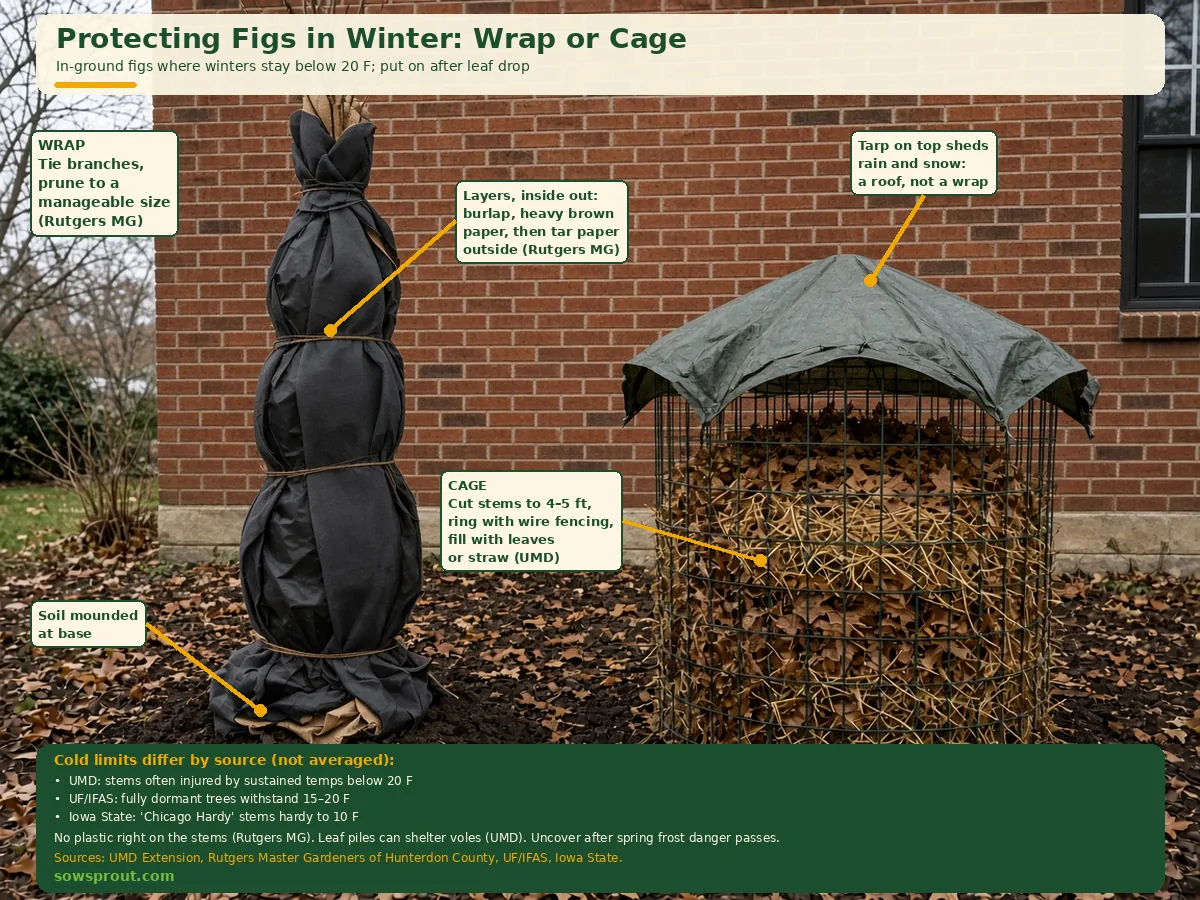
Burying option. Bend flexible branches down to the ground and bury them in a trench, or cover them with soil, leaves or compost. This insulates well, especially for smaller or more flexible plants, but can be labor-intensive and may not be practical for larger trees (Rutgers Master Gardeners of Hunterdon County).
Plastic: roof, not wrap. University of Maryland Extension says a plastic tarp can cover a leaf-filled cage to shed rain and snow; Rutgers Master Gardeners of Hunterdon County warns against wrapping the plant itself in plastic. The two fit together: use plastic only as a cover over insulation, not wrapped directly around the stems.
Watch for voles under the insulation
Insulating materials around fig bushes can make attractive winter homes for voles. They feed on the tender bark, which can reduce plant vigor and the next year’s fig crop (University of Maryland Extension). For trunk guards and hardware cloth, see how to protect young trees in winter.
Potted fig tree winter care
- Where to store it. Move the pot to an unheated basement, garage or greenhouse when the leaves start to turn or before the first killing frost. Figs need a dormant period, and yellowing, dropping leaves in fall are natural (UNH Extension). Iowa State also names an attached, unheated garage or cool basement (Iowa State University Extension).
- Water much less. Once indoors, let the upper two inches of potting mix dry before watering. Dormant roots take up little water but still need some moisture. Depending on pot size, mix and temperature, that may be only once every week or two. Avoid overwatering, which can cause root rot (UNH Extension).
- Plan for the move. UNH suggests wheeled plant stands or dollies (UNH Extension). Rutgers Master Gardeners suggest pots of at least 15 gallons on wheeled casters (Rutgers Master Gardeners of Hunterdon County).
- Back outside in spring. Set the fig outside for a few hours each day, gradually lengthening its time in the sun over a few weeks. Bring it back in at night until there is no longer a chance of frost (UNH Extension).
For other plants coming inside, see when to bring potted plants inside.
Site and care choices that reduce winter injury
- South side of a building. In colder areas, the ideal site is the south side of a building. Cold injury is further reduced if the fig does not get direct sun early in the morning or late in the evening in winter, and wind protection helps (Clemson HGIC; Rutgers Master Gardeners of Hunterdon County).
- Go easy on fertilizer. Clemson ties winter injury to vigor: low winter temperatures in the Piedmont easily kill vigorous, fast-growing plants. Where figs are often damaged by cold, Clemson says to cut fertilizer recommendations by one-half, and near the mountains to apply none (Clemson HGIC).
- No late-summer growth push. Avoid fertilizer and irrigation that promote a late-summer growth flush; that tender growth is killed by temperatures just below freezing (UF/IFAS (MG214)).
- Cultivar note. UF/IFAS reports Brown Turkey and Celeste as more cold hardy than many other fig cultivars (UF/IFAS (MG214)).
Checking a fig for winter damage in spring
- Scratch test. Lightly shave the bark on several stems with a razor blade or sharp knife. Green tissue underneath means the stem survived, and fruit will form on shoots from those stems. Stems with no green tissue under the bark are winter-killed and can be pruned off in early spring (University of Maryland Extension).
- Spring pruning. In March or April, prune out root suckers and dead, crowded, low-growing or weak wood. Gloves help avoid skin irritation from the milky sap (University of Maryland Extension).
Growing figs from the start? See how to grow figs for planting, care and harvest.
More winter protection guides
How to grow figs Protect plants from frost When to bring potted plants inside First hard freeze dates Protect young trees in winter Protect shrubs in winter ZIP planner All frost guides
Frequently asked questions
Do fig trees need to be covered in winter?
Where temperatures stay below 20°F for long periods, yes. University of Maryland Extension says unprotected fig stems are often injured by sustained temperatures below 20°F, although the roots usually survive. UNH Extension says figs grow well in zones 7 to 10, while zone 6 plants usually die back significantly in cold winters.
What is the best way to wrap a fig tree for winter?
Two extension-linked methods: Rutgers Master Gardeners tie the branches together and wrap with burlap, then heavy brown paper, then tar paper, with soil mounded at the base. University of Maryland Extension cuts main stems to 4 to 5 feet and covers them, or cages the plant with wire fencing filled with leaves or straw. Avoid wrapping plastic directly against the plant.
When should I wrap and unwrap my fig tree?
Wrap after the leaves have fallen and the plant is dormant, typically around Thanksgiving in many areas, and remove the protection in spring after the danger of frost has passed (Rutgers Master Gardeners). University of Maryland lists insulating figs as a November task.
Where should a potted fig tree go in winter?
An unheated garage, cool basement or greenhouse. UNH Extension says to move it when the leaves start to turn or before the first killing frost, then water only when the top two inches of potting mix are dry, which may be once every week or two. Iowa State recommends an attached, unheated garage or cool basement.
How cold can a fig tree get?
Sources give different figures for different situations: University of Maryland says unprotected stems are often injured by sustained temperatures below 20°F; UF/IFAS says fully dormant, cold-conditioned trees can withstand 15°F to 20°F without severe damage; Iowa State says Chicago Hardy stems are hardy to 10°F. Rutgers Master Gardeners say early frosts around 25°F to 27°F make figs drop their leaves.
Sources
- University of Maryland Extension: Growing Figs in Maryland; November Gardening Tips and Tasks
- UNH Extension: Is it possible to grow an edible fig in a container?
- Iowa State University Extension and Outreach: How do I over-winter the common fig?
- UF/IFAS Extension: The Fig (MG214)
- Rutgers Master Gardeners of Hunterdon County: Fig Tree Winter Protection (PDF)
- NOAA National Centers for Environmental Information: U.S. Climate Normals 1991–2020
- Clemson Cooperative Extension: Figs: How to Grow and Care for Figs in South Carolina