
How to Protect Young Trees in Winter: Tree Wrap, Sunscald and Rabbit Guards
Quick answer
Wrap the trunks of young, thin-barked trees with white or light-colored tree wrap or plastic guards in late fall, before freezing nights, and take the wrap off in spring after the last frost, for at least the first two to three winters. To stop rabbits and voles, add a loose cylinder of 1/4-inch hardware cloth about 6 inches from the trunk, buried 2 to 3 inches deep and reaching 18 to 24 inches above the usual snow line.
Jump to
- What sunscald and frost cracks are
- Which trees need winter protection
- When to wrap trees for winter, and when to take the wrap off
- Which tree wrap to use, and how to wrap a tree trunk
- Why tree wrap has to come off in spring
- How to protect trees from rabbits and voles in winter
- Fall care that lowers the risk
- If the bark is already damaged
- More guides
- Frequently asked questions
Updated
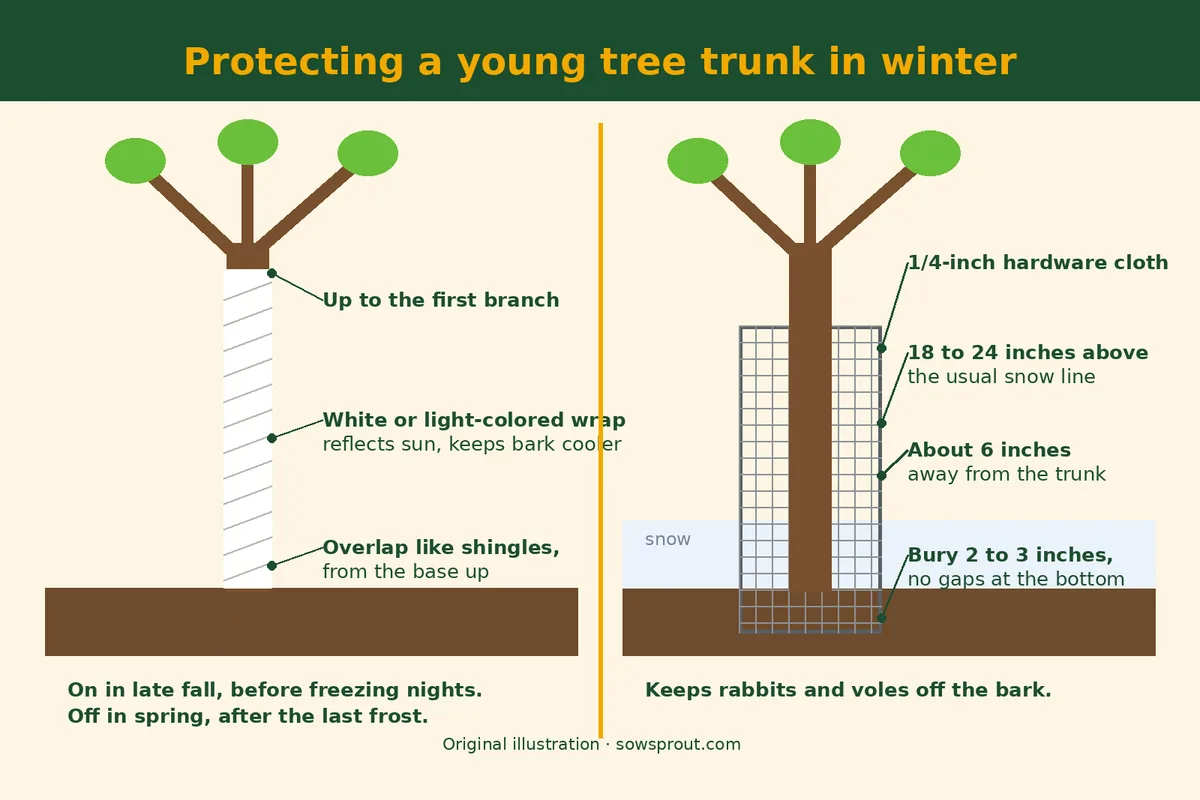
A young tree’s thin bark is easy to damage in winter. Sun warms the trunk on a cold day and the bark freezes again at night, which causes sunscald and frost cracks, and rabbits and voles chew the bark when other food runs short. Here’s when to put tree wrap and guards on in your zone, what to use, and when to take it all off, from university extension guides.
Jump to: Sunscald and frost cracks Which trees need it When to wrap, by zone Choosing and putting on wrap Taking it off Rabbits and voles Fall care If bark is damaged
What sunscald and frost cracks are
- Sunscald (also called southwest winter injury) starts when winter sun warms the bark and wakes dormant cells just under it. Utah State says the newly active cells “lose some of their cold-hardiness and are injured when temperatures drop below freezing during the nighttime hours.” “Research has shown that the south side of a tree can be as much as 77°F warmer on a cold winter day than the north side of the tree.” (Utah State University Extension)
- What it looks like: “discolored bark, bark cracking, sunken areas from lack of growth, or sloughing of surface bark to reveal dead tissue within the damaged area.” Damage is usually on the south or west side of the trunk (Utah State University Extension; UConn Home and Garden Education Center).
- Frost cracks are “vertical openings that can extend deep into the wood of the tree and are most often on the trunk”. UConn says they “are not generally fatal to a tree but they can allow disease organisms and canker pathogens to enter the tree.” They can come back: “This can recur over several winters, causing cracks to reopen and enlarge.” (UConn Home and Garden Education Center)
- Frost crack or growth crack? Normal growth cracks are different: “growth cracks do not go as deep, the heartwood is not exposed, and there is no decay or oozing.” (UConn)
Which trees need winter protection
- Young, thin-barked trees. “Young trees with thin bark are most susceptible to sunscald injury.” As most species mature their bark thickens, but thin, dark-barked trees in the Prunus genus (cherries, peaches, plums) “may remain susceptible or even become more susceptible with age.” (Utah State University Extension)
- Trees often named: Utah State lists apple, ash, aspen, birch, cherry, cottonwood/poplar, crabapple, honeylocust, linden/basswood, maple, mountain-ash, oak, peach, tuliptree and willow (Utah State University Extension). Montana State adds newly transplanted and heavily pruned trees (Montana State University Extension), and UConn names fruit trees among the thin-barked trees prone to frost cracks (UConn Home and Garden Education Center).
- Trees that just lost their shade: trees pruned to raise the lower branches, or moved from a shady spot to a sunny one (UMN, University of Minnesota Extension).
- Dry trees: “Drought stressed trees are more susceptible to sunscald injury than trees that enter the dormant period well-hydrated.” (Utah State)
- Evergreens are less prone to sunscald because foliage shades their trunks (Utah State). Their winter problem is winter burn on the needles and leaves, covered in how to protect shrubs in winter.
When to wrap trees for winter, and when to take the wrap off
- Utah State: wrap “should be applied in late fall before the risk of freezing temperatures and removed the following spring after the risk of freezing nights has passed.”
- UConn: apply it “in the fall prior to freezing temperatures” and remove it “as soon as the risk of freezing temperatures at night has passed.”
- UMN: “Put the wrap on in the fall and remove it in the spring after the last frost.” Texas A&M Forest Service also says to remove it “in the spring after the last frost” (Texas A&M Forest Service).
- Oklahoma State: “Normal application of tree trunk wraps is October to March for the first two growing seasons.” “Wraps should be removed each spring prior to spring growth.” (Oklahoma State University Extension)
- Hardware cloth guards for rabbits and mice go on before snow: “Be sure the mesh cylinder is in place before the first snowfall” (Iowa State, Iowa State University Extension).
The table turns that rule into dates: wrap by your typical first fall frost, and take the wrap off after your typical last spring frost. In zones 3 to 7 the typical first frost has already passed by early November, so wrap now; zone 8 usually reaches it around Nov 10, and in zone 9 and warmer it is still ahead. Enter your ZIP in the planner for the dates at your nearest NOAA station.
| USDA zone | ZIP codes | Wrap by: typical first fall frost, median (10th–90th pct) | Remove after: typical last spring frost, median (10th–90th pct) |
|---|---|---|---|
| Zone 3 | 223 | Sep 23 (Sep 7 – Oct 1) | May 17 (May 12 – May 30) |
| Zone 4 | 1,950 | Sep 30 (Sep 19 – Oct 7) | May 10 (May 2 – May 26) |
| Zone 5 | 4,869 | Oct 7 (Sep 26 – Oct 18) | May 3 (Apr 23 – May 21) |
| Zone 6 | 9,140 | Oct 19 (Oct 5 – Oct 28) | Apr 26 (Apr 13 – May 10) |
| Zone 7 | 7,068 | Oct 28 (Oct 17 – Nov 8) | Apr 11 (Apr 1 – Apr 26) |
| Zone 8 | 5,253 | Nov 10 (Oct 31 – Nov 20) | Mar 24 (Mar 9 – Apr 7) |
| Zone 9 | 3,241 | Dec 3 (Nov 17 – Dec 26) | Feb 24 (Jan 24 – Mar 16) |
| Zone 10 | 1,265 | Frost occasional to rare (70% of zone 10 ZIP codes’ nearest stations record 32°F in fewer than half of years). Where frost is regular: Dec 26 (Dec 13 – Jan 9) | Where frost is regular: Jan 24 (Jan 6 – Feb 6) |
| Zones 11–13 | 349 | Frost-rare, no wrap dates | Frost-rare, no wrap dates |
About this table: For each ZIP code we use the nearest NOAA NCEI 1991–2020 U.S. Climate Normals station’s 50%-probability 32°F frost dates (half of years frost earlier in fall or later in spring). Median across the zone’s ZIP codes, with the 10th–90th percentile range. Source: data/zonefrost.json, from NOAA NCEI 1991–2020 U.S. Climate Normals. In zones 11 to 13 frost is rare, so no wrap dates are shown; none of the sources above covers trunk wrap in frost-rare climates.
Which tree wrap to use, and how to wrap a tree trunk
- White or light-colored only. UMN: “Use a white commercial tree wrap or plastic tree guards. Do not use brown paper tree wrap or black colored tree guards, as they will absorb heat from the sun.” Utah State: “White tree wrap reflects light away from the trunk and limbs and keeps the bark surface temperature cooler.”
- Wrap from the bottom up, loosely. Oklahoma State: “Tree wraps should be applied loosely from base up to the first branch by overlapping for a shingle effect.” “Plastic wraps should fit loosely and include holes or slits for good air movement.”
- Plastic or paper? “Plastic wraps may provide better protection than paper wraps against lawn mower, weed-eater, and rodent damage.” (Oklahoma State)
- How many winters: Utah State says “Use tree wrap for a minimum of two to three winters after planting.” UConn says 2 to 3 winters “until the bark thickens.” UMN says to wrap newly planted trees “for at least two winters and thin-barked species up to five winters or more.”
- Other ways to shade the trunk: a light-colored board or an opaque fence on the south and west side of the tree. Some orchardists paint lower trunks with white latex paint; Utah State says to “use interior latex paint as some exterior paints contain antimicrobial agents that can be damaging to the tree.” “Paint can also be diluted 1:1 with water.” (Utah State University Extension) Montana State also lists white latex paint (Montana State University Extension).
- Lower branches help too. Iowa State: “The most reliable ways to reduce the incidence of sunscald is to leave lower branches on trees for as long as possible, avoid unnecessary wounding of the trunk, and prevent drought stress by properly watering young trees for the first two to five years.” Oklahoma State: “A twiggy trunk is preferable to tree wraps”, though not every tree has enough twigs.
Why tree wrap has to come off in spring
- Moisture and pests. UConn: “Wrap left on once the temperatures have warmed can keep the bark damp, encouraging disease. It may also harbor pests.” Texas A&M Forest Service removes it “to avoid insects living under the material during the summer.”
- Girdling. “During spring growth, the trunk expands and increases in size. Wraps too tightly wrapped or left on during this time may result in constriction to the trunk.” (Oklahoma State) Montana State says to remove wraps and guards in spring “to prevent constriction and girdling.”
- Check it over winter. Misused wraps can cause “trunk girdling or constriction, insects, diseases, and excessive bark moisture.” “Periodically inspect the wraps for trunk damage and insects.” (Oklahoma State)
How to protect trees from rabbits and voles in winter
UMN says mice, rabbits, voles and deer “girdle trees and shrubs by chewing through the bark.” Iowa State: if the damage “fully circles and girdles the tree, it will likely not survive.”
- Hardware cloth cylinders. UMN: “Protect tree trunks with cylinders of ¼-inch mesh hardware cloth around the trunk of the tree about 6 inches away from the trunk.” “For mice, the cylinder should extend 2 to 3 inches below the ground line. For rabbits, the cylinder should extend 18 to 24 inches above the anticipated snow line.” “Make sure there are no gaps between the bottom of the mesh cylinder and the ground where animals could crawl under the fencing.” Iowa State gives the same depth and height (Iowa State University Extension).
- Plastic guards on small trees: “For small trees, plastic tree guards are also effective.” (UMN)
- Voles “do the most harm to small trees and shrubs when they chew on the bark, often hidden below winter snow.” UMN: “Prevent vole damage to tree bark by encircling the tree with a light colored tree guard”; “The guard should be tall enough to reach above the snow line in the winter.” “Make sure that the guard is loose enough so that it does not constrict the tree.” (University of Minnesota Extension)
- Remove the cover they hide in. “Cut grasses and other vegetation short in late fall within 2 feet of young trees to reduce protective cover for mice and voles that might feed on trunks and stems.” Removing brush piles also discourages rabbits (UMN).
- Repellents are not poisons; UMN says a repellent “simply makes plants taste or smell bad to animals.” UMN: “One application of a repellent is usually enough for the entire dormant season.” Iowa State: “Animals may not be deterred by repellents if feeding pressure is high.”
- Leave the cylinder on all year? The sources disagree. UMN says the hardware cloth “can be kept on year-round.” Iowa State says “Do not leave the mesh cylinder on all year. Leaving the metal mesh wrapped around the tree can restrict growth or cause girdling.” If you leave one on, keep it loose and well away from the trunk, and check it each spring.
- Deer browsing and fencing are covered in how to protect shrubs in winter.
Fall care that lowers the risk
- Water before the ground freezes. UConn: “Be sure to water drought stressed trees up until a hard frost.” Utah State: “make sure trees are fully hydrated in the fall before the ground freezes.” For how much water, see watering until the ground freezes; for dates, first hard freeze dates by zone.
- Mulch the base. Utah State says a layer of mulch around the base “will help conserve soil moisture and moderate temperature.” Texas A&M Forest Service: “A two- to three-inch layer of mulch should be spread around the base of the tree”, kept “about two inches away from the tree’s trunk.” Shredded leaves work: see what to do with fall leaves.
- Skip fall fertilizer. UConn: “Don’t fertilize trees in late summer to avoid a flush of new growth that may not harden off before winter. If you must fertilize in the fall do so after the leaves have dropped or in the spring.”
- Keep mowers and string trimmers off the trunk. UConn: avoid using them “close to the trunk to prevent damage that could expand during the winter.”
- Next time you plant: “Susceptible species should be planted where they do not have a strong south-southwest exposure.” (UConn) Utah State suggests planting susceptible trees to the north and east of buildings or evergreens.
If the bark is already damaged
- Don’t paint or seal it. UConn: “Damaged areas should not be painted or sealed but allowed to heal naturally.” UMN: “Do not apply paint, tar or a commercial tree wound dressing to the open wound.” Utah State says the same, and Iowa State says so for bark damaged by animals.
- Trim loose bark cleanly. UConn: “A knife dipped in a 10% bleach solution may be used to trim away any excess bark.” UMN: “Trees will typically heal themselves through new growth of the inner bark or along the edges where the bark splits.”
- After rabbit or vole damage, Iowa State says to “Provide adequate moisture through the spring and summer and monitor closely as these areas are more likely to see secondary damage from diseases or insects.”
- Then protect it next winter. UMN: “Wrap the tree in winter to prevent further sunscald.”
More guides
Protect shrubs in winter When to prune trees When to prune fruit trees First hard freeze dates What to do with fall leaves November garden tasks by zone ZIP planner
Frequently asked questions
When should I wrap my trees for winter?
In late fall, before freezing nights begin. Utah State and UConn say to put wrap on in fall before freezing temperatures, and Oklahoma State gives October to March as the normal season for the first two growing seasons. Our table uses your zone’s typical first fall frost as the wrap-by date.
When should I remove tree wrap in spring?
After the last frost, once the risk of freezing nights has passed (UMN, Utah State, Texas A&M Forest Service), and before spring growth starts (Oklahoma State). Wrap left on into warm weather can keep bark damp, harbor pests and constrict the growing trunk.
How many years should I wrap a young tree?
At least two to three winters after planting (Utah State, UConn). UMN says at least two winters for newly planted trees and up to five winters or more for thin-barked species. It becomes less necessary as the bark thickens.
Will sunscald kill a tree?
The sources stop short of that. Utah State says sunscald can cause significant stress and lets pests and diseases into the damaged area, and that the damage may eventually heal. UConn says frost cracks are not generally fatal. Bark chewed all the way around the trunk by animals is different: Iowa State says that tree will likely not survive.
What color tree wrap is best?
White or light-colored. UMN says to use white commercial tree wrap or plastic tree guards, and not brown paper wrap or black guards, because they absorb heat from the sun. Utah State says white wrap reflects light and keeps the bark cooler.
How do I protect trees from rabbits in winter?
Put a cylinder of 1/4-inch hardware cloth around the trunk, about 6 inches away from it, buried 2 to 3 inches deep with no gaps at the bottom, and reaching 18 to 24 inches above the usual snow line (UMN, Iowa State). Have it in place before the first snowfall. Plastic guards also work on small trees (UMN).
Is winter burn on trees the same as sunscald?
No. Winter burn is the drying and browning of evergreen needles and leaves: UMN says winter sun and wind cause water loss from the foliage while the roots are in frozen soil and can’t replace it. Sunscald is injury to the bark of the trunk and limbs. For winter burn, see our guide to protecting shrubs in winter.
Should I leave hardware cloth around a tree all year?
Sources disagree. UMN says the cylinder can be kept on year-round; Iowa State says to remove it in spring because it can restrict growth or cause girdling. If you leave one on, keep it loose and well away from the trunk and check it each spring.
Sources
- Utah State University Extension: Sunscald Injury or Southwest Winter Injury on Deciduous Trees (Utah Forest Facts 021)
- UConn Home & Garden Education Center: Frost Cracks and Sunscald on Trees
- Montana State University Extension: Reducing Winter-Related Injury in Landscape Trees
- University of Minnesota Extension: Protecting trees and shrubs in winter; How to manage vole damage on lawns, trees and shrubs
- Texas A&M Forest Service: Tree Care in the Cold and Ice Damage
- Oklahoma State University Extension: Trunk Protective Materials (Horticulture Tips)
- Iowa State University Extension: Winter Damage on Trees
- NOAA National Centers for Environmental Information: U.S. Climate Normals 1991–2020