
Basil Plant Care: How to Grow, Prune and Save Basil Before Frost
Quick answer
Give basil full sun (6 or more hours), rich, well-drained soil and steady moisture, watering at the base rather than on the leaves. Pinch stem tips to keep it bushy, and pinch off flower buds as soon as they appear so the leaves keep their flavor. Basil is frost-tender: cold nights near 50°F can blacken the leaves and frost kills it, so harvest, preserve or bring basil inside before your first fall frost.
Jump to
- Before frost: harvest, preserve or bring basil inside
- Basil plant care indoors: bring a plant in, root cuttings or sow a pot
- Sun and where to plant basil
- Soil and fertilizer
- Watering and mulch
- How to prune basil (and what to do when it flowers)
- Harvesting basil
- Freezing and drying the fall harvest
- Basil turning black, yellow leaves and other problems
- Next spring: when to plant basil outdoors
- More guides
- Frequently asked questions
Updated
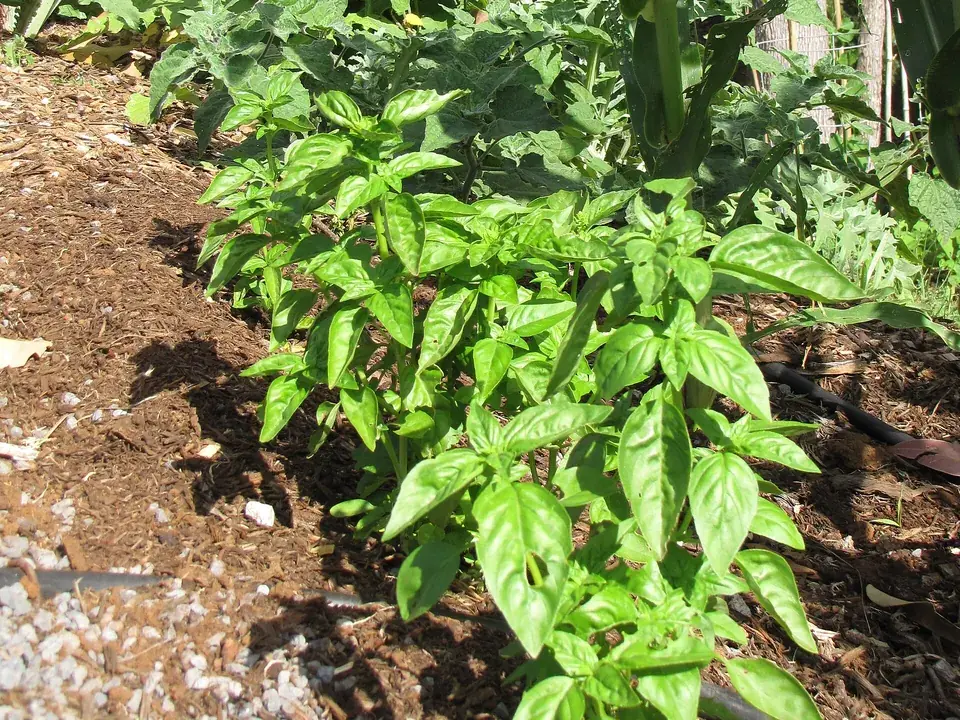

Basil is a tender annual that rewards a sunny spot, steady water and regular pinching. Here’s how to care for a basil plant through the season, from sun, soil and watering to pruning, harvest and the problems that turn leaves yellow or black, plus what to do now, before frost: a final harvest, freezing or drying, or bringing basil indoors for winter.
Jump to: Before frost Basil indoors Sun Soil Water Pruning Harvesting Freezing and drying Problems Next spring
Before frost: harvest, preserve or bring basil inside
- The cold rule. “Cold soil and air temperatures can stunt basil growth and can even cause damage and blackened leaves at 50 degrees” (Illinois Extension). Rutgers adds that “if temperatures fall below 40° F basil will show cold injury and turn black” (Rutgers FS1279). Frost is the end: Clemson’s fall advice begins “Before the first fall frost kills the basil” (Clemson HGIC), and our frost protection guide lists basil among the plants a light frost (32°F) kills.
- Do your big harvest, or move potted basil inside, before nights drop to about 50°F. Your first fall frost (32°F) is the last possible day. Before that frost, “plants can be cut back for harvest” (Clemson). For drying, “It is best to cut leaves for drying just before flowers open” (University of Maryland Extension).
- Why the leaves blacken. UC Davis calls basil and shiso “the only chilling sensitive fresh culinary herbs.” Chilling symptoms include “browning of the leaves and growing tip, bronzing of the leaf veins, and loss of the glossy appearance of the leaves” (UC Davis).
- Just one cold night in the forecast? Cover plants as shown in how to protect plants from frost.
Your basil deadline: first fall frost by USDA zone
| USDA zone | Earlier locations: first frost (10th percentile) | Typical first frost (median) | Later locations (90th percentile) |
|---|---|---|---|
| Zone 3 | Sep 7 | Sep 23 | Oct 1 |
| Zone 4 | Sep 19 | Sep 30 | Oct 7 |
| Zone 5 | Sep 26 | Oct 7 | Oct 18 |
| Zone 6 | Oct 5 | Oct 19 | Oct 28 |
| Zone 7 | Oct 17 | Oct 28 | Nov 8 |
| Zone 8 | Oct 31 | Nov 10 | Nov 20 |
| Zone 9 | Nov 17 | Dec 3 | Dec 26 |
| Zone 10 | Frost occasional to rare (70% of zone 10 ZIP codes’ nearest stations record 32°F in fewer than half of years). Where frost is regular: Dec 13 | Dec 26 | Jan 9 |
| Frost rare | — | — |
About this table: For each ZIP code we use the nearest NOAA NCEI 1991–2020 U.S. Climate Normals station’s 50%-probability first-fall date for 32°F. The table shows the median across each zone’s ZIP codes and the 10th and 90th percentiles. A median is not a safe date: in half of years frost comes earlier. Basil is damaged at about 50°F (Illinois Extension), which usually arrives before these dates, so treat the earlier column as your outside deadline. Source: data/zonefrost.json, from NOAA NCEI 1991–2020 U.S. Climate Normals. The site has no data on when nights reach 50°F, so that rule stays a rule, not a date. Enter your ZIP in the planner for the dates at your nearest NOAA station.
In zones 3 to 5, at least 9 in 10 ZIP codes have a typical first frost of Oct 18 or earlier, so if basil there is still growing, harvest it now. For zone 11 and other frost-rare areas, see the zone 10 guide (nearest to zone 11).
Basil plant care indoors: bring a plant in, root cuttings or sow a pot
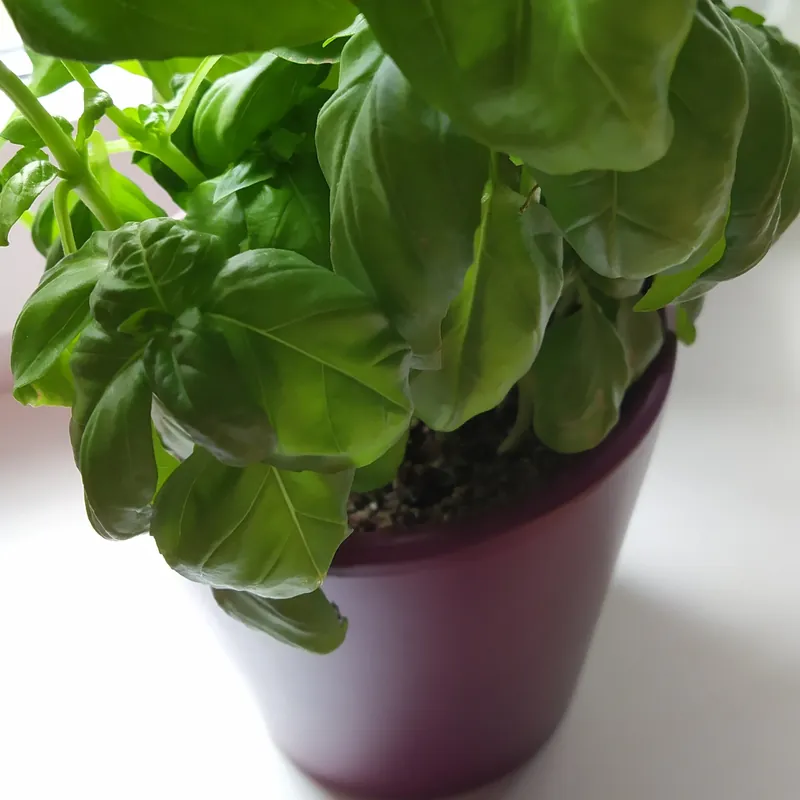
Dig and pot a plant
- Before the first fall frost, the root systems can be “dug up and potted in containers for continued growth indoors. Put plants in a sunny window. Water the plants regularly, but do not over-water, and do not let the plants stand with water in their saucers” (Clemson HGIC).
- Light is the hard part. Give indoor basil “plenty of bright light. You may have to install artificial lights and run them for 10-12 hours daily since indoor light will not be enough during the darker winter months” (UMN Extension).
- Feed sparingly: UMN suggests a liquid fertilizer “at one-half the label recommended strength every four to six weeks for indoor plants.”
- Expect less. “Plants grown indoors will have a less intense flavor and fragrance” (Iowa State). And “As annuals, basil plants will flower and die eventually, even indoors. Plan to start new seeds or buy new plants each spring” (UMN).
- Rinse and check any pot for pests before it comes in. See when to bring potted plants inside for the pest check, quarantine and light steps.

Or root cuttings
- Basil is one of the herbs that “root easily from shoot tip cuttings.” Purdue’s method: “Take the cutting at a node on the stem (where the leaves attach),” “Remove the lower leaves and insert the cut end of the stem into moist media such as soil mix, vermiculite or perlite,” then cover the container with plastic to raise humidity (“If the plastic lays on the foliage, it can decay”) and “Place the pot in a warm, shaded location” (Purdue).
- Illinois Extension notes basil grows easily “from tip cuttings of overwintered plants,” and Iowa State says basil “can also be propagated by cuttings and can successfully be grown indoors on a sunny windowsill.”
Or sow a windowsill pot
“Basil is easily grown as a window sill herb for fall, winter and early spring harvest.” Sow several seeds in a small pot of potting mix, keep it moist and in full sun; “Harvesting can begin in about 4 to 5 weeks,” and sowing again every 2 weeks “insures a continuous supply of fresh basil” (Illinois Extension).
Sun and where to plant basil
- “Like most herbs, basil requires a sunny location that receives at least six to eight hours of bright light per day and well-drained soil conditions” (UMN Extension). Full sun means “6 or more hours of direct sun daily in summer” (University of Maryland Extension).
- Clemson: basil prefers full sun, but it “grows reasonably well in part-sun (six hours of sun per day).”
- Sun and space help prevent disease. “Plant basil in a very sunny site and space the plants far enough apart to promote rapid leaf drying from dew and after rainfall” (Clemson). University of Maryland Extension spaces plants 12 inches apart with 18 inches between rows; UMN thins seedlings to 6 to 12 inches apart.
Soil and fertilizer
- Test first. UMN: “Have your soil tested.” Clemson: “A soil test is always recommended before planting a garden.”
- pH: sources differ slightly. UMN says “A pH range of 6.0 to 7.5 is best”; Clemson recommends liming the soil to 6.0 to 6.5; Rutgers lists 6.0 to 7.0 (Rutgers FS1279).
- Rich, well-drained soil. Mix compost or other organic matter into the soil before planting, “as basil grows best in a rich, well-drained soil” (Clemson).
- Go light on fertilizer. “Basil plants should not be over-fertilized because the flavor in the foliage will be reduced during rapid plant growth” (Clemson). University of Maryland Extension: avoid “overly-lush growth (such as from heavy fertilization) as it may reduce flavor.” Iowa State: “Too much nitrogen affects its flavor.”
- In pots outdoors, UMN suggests liquid fertilizer at half the label strength “every three to four weeks for basil grown outside in containers.”
Watering and mulch
- “Depending on the amount of regular rainfall, water deeply every seven to ten days.” “Plants grown in containers will dry out faster than those in garden beds. Water them more frequently,” and choose a container with drainage holes (UMN).
- Keep the leaves dry. Basil needs “a relatively constant supply of soil moisture.” “It is best to water by soaker hoses, drip irrigation or by hand at the base of each plant. Do not wet the foliage, as it will be more prone to disease” (Clemson).
- “While established basil is relatively drought-tolerant, regular watering in dry weather promotes plant growth” (Iowa State).
- Mulch. UMN: “A two to three inch mulch of grass clippings, straw, compost or ground-up leaves retains soil moisture and minimizes weeds.” Clemson uses pine needles or ground-up leaves 3 inches deep, which also helps “keep the foliage clean from rain-splashed soil.”
How to prune basil (and what to do when it flowers)
- Pinch to make it bushy. “Pinch stems as they lengthen to promote bushy, compact growth” (University of Maryland Extension). Clemson: “The terminal growth of basil plants may be pinched out periodically to encourage branching. This will create thicker plants with more tender foliage for harvest.”
- Where to cut. “If you harvest whole stems, cut just above a pair of leaves. New growth will occur at the cut point and should be visible within a week’s time” (UMN).
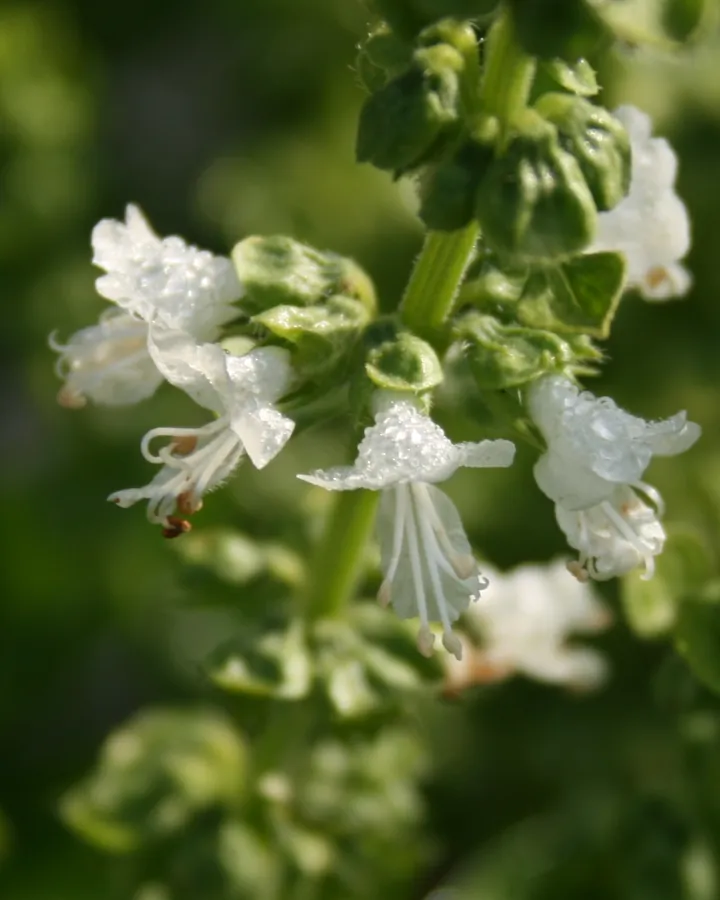
- Pinch off flower buds. “For the most flavorful foliage, flower buds should be pinched out as soon as they appear” (Clemson). Illinois Extension: remove them “as soon as you see them form. Leaving them on the plant will affect the flavor of the leaves.” UMN: “If you allow basil to flower and form seed, it will become woody and yields will be considerably less. Flowering will lead to more bitter flavors.”
- Already flowered? Keep pruning: UMN says “it is important to prune the plant periodically throughout the growing season to maintain succulent and productive growth.” “If your plants flower, cut some stems for a mixed bouquet”; purple-leafed types have ornamental pink blooms (UMN).
- Saving seed: “Some flower spikes may be allowed to develop if seed is to be collected.” To keep seed true to type, “the different cultivars must be separated by 150 feet to prevent cross-pollination,” and don’t save seed from plants that had Fusarium wilt or bacterial leaf spot (Clemson).

Harvesting basil
- “Basil leaves can be picked about 6 weeks after planting” (University of Maryland Extension). UMN: “Begin harvesting at any time by snipping the fresh young leaves as needed.”
- “For maximum flavor, basil should be harvested when flower buds have started to form but before they begin to open” (Iowa State).
- Don’t strip the plant. “Leave enough foliage on each plant after harvest so that plant growth is not significantly reduced” (Clemson). Rutgers’ guide for market growers says “At least four sets of true leaves should be left to allow for continued growth of the plant.”
- Pick on dry days. Gray mold infections “usually begin on the surface of stem cuts that are made during harvest.” Cut stems are much less susceptible 24 hours after harvest and fully healed at 48 hours, so “do not harvest in wet weather” (Clemson).
- Keep it out of the fridge. “Basil picked for use in the kitchen is best held in a glass of water at room temperature. Putting basil in the refrigerator results in discolored and unattractive leaves” (Illinois Extension). UC Davis: basil is “chilling sensitive” and “should be stored above 10°C (50°F).”
Freezing and drying the fall harvest
- Freeze for the freshest flavor. Freezing “usually results in a product with a flavor more like fresh basil”; air-dried basil leaves “turn an unpleasant brown color” (UMN).
- Three ways to freeze (UMN): whole leaves in small plastic bags; chopped leaves in an ice cube tray “topped off with a little water”; or “one-fourth-cup chopped basil with two teaspoons of vegetable or olive oil,” dropped by teaspoonfuls onto wax paper-lined baking sheets, frozen, then bagged. “Use frozen basil within a year.”
- Pesto: freeze it in small containers, and “Omit any cheese from the recipe if you plan to freeze pesto” (UMN). “Pesto, or other herbs in oil, should not be canned because of the risk of botulism,” and refrigerated pesto is best used within 3 days (Clemson).
- Drying: Iowa State prefers racks or trays over hanging bunches, in “a warm, well-ventilated area, away from direct sunlight.” Brown leaves mean too much heat. Clemson dries basil in a food dehydrator “at less than 125 ºF.” Store dried leaves in airtight containers away from heat and light: about a year (UMN), or up to 12 months (Clemson).
Basil turning black, yellow leaves and other problems
Basil turning black
- After a cold night: that’s cold injury. Leaves can blacken at 50°F (Illinois Extension), and below 40°F basil “will show cold injury and turn black” (Rutgers). Harvest or bring plants in before the cold arrives (see before frost).
- In the fridge: refrigeration “results in discolored and unattractive leaves” (Illinois Extension); store cut basil in a glass of water at room temperature.
- Black spots on yellowing leaves: with downy mildew, “Irregular black spots appear on infected leaves as they age” (UMN). See below.
Yellow leaves? Check for basil downy mildew
- Downy mildew “has been the most common and most important (damaging) disease of basil in the United States (US) since it was first reported in south Florida in October 2007” (Cornell). It is caused by Peronospora belbahrii, “a water mold as opposed to a true fungus” (UMN Extension).
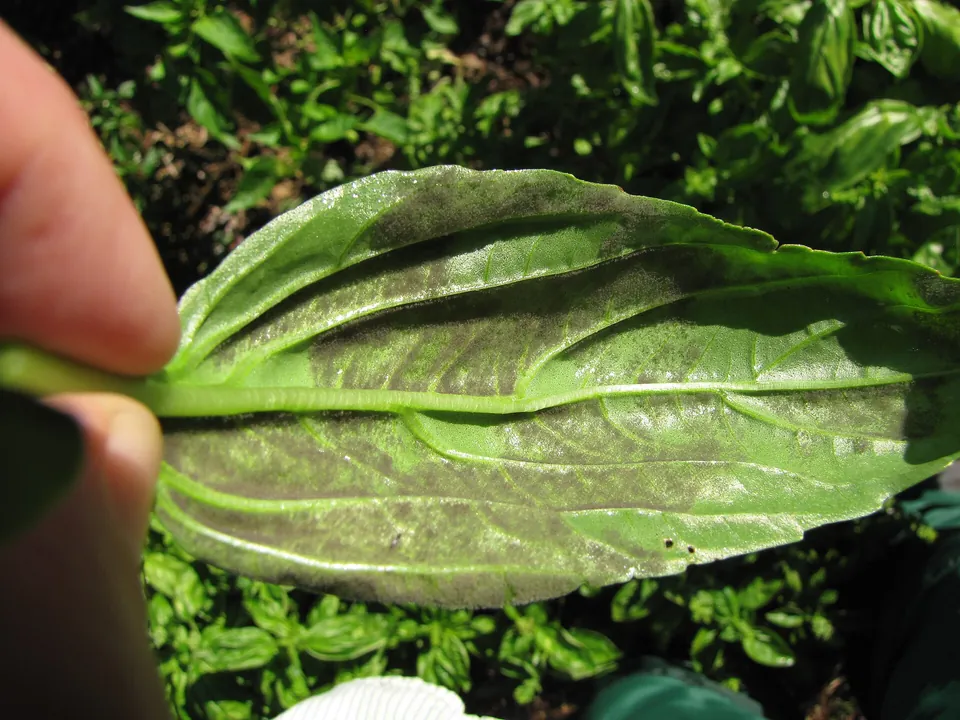
- Signs: “Infection starts on lower leaves and moves up the plant.” “Infected leaves first turn yellow in areas restricted by major veins,” and “Fluffy gray spores grow on the underside of infected leaves” (UMN). The yellowing can look like a nutrient deficiency (Cornell), and UMass describes the spores as “a characteristic fuzzy, dark gray to purple growth on the underside of the leaves.”
- Flip the leaf, early. “Because spores are produced during the dark night period, early morning is the best time to inspect basil for downy mildew.” Sunburn and thrips damage can look similar but lack the fuzzy spores underneath (Cornell).
- When it strikes: the pathogen “can infect and produce spores in temperatures as low as 59°F. But it thrives in warm, humid conditions. As a result, the most devastating damage is often in late summer” (UMN). UMass: “Sporulation occurs at 50-78°F and >85% relative humidity” (UMass Extension). It spreads on seed, transplants and fresh leaves, and spores travel long distances on moist air currents (UMN).
- What to do: “Remove and destroy immediately any plant with basil downy mildew.” Space plants for air movement; if you must use a sprinkler, water “early on a sunny day so leaves dry quickly in the sun”; and “If growing basil in small pots, move pots indoors overnight during periods of high humidity or on rainy days to reduce infection” (UMN). “It is safe to eat leaves from infected plants - the disease does not harm people,” and if plants die, “sow fresh seeds in containers or in another part of the garden” (University of Maryland Extension).
- Sprays won’t save it. UMN: “Because of this pathogen’s unique biology, products available to homeowners are not effective.”
- Genovese, the classic sweet basil, is the type most susceptible to downy mildew (University of Minnesota Extension), so give it full sun and enough spacing for the leaves to dry quickly.
- Next year: “There are varieties of basil available with downy mildew resistance, often denoted in seed catalogs with the abbreviation DMR” (UMN). Sweet basil types are the most susceptible; UMN reports lower disease levels in red leaf and lemon basils. The pathogen “is not known to be able to survive in the absence of living plants” (Cornell), and UMass says it “is unable to survive winter temperatures in the northeastern US.”

Other basil problems
- Fusarium wilt: a soil-borne fungus. “Infected basil plants will grow normally until they are six to twelve inches tall, then become stunted and exhibit browning of terminal growth,” then suddenly wilt. Remove infected plants promptly; the pathogen “can survive for many years in the soil; therefore plant resistant basil varieties” (Clemson).
- Gray mold: starts on fresh harvest cuts in wet weather; don’t harvest when it’s wet and don’t wet the foliage (Clemson).
- Root rots: improve drainage with compost or composted pine bark, but water often enough that plants do not wilt, and rotate where basil grows each year (Clemson).
- Pests: “The most common pests of basil are Japanese beetles, slugs and aphids” (Clemson). Japanese beetles “can be hand-picked from the plants and crushed or dropped into soapy water.” For aphids and other soft-bodied pests, Clemson suggests an insecticidal soap, sprayed “in the early evening to reduce the chance of damage to the foliage”; use a product labeled for basil, as the label directs. Iowa State adds that slugs and snails occasionally eat holes in leaves, and thrips may discolor them. Aphids: strong stream of water; insecticidal soap or oil with thorough coverage; not on drought-stressed plants or above 90°F (UC IPM aphids). Slugs/snails: handpick at night; iron phosphate baits when needed, follow the label (UC IPM).
Next spring: when to plant basil outdoors
- Our planner’s rule: start seeds indoors 4 to 6 weeks before your last spring frost and transplant 1 to 2 weeks after it. Clemson sows basil indoors “four to six weeks ahead of the outdoor planting time,” and Iowa State says “Start seeds indoors 4 or 5 weeks before the last frost date.” Sources differ: UMN suggests six to eight weeks, UNH Extension gives 6 to 8 weeks from seed to transplant and sets basil out 2 weeks after the last frost, and Illinois allows “about 3 to 4 weeks to produce transplants.”
- Wait for warmth, not just the frost date. Clemson: don’t transplant “until the daytime temperature is consistently in the 70s, and the nighttime temperatures are above 50 ºF.” Iowa State: direct-sow “after night temperatures are consistently above 50°F.” Illinois: soil “at least 60 degrees and above.”
- Seed: sow 1/4 inch deep (UMN; Clemson). Seeds germinate in 5 to 7 days (UMN; Illinois Extension) with the growing medium at least 70°F (Illinois Extension).
| USDA zone | Typical last spring frost (median) | Start seeds indoors (4–6 weeks before) | Transplant outside (1–2 weeks after) |
|---|---|---|---|
| Zone 3 | May 17 | Apr 5 – Apr 19 | May 24 – May 31 |
| Zone 4 | May 10 | Mar 29 – Apr 12 | May 17 – May 24 |
| Zone 5 | May 3 | Mar 22 – Apr 5 | May 10 – May 17 |
| Zone 6 | Apr 26 | Mar 15 – Mar 29 | May 3 – May 10 |
| Zone 7 | Apr 11 | Feb 28 – Mar 14 | Apr 18 – Apr 25 |
| Zone 8 | Mar 24 | Feb 10 – Feb 24 | Mar 31 – Apr 7 |
| Zone 9 | Feb 24 | Jan 13 – Jan 27 | Mar 3 – Mar 10 |
| Zone 10 | Frost occasional to rare (70% of ZIP codes). Where frost is regular: Jan 24 | Dec 13 – Dec 27 | Jan 31 – Feb 7 |
| Frost rare | No frost-based date | No frost-based date |
About this table: dates count from the median last spring frost of each zone’s ZIP codes (NOAA NCEI 1991–2020 normals: the date after which 32°F occurs in only 50% of years; data/zonefrost.json). Start indoors = last frost minus 4 to 6 weeks; transplant = last frost plus 1 to 2 weeks (the Sow & Sprout planner rule; Clemson and Iowa State give 4 to 6 and 4 or 5 weeks for starting indoors, and UNH Extension sets basil out 2 weeks after the last frost). In zones 9 to 11 the frost date is early or absent, so also wait until nights stay above 50°F (Iowa State; Clemson). Enter your ZIP in the planner for the dates at your nearest NOAA station.
Exceptions. Pacific Northwest: for western Washington and western Oregon ZIP codes, our planner shows no basil date, because we have no WSU or OSU Extension date for it, and OSU Extension says warm-season crops, basil included, need soil of “at least 60 degrees” (OSU Extension). Wait for warm soil, and see your ZIP in the planner. Low-desert Arizona: see the University of Arizona basil months on our Phoenix planting calendar. Zone 11 and frost-rare ZIP codes: there’s no frost-based basil date; see the zone 10 guide (nearest to zone 11).
Basil is a common partner for tomatoes; read our companion planting basil with tomatoes guide for what the research does and doesn’t show.
More guides
When to bring potted plants inside How to protect plants from frost Frost dates First hard freeze dates When to plant garlic ZIP planner
Frequently asked questions
Can basil survive winter outside?
Not where it freezes. Basil is a tender annual (UMN), and Clemson’s fall advice starts with “Before the first fall frost kills the basil.” To keep it going, dig and pot a plant for a sunny window, root tip cuttings (Purdue), or sow a windowsill pot (Illinois Extension), and start fresh plants in spring.
What temperature is too cold for basil?
Illinois Extension says cold can damage basil and blacken its leaves at 50 degrees, and Rutgers says that if temperatures fall below 40°F basil will show cold injury and turn black. A frost (32°F) kills it. Harvest or bring basil inside before nights drop to about 50°F.
How do I prune basil so it gets bushy?
Pinch stem tips as they lengthen (University of Maryland Extension), and when you cut whole stems, cut just above a pair of leaves; new growth should appear at the cut within a week (UMN). Leave enough leaves on the plant that growth isn’t significantly reduced (Clemson).
Should I cut the flowers off my basil?
Yes, if you want leaves. Clemson says flower buds should be pinched out as soon as they appear for the most flavorful foliage. UMN says letting basil flower and set seed makes it woody, cuts yields considerably and makes the flavor more bitter. Leave a few flower spikes only if you want to save seed.
Why is my basil turning black?
Usually cold. Illinois Extension says leaves can blacken at 50 degrees, and Rutgers says basil turns black below 40°F. Basil kept in the refrigerator also discolors (Illinois Extension); store cut basil in a glass of water at room temperature. Black spots on yellowing leaves can also be downy mildew (UMN).
Why are my basil leaves turning yellow?
Flip a yellow leaf over. Yellow patches bounded by the veins with fuzzy gray to purple spores underneath point to basil downy mildew (UMN, UMass). Remove and destroy infected plants right away, and plant resistant (DMR) basil next year. Cornell notes that sunburn and thrips damage can look similar but lack the fuzzy spores.
Can I grow basil indoors in winter?
Yes. Put it in a sunny window, and UMN says you may have to run grow lights 10 to 12 hours a day because indoor light is not enough in the darker winter months. Iowa State says indoor basil has a less intense flavor, and UMN notes it will eventually flower and die, so plan on new plants each spring.
Sources
- University of Illinois Extension: Basil (Herbs)
- Rutgers NJAES Cooperative Extension: Ultra-Niche Crops Series: Fresh-Market Basil (FS1279)
- Clemson Cooperative Extension: Basil (HGIC 1327)
- UC Davis Postharvest Research and Extension Center: Herbs (Fresh Culinary)
- NOAA National Centers for Environmental Information: U.S. Climate Normals 1991–2020
- University of Minnesota Extension: Growing basil in home gardens; Basil downy mildew
- Iowa State University Extension: Growing Basil in the Home Garden
- Purdue University: Propagate Herbs Now for Yearlong Enjoyment
- University of Maryland Extension: Growing Basil in a Home Garden
- Cornell University Vegetable Program: Basil Downy Mildew (Vegetable MD Online)
- UMass Extension: Basil Downy Mildew
- UNH Extension: When to Plant Your Vegetable Garden
- Oregon State University Extension: Patience pays off when planting vegetables in Oregon
- University of California Agriculture and Natural Resources (UC ANR): UC IPM: Aphids; UC IPM: Snails and slugs