
How to Winterize Roses (and When to Start, by Zone)
Quick answer
Wait until several hard freezes have dropped the leaves and the rose is dormant, but finish before the soil freezes (University of Missouri; Illinois Extension). Clean up fallen leaves, tie the canes loosely and mound 10 to 12 inches of soil or compost over the base (Iowa State). Once the mound freezes, add straw, leaves or evergreen boughs on top. Hardy shrub and old garden roses need little more than mulch.
Jump to
- Which roses need winter protection?
- When to winterize roses: after several hard freezes, before the soil freezes
- First hard freeze dates by zone: the earliest you’d start
- Before you cover: stop feeding, clean up and trim lightly
- How to mound (hill) roses for winter
- Rose cones: use with care
- How to protect climbing roses and tree roses in winter
- Winterizing roses in zone 7 and warmer
- How to winterize roses in pots
- When to uncover roses in spring
- More guides
- Frequently asked questions
Updated
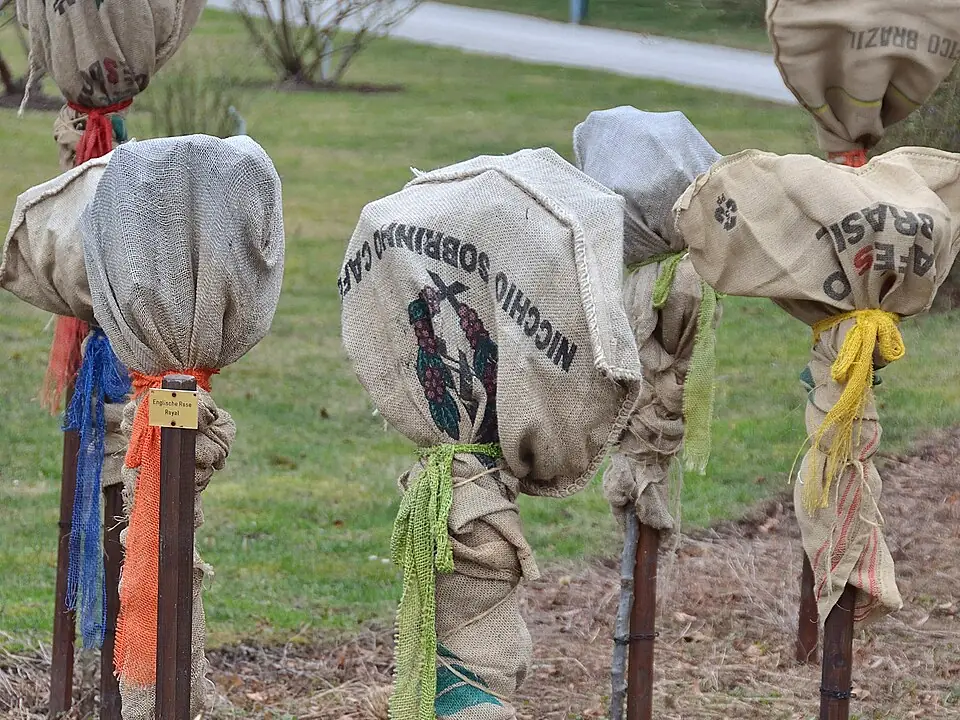

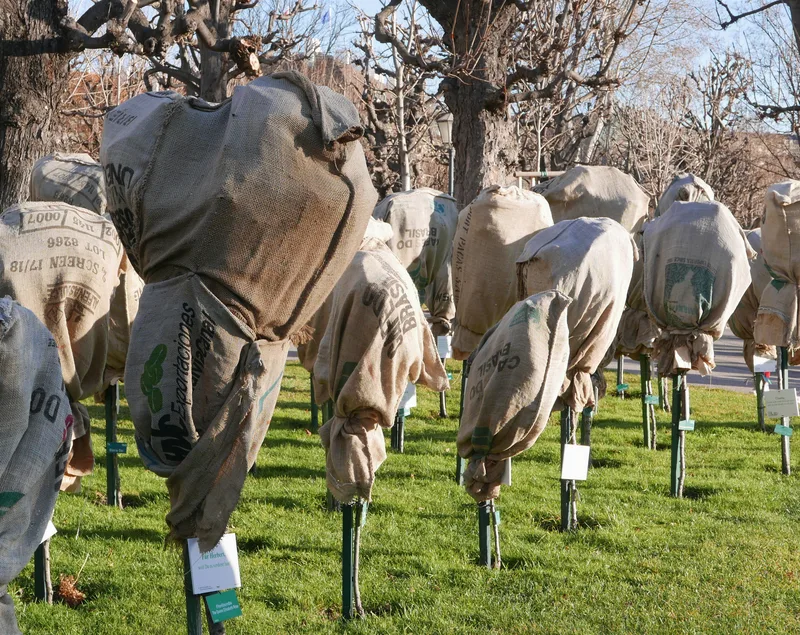
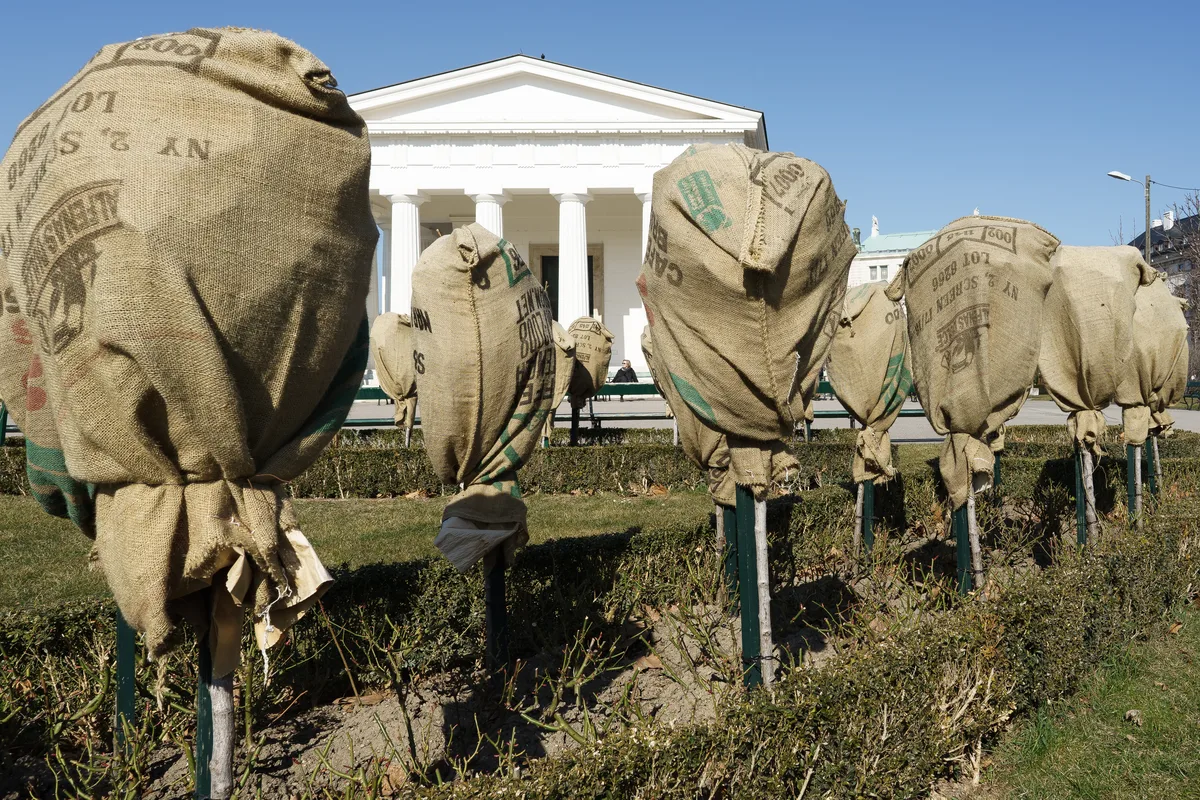
Grafted roses such as hybrid teas need help to get through a cold winter, and the timing matters as much as the method. Cover them too early and the warm, damp mound can cause stem cankers; too late and the soil is frozen. Here is when to start in your USDA zone, how to mound and mulch, and what changes for climbers, tree roses and roses in pots, from university extension rose guides.
Jump to: Which roses need it When to winterize Dates by zone Before you cover How to mound Rose cones Climbing and tree roses Roses in pots Spring
Which roses need winter protection?


| Rose type | Winter protection | Source |
|---|---|---|
| Hybrid tea, grandiflora, floribunda (grafted modern roses) | Mound 10 to 12 inches of soil or compost over the base, then mulch on top once it freezes | Iowa State, Missouri, Illinois |
| Old garden, shrub and species roses | Usually little or none; 2 to 4 inches of mulch after the first hard frost | Iowa State, University of Minnesota |
| Own-root roses | Depends on how hardy the rose is compared with your zone | Penn State |
| Climbing roses | Wrap the canes in place, or take them down, pin them to the ground and cover them | UNH, Iowa State |
| Tree (standard) roses | Protect the high graft union, or lay the whole plant down and cover it | Iowa State, Penn State |
| Roses in pots | Unheated garage or shed, or bury the pot in the ground | Penn State, Iowa State, Clemson |
About this table: Each row is summarized from the extension sources named in it; the sections below quote each one and link to it.
- Grafted modern roses need it most. Iowa State University Extension: “Most hybrid tea, grandiflora, floribunda, and other modern roses require protection during the winter months. Low temperatures and rapid temperature changes in winter can severely injure and sometimes kill unprotected modern roses.” The weak point is the graft union: “This graft union is particularly sensitive to cold temperatures and requires protection over the winter months.”
- Why the graft matters. Penn State Extension: “If the graft union is compromised, the part of the plant above that graft union will die.” University of Missouri IPM adds that in severe winters “the root system of unprotected plants might be the only part that survives”, and the suckers that grow back will not match the named rose.
- Hardy roses need little. Iowa State: “Most old garden roses possess excellent cold hardiness and don’t require winter protection.” University of Minnesota Extension says hardy shrub roses “rarely need elaborate winter protection; their genetics do the work.”
- Match the rose to your zone. Penn State: “A rose cultivar that has been specially bred to be hardy in Zone 4 will need little to no added protection when growing in a Zone 7b garden.” Own-root roses “may also need protection, depending on their hardiness compared with the garden’s hardiness zone.”
- The goal is steady cold, not warmth. UNH Extension: the main goal is “to keep the plant, especially the crown and lower portion of the canes, uniformly cold throughout the coldest winter months.” “Cold damage occurs due to plant tissues alternating between freezing and thawing”. Illinois Extension: “Wet and cold is far more damaging than dry and cold.”
When to winterize roses: after several hard freezes, before the soil freezes
The extension guides below agree on the rule: wait until the rose is dormant, after several hard (killing) freezes have dropped its leaves, and finish before the ground freezes.
- University of Missouri IPM: “Delay winterization until several “hard” (killing) frosts have occurred but before the soil freezes”. Covering early backfires: “mulch applied too early will keep the stem of the rose warm and moist”, which “encourages the establishment of stem cankers.”
- UNH Extension: “Avoid applying winter protection until hard frosts have killed any remaining leaves.” “Consider allowing rose plants to go through several nights with temperatures in the mid-teens to ensure dormancy prior to protecting.”
- Illinois Extension: “Wait until a hard killing frost has caused most of the leaves to fall. You may also want to wait until the temperature has dropped into the teens for several nights.”
- NDSU Extension: “Gardeners need to wait until the rose is completely dormant after several hard freezes.”
- Penn State Extension: “proceed with winter insulation only after several killing freezes to ensure that winter dormancy has been reached.”
What that looks like on the calendar, by state. Iowa State begins “in late fall (mid-November)”. In Missouri, MU Extension says “Early December is an ideal time to get rose plants ready for winter.” In the North Carolina Triad (zone 7), N.C. Cooperative Extension, Guilford County cuts roses back “after a few fall frosts have occurred, which is usually by the end of November or early part of December.” These are local examples; use your own freezes as the trigger.
First hard freeze dates by zone: the earliest you’d start
A hard freeze is 28°F or colder. The table shows when the first one typically arrives in each USDA zone. It is the earliest sensible start: the sources above say to wait for several hard freezes after it, then protect roses before the soil freezes. No source gives a fixed number of weeks, so watch your own weather.
| USDA zone | Typical first hard freeze (28°F), median | Earlier to later locations (10th–90th percentile) |
|---|---|---|
| Zone 3 | Oct 1 | Sep 19 – Oct 13 |
| Zone 4 | Oct 9 | Sep 29 – Oct 18 |
| Zone 5 | Oct 19 | Oct 5 – Oct 29 |
| Zone 6 | Oct 30 | Oct 17 – Nov 6 |
| Zone 7 | Nov 7 | Oct 28 – Nov 20 |
| Zone 8 | Nov 22 | Nov 11 – Dec 4 |
| Zone 9 | Dec 16 | Dec 1 – Jan 2 (in 17% of zone 9 ZIP codes with a frost date, the nearest station reaches 28°F in fewer than half of years) |
| Zone 10 | Hard freeze rare: 90% of the zone 10 ZIP codes that have a frost date have no 50% 28°F date | — |
| Frost rare | — |
About this table: For each ZIP code we use the nearest NOAA NCEI 1991–2020 U.S. Climate Normals station’s 50%-probability first-fall date for 28°F (data/zonefreeze28.json), summarized by USDA zone across ZIP codes (median ZIP, plus the earliest and latest 10% of ZIPs). We use a station’s 28°F date only when it records 28°F in at least half of years. This is our data summary, not an extension recommendation. Source: NOAA NCEI U.S. Climate Normals. Enter your ZIP in the planner for the dates at your nearest NOAA station.
More on hard freezes: first hard freeze (28°F) dates by zone.
Before you cover: stop feeding, clean up and trim lightly
- Let the rose slow down. Clemson HGIC: “Stop fertilizing your roses six weeks before your expected first frost date.” Illinois: “stop dead-heading or cutting flowers after October 1 and allow the plant to form hips.”
- Water before the ground freezes. Penn State Extension says to “water thoroughly late in the season, after the first frost, but before the ground freezes.” Clemson: as it gets cold, “reduce the amount of water, but do not allow roses to completely dry out.”
- Clean up. Iowa State University Extension: “Removal of diseased plant debris will help reduce disease problems next season.” Penn State: “Dispose of and do not compost diseased leaves and plant parts.”
- Tie the canes. Iowa State says to “Loosely tie the canes together with twine to make working around the plants easier and prevent the canes from being whipped by strong winds.”
Should you cut back roses in fall? Only lightly. UNH Extension: “Heavy fall pruning of bush roses could mean loss of the entire plant in the event of a severe winter.” Leaving 18 to 24 inches of healthy cane under the mulch, it says, gives you new growth and healthy canes in spring. It does advise cutting “extremely long stems back to prevent their whipping about in winter winds”, and sums it up: “A good rule for tea roses is to cut less in the fall and more heavily in the spring.” How far down differs by source: University of Minnesota Extension cuts hybrid teas “back to 24-30 inches after hard frosts to prevent wind rock”; Clemson says “To prevent wind damage on large bushes, cut the canes back to 3 feet.” For other perennials, see which perennials to cut back in fall.
How to mound (hill) roses for winter
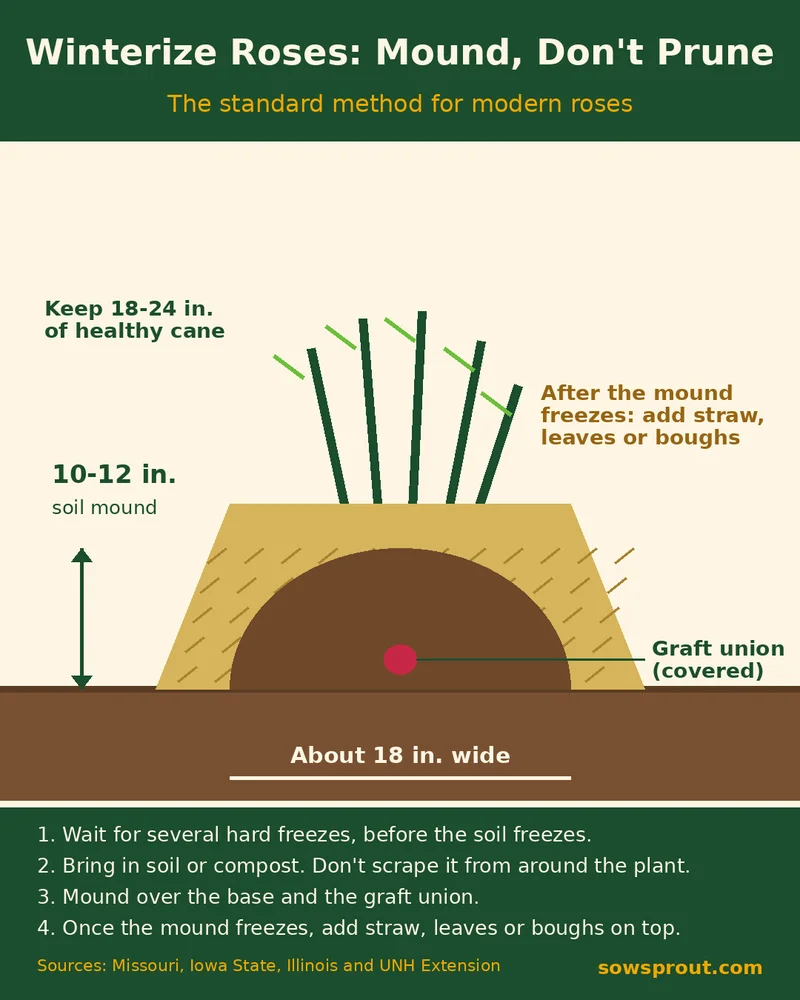
Mounding soil or compost over the base of the plant is the standard method for grafted roses. It keeps the graft union and the lower canes at a steady temperature.
- Build the mound. Iowa State University Extension: “Cover the bottom 10 to 12 inches of the rose canes with soil.” University of Missouri IPM: “form a mound about 10 to 12 inches high and 18 inches wide at the base of the plant, covering the stem and bud union.”
- Bring the soil in. Illinois Extension: “Soil that is used to “hill-up” plants should be brought in from outside the rose garden. Scraping up soil from around the plant can cause root injury and lessen the plant’s chance for survival.” Penn State suggests “a 12-inch-deep mound of well-draining compost, potting mix, clean soil, or aged manure”.
- Mulch on top once it freezes. Illinois: “After the soil mound has frozen, the mound can be covered with evergreen boughs, hardwood leaves, or straw to help insulate and keep the soil frozen.” Iowa State: “Typically 1 to 2 feet of material loosely packed is sufficient.”
- Keep it in place. Iowa State: “A small amount of soil placed over the straw or leaves should hold these materials in place. Alternatively, wire fencing can hold the loose mulch material in place.” Missouri: “Additional mulch may need to be added during the course of the winter should the original application settle.”
- Or use a collar. Illinois: “An 18-inch-high circle of hardware cloth or chicken wire is placed around the plant. The collar is filled with soil, allowed to freeze and then mulched with straw.” Its benefit: “it holds the soil in place all winter”.
Rose cones: use with care
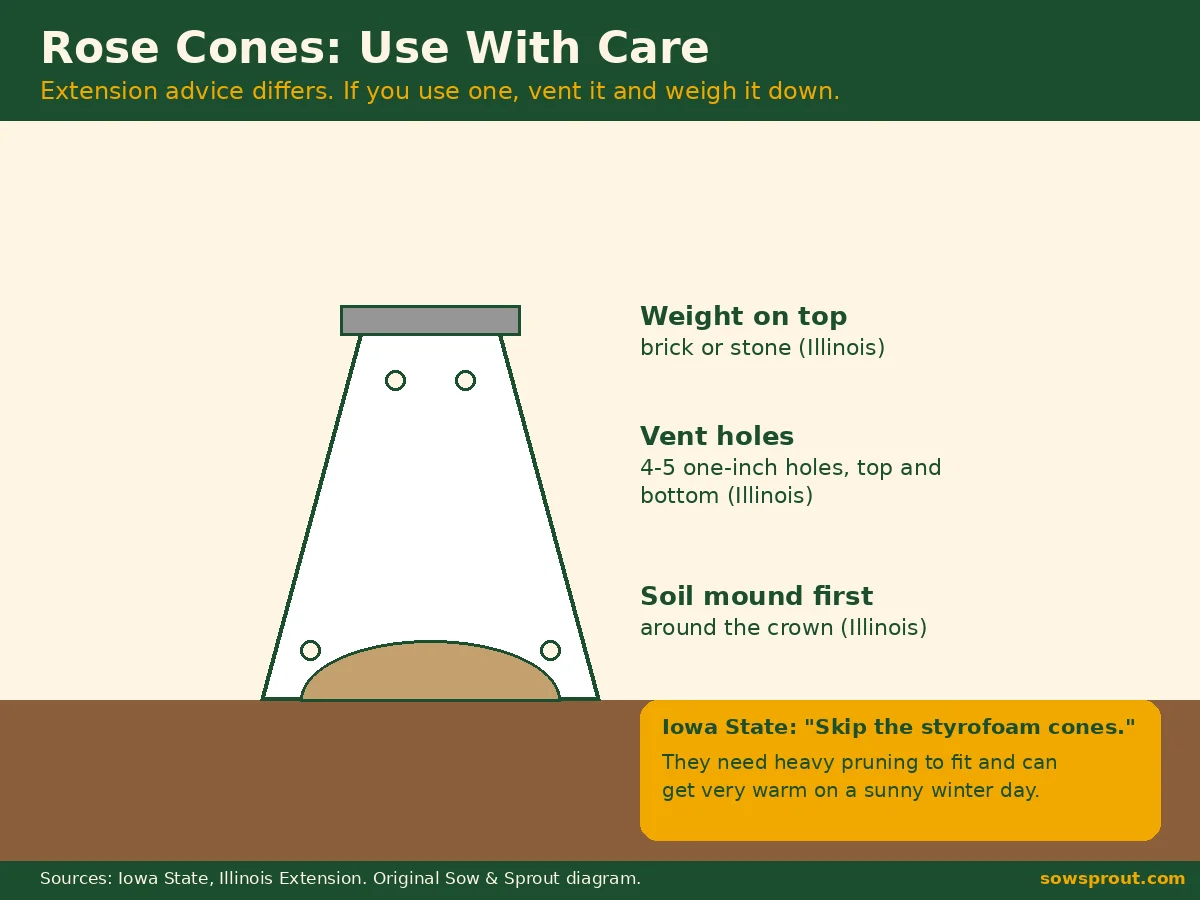
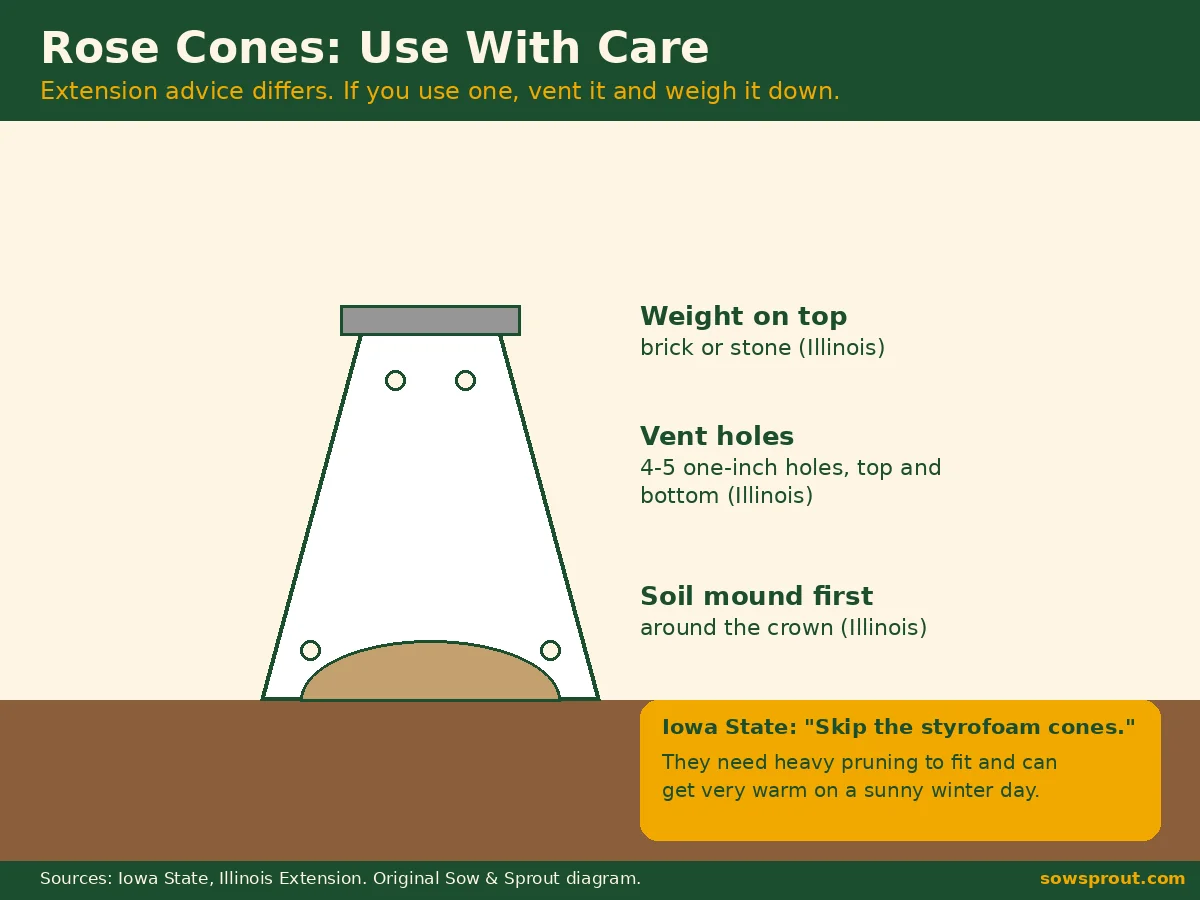
Iowa State University Extension says “Skip the styrofoam cones.” Fitting a rose inside takes heavy pruning, and “These cones can also get very warm on a sunny winter day.” NDSU Extension adds that “The cone traps moisture that can lead to rotting.”
If you do use cones, Illinois Extension says to wait as you would for other methods, and “Cut four to five 1-inch holes around the top and bottom of the cone.” It also advises mounding “soil around the crown of the plant before putting the cone in place” and weighting the cone “with a brick or stone to keep it from blowing away.”
How to protect climbing roses and tree roses in winter


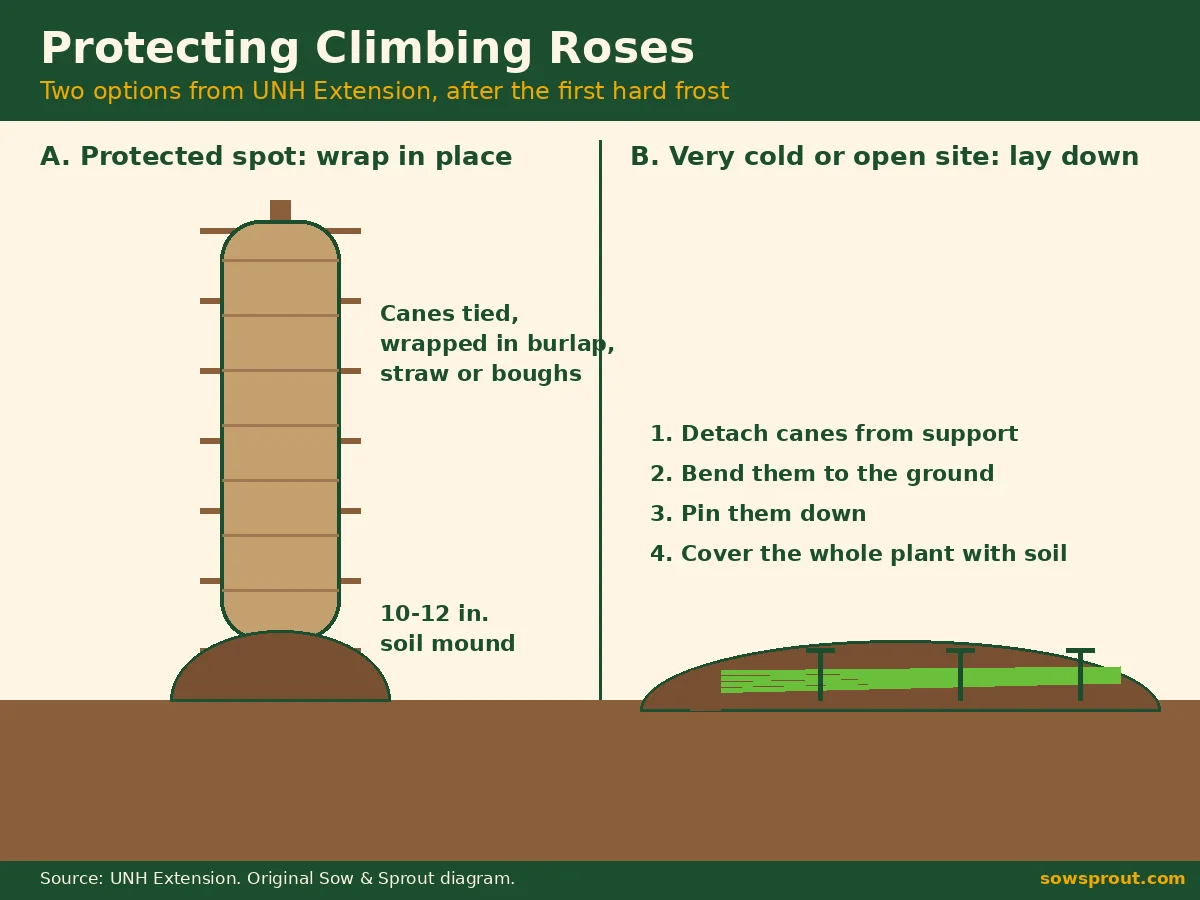
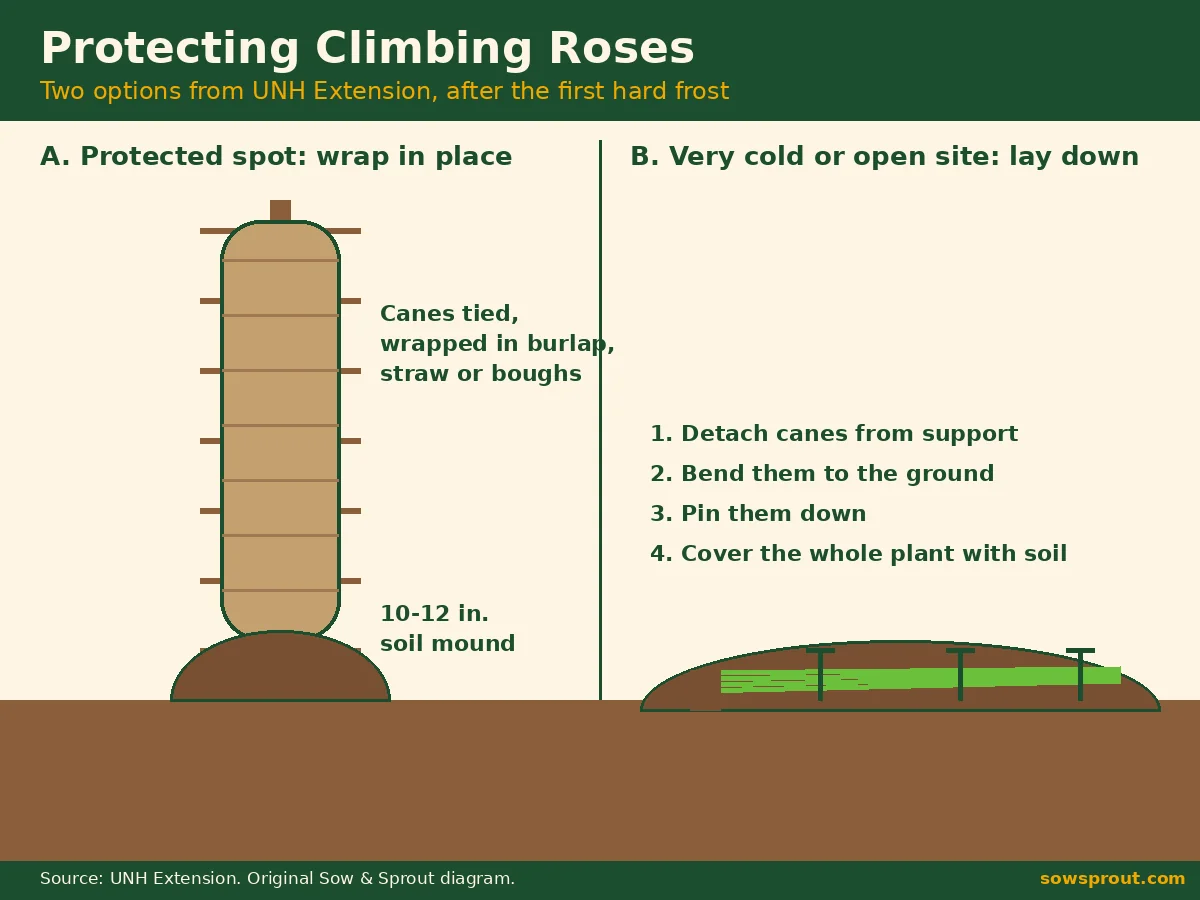
- Climbers in a sheltered spot: UNH Extension says to “secure canes to their support and prune off long ends. Next, wrap the canes in burlap, straw, or evergreen boughs and tie with twine. Mound 10”-12” of soil around the base of the plant.”
- Climbers in cold or open spots: UNH says “the best way to protect a climbing rose is to shield the entire plant with earth.” Iowa State University Extension describes it for climbers that aren’t reliably hardy: “remove the rose from its trellis or climbing structure. Carefully bend the canes to the ground. Gently pin the rose down and cover the canes with several inches of soil and a layer of mulch.”
- Hardy climbers: University of Minnesota Extension: “Skip heavy pruning until spring. Tie canes securely against wind. Mulch the base as you would a shrub rose.”
- Tree (standard) roses: Penn State: their “graft union for rose standards may be more than three feet above the ground”, so “The stem, bud union, and several inches of the canes emerging from the graft will need to be protected.” One option is wrapping the cut-back head and fencing the stem with leaves or straw; the other is to lay the whole plant down. Iowa State lays it down in early to mid-November and covers “the partially exposed root ball, trunk, and all the stems with 10 to 12 inches of soil.”
The Minnesota Tip (coldest zones). University of Minnesota Extension: “after several hard frosts but before the ground freezes, lay the plant into a shallow trench and cover with soil.” NDSU Extension explains the steps: tie the canes, dig a trench next to the plant, loosen the roots on the far side with a spading fork and tip the rose in. “If done correctly, only the roots will bend.” Then “After the soil has frozen, cover with another foot of leaves or straw.”
Winterizing roses in zone 7 and warmer
Where winters are milder, the job is lighter. N.C. Cooperative Extension, Guilford County: “For zone 7 roses, cover the graft union with about 5-6” of pine, mushroom compost, or hardwood mulch.” The base of tender rose bushes can also be mounded with 10 to 12 inches of soil, which it calls particularly important for grafted roses. It prunes “only to 36” high” in late fall and says “Heavy pruning occurs in February.” Clemson HGIC recommends “A 3-inch mulch of pine straw, leaves, pine bark, or wood chips” and “Leave some space clear of mulch against the stem.” University of Missouri IPM says winterizing shrub roses such as “‘Knock Out’ is not necessary at our latitude.”
How to winterize roses in pots
- Why pots need it. Iowa State University Extension: “Potting soil temperatures in containers left above ground are likely to get extremely cold, damaging or destroying the roots of the rose.”
- Easiest option. Penn State Extension: “Moving the entire container into an unheated garage or shed is the easiest option.” Otherwise wrap the container and several inches above the rim in big-bubble bubble wrap, or fence it and fill with leaves or straw.
- Bury the pot. Penn State says smaller pots can go in the ground “once the plant is dormant and before the ground freezes.” Iowa State does this “in late autumn before the ground freezes but after the plant has gone dormant (mid to late November)”, then covers the bottom 6 to 8 inches of the canes with soil. Clemson HGIC: “Roses grown in containers need to be put in the ground, container and all, in a protected area of the yard.”
More on containers: when to bring potted plants inside.
When to uncover roses in spring
Penn State Extension: when winter lows “are not forecasted to dip below 20°F”, start removing the mound. “This may take several attempts as lower layers may still be frozen and need to thaw before removal.” Iowa State removes everything “after the ground thaws in the spring - typically sometime between mid-March and early April in Iowa.” Save the main pruning for spring: UNH’s rule is to cut less in fall and more in spring.
More guides
How to protect shrubs in winter How to protect young trees in winter First hard freeze dates Which perennials to cut back in fall All shrub guides
Frequently asked questions
When should I winterize my roses?
After several hard (killing) freezes have dropped the leaves and the rose is dormant, but before the soil freezes (University of Missouri; Illinois Extension; Penn State Extension). Covering too early keeps the stems warm and moist, which encourages stem cankers. Your zone’s typical first hard freeze is the earliest start; the table above lists it.
Do Knock Out roses need winter protection?
University of Missouri Extension says winterizing shrub roses such as ‘Knock Out’ is not necessary in Missouri. In general, hardy shrub roses rarely need elaborate protection (University of Minnesota Extension); 2 to 4 inches of mulch after the first hard frost is enough. In colder zones, check that the rose is rated hardy for your zone (Penn State Extension).
Should I cut back roses in the fall?
Only lightly. UNH Extension warns that heavy fall pruning of bush roses can cost you the plant in a severe winter; leave 18 to 24 inches of healthy cane under the mulch and cut only extremely long stems that would whip in the wind. Do the main pruning in spring.
How do you cover roses for winter?
Mound 10 to 12 inches of soil or compost over the base of the plant, bringing the soil in rather than scraping it from around the roots. Once the mound freezes, add evergreen boughs, leaves or straw on top (Iowa State; Illinois Extension; University of Missouri).
Are rose cones a good idea?
Iowa State says to skip styrofoam cones: they need heavy pruning to fit and can get very warm on sunny winter days. If you use them, Illinois Extension says to cut four to five 1-inch ventilation holes, mound soil around the crown first and weight the cone down.
How do I winterize roses in pots?
Move the pot into an unheated garage or shed, or bury the pot in the ground once the rose is dormant and before the ground freezes, then mound soil over the base (Penn State Extension; Iowa State). Potted roses left above ground can have their roots badly damaged by cold.
Sources
- Iowa State University Extension: How to Overwinter Roses (Yard and Garden); How should I prepare my hybrid tea roses for winter?
- Penn State Extension: Protecting Your Roses through Pennsylvania Winters
- University of Missouri IPM: Winterizing Roses (Missouri Environment and Garden)
- University of Minnesota Extension: Autumn rose care in Minnesota
- UNH Extension: Winter Protection of Roses (fact sheet)
- University of Illinois Extension: Roses: Care
- North Dakota State University Extension: Dakota Gardener: Winter protection for tender roses
- University of Missouri Extension: Winterize roses in December
- NC State Extension: Prepping Roses for Winter
- NOAA National Centers for Environmental Information: U.S. Climate Normals 1991–2020
- Clemson Cooperative Extension: Growing Roses (HGIC 1172)