
How to Grow Broccoli: Planting, Spacing, Care & Harvest
Quick answer
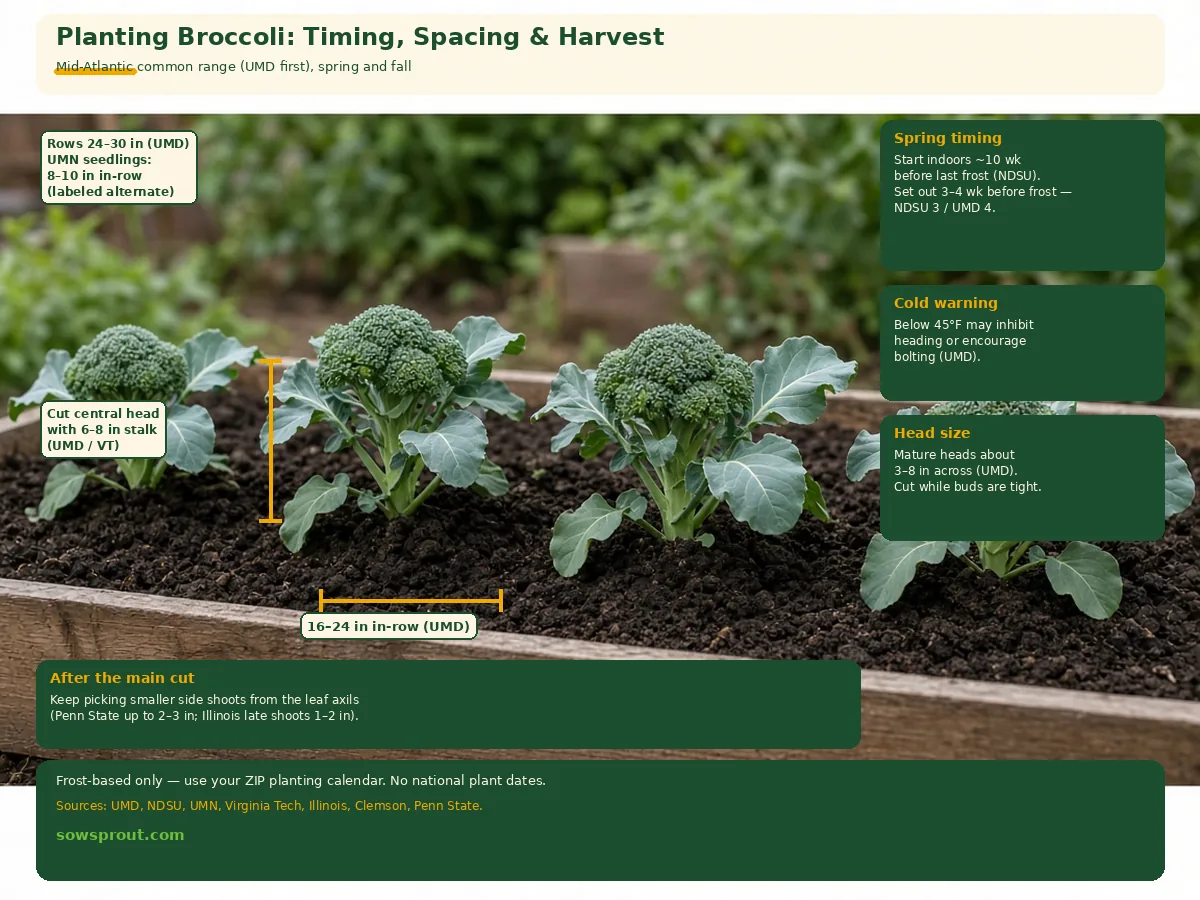
Broccoli is a cool-season crop grown for its tight green flower buds. For spring, start seeds indoors about 10 weeks before your last frost and set hardened transplants out about 3 to 4 weeks before that frost date (NDSU chart: 3 weeks; UMD: 5- to 7-week-old transplants 4 weeks before), or buy young, sturdy transplants. Space plants about 16 to 24 inches apart in the row with 24 to 30 inches between rows. Keep the soil evenly moist, especially as heads form. Cut the central head while the buds are still tight, before any yellow flowers show, then keep picking the smaller side shoots for weeks. In the Mid-Atlantic, a summer-planted fall crop often yields more than spring. Use the ZIP planting calendar for your local frost dates rather than a national plant date.

Broccoli at a glance


Weeks relative to last frost (LF). Colored weeks show when our ZIP planner schedules each step.
Jump to
Updated
Broccoli is a cool-season crop grown for its tight green flower buds. For spring, start seeds indoors about 10 weeks before your last frost and set hardened transplants out about 3 to 4 weeks before that frost date (NDSU chart: 3 weeks; UMD: 5- to 7-week-old transplants 4 weeks before), or buy young, sturdy transplants. Space plants about 16 to 24 inches apart in the row with 24 to 30 inches between rows. Keep the soil evenly moist, especially as heads form. Cut the central head while the buds are still tight, before any yellow flowers show, then keep picking the smaller side shoots for weeks. In the Mid-Atlantic, a summer-planted fall crop often yields more than spring. Use the ZIP planting calendar for your local frost dates rather than a national plant date.
Planting dates for your ZIP: use the ZIP planting planner and frost dates / planting calendars. No national plant date. Sister brassica: how to grow cabbage. Cool-season: lettuce, garlic.
Organic pests, diseases and fertilizer: see how to grow broccoli organically. Use any product as the label directs.
Spring vs fall timing
Set-out weeks disagree — do not average. NDSU H1139: start indoors about 10 weeks before last frost, set out about 3 weeks before that frost (NDSU H1139). UMD: “Five to seven-week-old transplants are set out four weeks prior to the last frost date in spring.” Publish the band as 3 to 4 weeks before frost and label both sources. UMD also warns “Temperatures below 45°F may inhibit heading or encourage seed stalk formation (bolting).”.
Cool-season crop: UMD rates broccoli hardy (heavy frosts in spring and fall). Clemson prefers about 65–75°F; VT often cites 60–65°F. Clemson: spring broccoli must be planted early enough to harvest before heat. Illinois: late spring plantings and a weak start push yellow flowers early. UMN: hot weather (about 86°F days and over 77°F nights) can cause plants to grow no crown.
Fall crop (regional — attribute, link ZIP tools): UMD “Fall broccoli often produces higher yields than spring plantings in the mid-Atlantic region.”. UMD “Seeds can be sown directly in mid-July for a fall harvest or transplants are set out by the first week in August.” UMN: “For the fall crop, start seeds indoors or out, in early to late July.” UMN also says to “choose varieties with a longer growth cycle of 60 to 85 days so that the heads are forming in cooler temperatures.”. Illinois: count backward from first fall frost and add about 10 to days-to-harvest from transplants. Those month windows are regional, not a national calendar date.
Transplants
Buy or grow. Penn State: a good transplant is five or six weeks old, sturdy, not leggy, hardened off. NC State: “Large transplants are much more susceptible to buttoning, so look for plants with no more than four to six leaves” (NC State Extension). UMN: plant at the same soil line as in the pot; harden off over about a week. Illinois may set transplants slightly deeper. Water thoroughly at set-out (Clemson). Rotate away from cabbage-family crops about three to four years (UMN / Penn State). Starter fertilizer language points to a soil test — no product rates here.
Spacing
Lead with Mid-Atlantic UMD; attribute UMN 8–10 in and other bands — do not average. UMD: “16"- 24" in-row x 24" - 30" between rows.”. UMN: “Place the seedlings eight to 10 inches apart”. Virginia Tech about 15–24 × 24–36; Illinois 18–24 in-row with 36 in between rows, or about 1 foot apart in all directions in beds; Clemson about 1½–2 ft in-row with rows about 3 ft; Rutgers planning table often 15 × 30. Plants often reach about 2½ feet (Illinois).
Watering and mulch
UMN: “To produce sweet, flavorful, firm, non-bitter heads, the plants must not experience water stress.” “If the planting does not receive one inch of rain each week, soak the soil thoroughly at least once a week.” Water sandy soil more often. UMD: keep the root zone moist; water more as heads begin to develop. Clemson: moisten soil to at least 6 inches; light sprinkles encourage shallow roots. Critical periods: establishment and head development. Roots are shallow (UMD) — cultivate carefully or mulch about 3–4 inches (UMN).
Buttoning, bolting, and hollow stem
Buttoning (tiny heads early): NC State “Excessive cold, nutrient deficiency, or drought stress (usually soon after planting) can cause buttoning. Large transplants are much more susceptible to buttoning, so look for plants with no more than four to six leaves”. UC IPM: “Buttoning can also be caused by insufficient water, a shortage of nitrogen, excessive salt, or weed competition” (UC IPM).
Bolting / early yellow flowers: UMD chill below 45°F can inhibit heading or encourage bolting. Clemson: 10 or more consecutive days at about 35–50°F after favorable growth can bolt cole crops — labeled separately from the UMD 45°F note, not averaged. Heat also opens yellow flowers early (Illinois) or can stop crown formation (UMN).
Hollow stem: Clemson calls it the most common broccoli problem; the non-decayed type ties to excess nitrogen, warmth, too much water, and low soil pH. Proper spacing, planting dates, and nutrient management help — point to a soil test and organic broccoli; no product rates here.
Harvest and side shoots
UMD: “The heads of broccoli are really flower buds that must be harvested before the flowers open or show yellow.” “Cut the central head (large terminal bud cluster) before flowers open, then cut small side bud clusters as flowers develop over the following weeks. Harvest with 6 to 8 inches of stalk.” Mature heads about 3–8 inches across (UMD); other guides often cite 3–6 or 4–6 inches — publish as a band.
UMN: “After you harvest the main head, smaller side shoots will grow for another harvest.” Penn State: side shoots may reach about 2–3 inches. Illinois: you usually can keep harvesting for several weeks. Days to maturity: UMD “55 - 65 from transplanting, longer for fall crop”; Clemson about 50–90 after transplant; VT about 60–100 — publish as a band. Fridge for a few days at home; UMD also notes very cold moist storage about 10–14 days and that broccoli can be blanched and frozen.
Containers
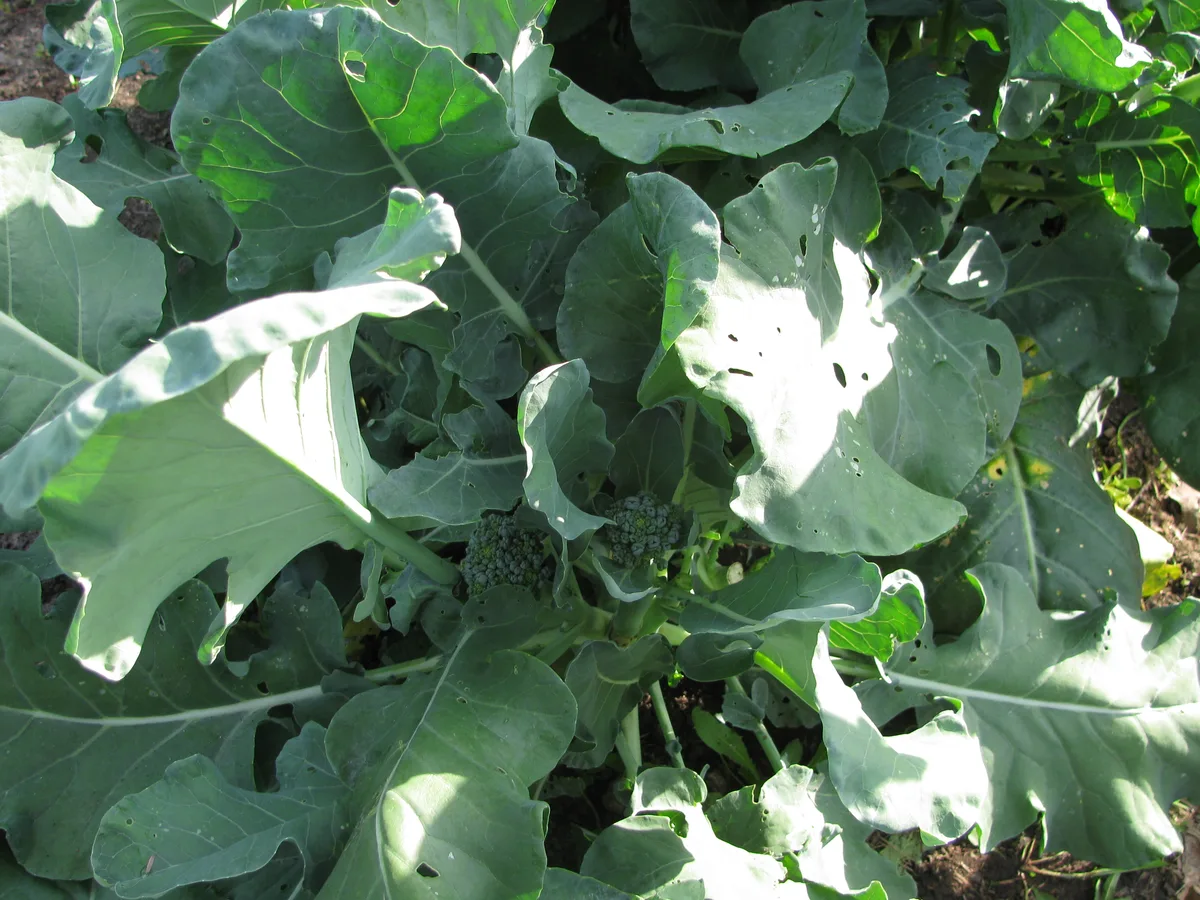
UMD Extension shows a healthy broccoli plant ready to harvest in a 5-gallon food-grade bucket (UMD Extension). That is a photo caption, not a published minimum pot size — no extension source here lists a broccoli container minimum. Keep moisture steady; pots dry fast.
Common failure reasons
| Problem | What extensions say |
|---|---|
| Tiny heads / buttons | Overgrown or stressed transplants; cold; drought; low nutrients (NC State, UC IPM, Illinois, UMN) |
| Yellow flowers early | Heat; planting too late in spring (Illinois); chill-related bolting (UMD, Clemson) |
| No crown | Hot weather ~86°F days / 77°F+ nights; pests such as Swede midge (UMN) |
| Bitter / small / off-flavor | Water stress (UMN) |
| Hollow stem | Excess N, warmth, too much water, low pH (Clemson) |
| Loose uneven spring heads | Temperature swings (Clemson) |
Pests (cabbageworms, flea beetles, clubroot, etc.): cultural notes only here — full IPM on organic broccoli. No fertilizer product rates. UMD Extension · UMN Extension · Illinois Extension · Virginia Tech SPES-792 · Clemson HGIC · Penn State Extension
Frequently asked questions
When should I plant broccoli?
In spring, start seeds indoors about 10 weeks before your last frost and set transplants out about 3 weeks (NDSU) to 4 weeks (UMD) before that frost — do not average those set-out weeks into one number. For fall in the Mid-Atlantic, UMD: seeds can be sown directly in mid-July or transplants set out by the first week in August. Check your ZIP planting calendar.
When should you plant broccoli for a fall harvest?
Illinois: count backward from the first fall frost and add about 10 to the days to harvest from transplants. UMN: start seeds indoors or out in early to late July, and choose types with a longer 60- to 85-day cycle so heads form in cooler weather. UMD: fall broccoli often yields more than spring in the mid-Atlantic.
How far apart should you plant broccoli?
UMD: 16 to 24 inches in the row and 24 to 30 inches between rows (Mid-Atlantic lead). UMN: place seedlings 8 to 10 inches apart. Illinois: 18 to 24 inches in the row with 36 inches between rows, or about 1 foot apart in beds. The sources differ — do not average them.
Why are my broccoli heads so small?
That is buttoning. NC State: excessive cold, nutrient deficiency, or drought stress soon after planting can cause it, and large transplants are more prone — look for plants with no more than four to six leaves. UC IPM also lists insufficient water, nitrogen shortage, salt, or weed competition.
Why is my broccoli flowering before the head gets big?
Illinois: yellow flowers may appear before heads are ready in high heat; planting too late in spring or a weak start contributes. Clemson: prolonged cold (10+ days at about 35–50°F) after good growth can also cause bolting.
When is broccoli ready to harvest?
Illinois: harvest when the head is large and firm with a compact cluster of small flower buds and none open enough to show bright yellow. UMD: mature heads measure about 3 to 8 inches across. Cut with about 6 to 8 inches of stalk (UMD).
Does broccoli grow back after you cut it?
Yes, as side shoots. UMN: many smaller heads form after you remove the central head. Penn State: side shoots can grow as large as 2 to 3 inches. Illinois: you usually can continue harvesting for several weeks.
How long does broccoli take to grow from seed to harvest?
UMD: 55 to 65 days from transplanting, longer for a fall crop, and transplants go out at five to seven weeks old. Clemson: about 50 to 90 days after transplanting depending on type. Publish as a band — do not invent one national day count.
How much water does broccoli need?
UMN: if rain does not supply about 1 inch a week, soak thoroughly at least once a week; water sandy soil more often. UMD: water more frequently when heads begin to develop. Keep moisture even to avoid bitter, small heads.
Can broccoli handle frost?
UMD rates broccoli hardy — it can withstand heavy frosts in spring and fall. UMN: it will continue to grow after the first light frosts in fall. But UMD warns temperatures below 45°F may inhibit heading or encourage bolting.
Why is my broccoli stem hollow?
Clemson: hollow stem is the most common problem in broccoli. The non-decayed type is tied to excess nitrogen, warm temperatures, too much water, and low soil pH. Proper spacing, planting dates, and nutrient management help — soil-test; no product rates here.
Can you grow broccoli in a pot?
UMD Extension shows a healthy broccoli plant ready to harvest growing in a 5-gallon food-grade bucket. No extension source checked here publishes a minimum pot size for broccoli. Keep moisture steady — pots dry fast.
More grow guides: Cabbage · Lettuce · Garlic · Tomatoes · Peppers · Beans · Potatoes · Cucumbers · Squash · All grow guides
Sources
- North Dakota State University Extension: NDSU H1139
- NC State Extension: Frequently asked questions vegetables
- University of California Agriculture and Natural Resources (UC ANR): Buttoning in broccoli and cauliflower
- University of Maryland Extension: UMD Extension; UMD Extension
- University of Minnesota Extension: UMN Extension
- University of Illinois Extension: Broccoli
- Virginia Cooperative Extension (Virginia Tech): Virginia Tech SPES-792
- Clemson Cooperative Extension: Clemson HGIC
- Penn State Extension: Cole crops for the home vegetable garden