
How to Grow Beans: Planting, Spacing, Care & Harvest (Bush and Pole)
Quick answer
Sow bean seed straight into the garden after the danger of frost has passed and the soil has warmed (Clemson: at least 60°F at a 4-inch depth), about 1 inch deep; beans do not do well as transplants. Space bush beans about 2 to 4 inches apart in rows 2 to 3 feet apart, and sow pole beans about 4 inches apart along a sturdy 6- to 8-foot trellis, or put 2 to 4 seeds at the base of each pole. Re-sow bush beans every 2 to 3 weeks through mid-to-late July for a steady harvest; pole beans keep flowering until frost. Aim for about 1 inch of water a week, watering more once pods form, skip extra nitrogen (too much delays flowering), and pick snap beans before the seeds bulge in the pod.

Beans at a glance


Weeks relative to last frost (LF). Colored weeks show when our ZIP planner schedules each step.
Jump to
Updated
Sow bean seed straight into the garden after the danger of frost has passed and the soil has warmed (Clemson: at least 60°F at a 4-inch depth), about 1 inch deep; beans do not do well as transplants. Space bush beans about 2 to 4 inches apart in rows 2 to 3 feet apart, and sow pole beans about 4 inches apart along a sturdy 6- to 8-foot trellis, or put 2 to 4 seeds at the base of each pole. Re-sow bush beans every 2 to 3 weeks through mid-to-late July for a steady harvest; pole beans keep flowering until frost. Aim for about 1 inch of water a week, watering more once pods form, skip extra nitrogen (too much delays flowering), and pick snap beans before the seeds bulge in the pod.
Planting dates for your ZIP: use the ZIP planting planner and frost dates / planting calendars. After frost risk is past and soil has warmed (Clemson: at least 60°F at a 4-inch depth). No national plant date.
Organic pests and diseases: see organic pest control for beans. Use any product as the label directs.
When and how to plant
Beans are tender annuals. UMD: “Seed after danger of frost is past.” Clemson: do not plant before soil is at least 60ºF at the 4-inch depth; plants are killed by light frost. UMN: seed planted in cold soil may rot rather than germinate. Direct sow — don’t transplant. Clemson: “Beans, corn, and carrots do not do well as transplants and should be planted directly from seed into the garden.”
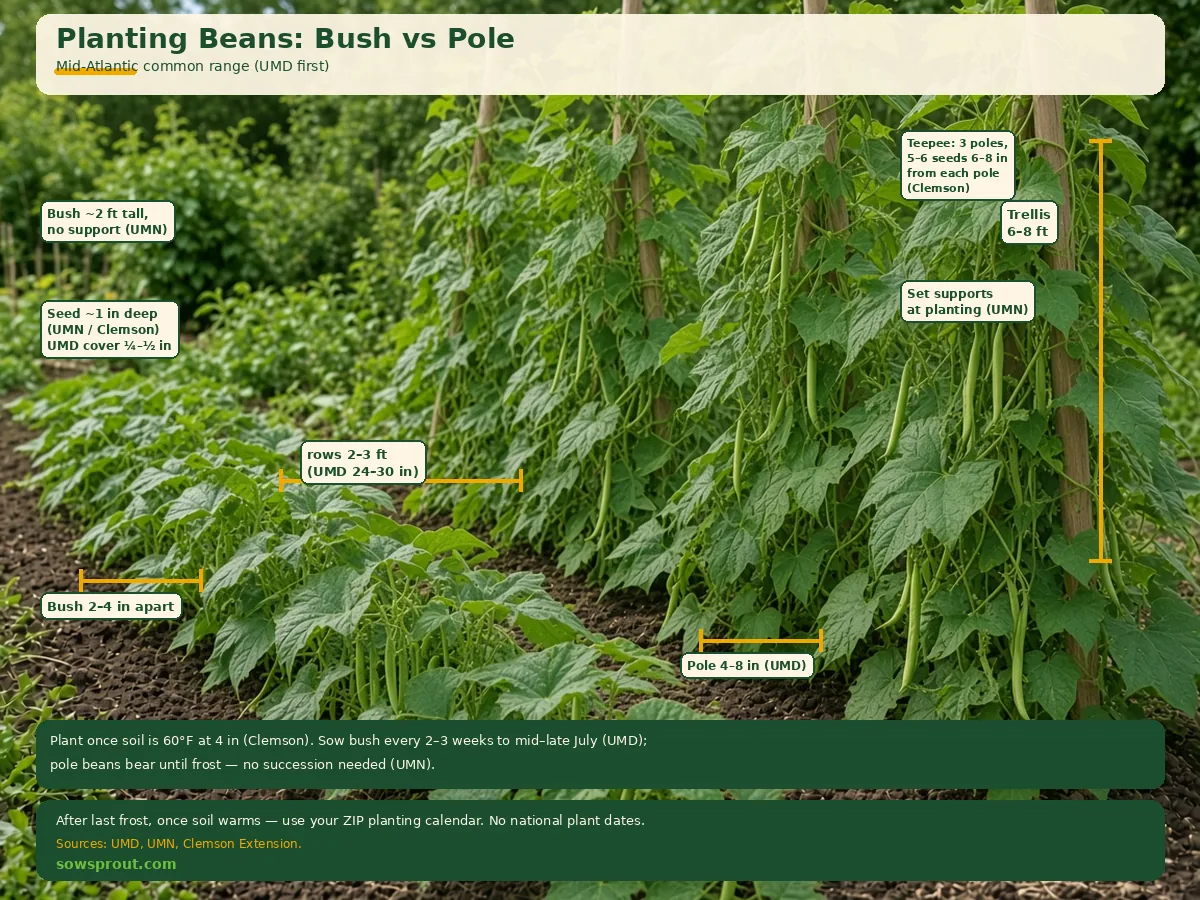
Seed depth — do not average. UMN: “Plant seeds about an inch deep, or according to package directions. Plant small-seeded beans more shallowly than larger seeds.”. Clemson: all beans about 1 inch deep. UMD covers seed with 1/4 to 1/2 in. of soil or compost. Keep soil moist, not soaking, until seedlings emerge. Full sun at least 6 hours (prefers 8–10).
Bush vs pole beans
| Bush beans | Pole beans | |
|---|---|---|
| Habit | Upright, about 2 ft, no support (UMN) | Twining vines; need 6–8 ft trellis |
| Harvest | Short window; big harvest at once (canning/freezing) | Flower and produce all season; higher yields in less space (UMD) |
| Days | Snap 50–60 (UMD) | 60–110 (UMD) |
| Succession | Re-sow every 2–3 weeks through mid-to-late July (UMD) | Not needed — bears until frost (UMN) |
UMN: “Pole beans will continue to flower and bear until frost, so there is no need for succession planting.”. Half-runners (~3 ft) are generally grown like bush beans; a short trellis may raise yield (UMD, Clemson). Put supports in at planting (UMN).
Spacing
- Bush beans (UMN): “single or double rows, with seeds four inches apart and rows two to three feet apart”. UMD/Clemson also use 2–4 inches in-row; UMD rows 24–30 in.
- Pole beans (UMN): “Plant seeds four inches apart or two to four seeds at the base of each pole.”. UMD: 4–8 in in-row × 24–36 in between rows.
- Clemson teepee: three poles; five or six seeds in a circle 6–8 inches from each pole.
UMN Extension · UMD Extension · Clemson HGIC
Feeding (no rates)
UMD: “Excess nitrogen will delay flowering; side-dressing is usually not necessary.” Beans fix nitrogen once a good root system is established. UMN: bean plants do not need as much fertilizer as other crops; start with compost/soil test. Do not print fertilizer product rates.
Watering
UMN: “One inch of rainfall per week is good.”. UMD: “Water more frequently when pods begin to develop.”. Clemson: critical period is pod set and pod development; water in the morning so foliage is dry before dark; soak deeply rather than sprinkle.
Harvest cues
- “Pick snap beans before the individual seeds inside the pods bulge.”
- “Pick shelling beans when the pods are thin and tough, but not dry.”
- “Pick dry beans when the pods are dry and the beans inside rattle.”
UMD: “Pick snap beans regularly to keep plants producing heavily.”. Refrigerate fresh beans up to about a week; freeze well after a brief blanch (UMD).
Heat, flower drop and poor pod set
UMN: “when the weather is extremely hot during flowering, bean plants may not set fruit”. Clemson: blossom drop may be a problem above about 90ºF; plants usually set more pods when days cool. Also check excess nitrogen (UMD) and dry soil at pod set (Clemson).
Common problems
UMD/UMN/Clemson name bacterial blight, Mexican bean beetle, spider mites, powdery mildew, root rot and more. No spray recipes here — ask your local extension clinic. Weeds: shallow cultivate in the first six weeks; mulch 3–4 inches (UMN) without deep cultivation that cuts surface roots.
Frequently asked questions
When should I plant beans?
After the danger of frost has passed and the soil has warmed — Clemson says at least 60°F at a 4-inch depth. Cold soil can make seed rot (UMN). Check your ZIP's frost dates for timing.
Can I start beans indoors and transplant them?
It's better not to. Clemson: Beans, corn, and carrots do not do well as transplants and should be planted directly from seed into the garden.
How deep do you plant bean seeds?
About 1 inch (UMN, Clemson), shallower for small seeds (UMN). UMD covers seed with ¼ to ½ inch of soil or compost — that cover band is not averaged with the 1-inch guides.
How far apart should you plant bush beans and pole beans?
Bush beans: 2 to 4 inches apart in rows 2 to 3 feet apart (UMD, UMN, Clemson). Pole beans: about 4 inches apart (UMD says 4 to 8), or 2 to 4 seeds at the base of each pole (UMN).
Bush or pole beans: which should I grow?
Bush beans need no support and give one big harvest, which suits canning and freezing. Pole beans need a 6- to 8-foot trellis but keep producing all season and use less ground (UMN, UMD).
How often should I plant beans for a steady harvest?
Sow bush snap beans every 2 to 3 weeks from the frost-free date through mid-to-late July (UMD). Pole beans keep bearing until frost, so they don't need succession sowing (UMN).
How much water do green beans need?
About 1 inch a week (UMN). Water more once pods start forming (UMD); pod set and pod growth are the critical period (Clemson).
Do beans need fertilizer?
Less than most crops (UMN). Beans fix nitrogen, and excess nitrogen delays flowering (UMD). Start with a soil test (Clemson, UMN). No product rates on this page.
When should you pick beans?
Snap: before seeds bulge in the pod. Shelling: pods thin and tough but not dry. Dry: pods dry and beans rattle (UMN).
Why are my beans flowering but not making pods?
Heat is the usual cause: Clemson notes blossom drop above 90°F, and UMN says hot days and nights can abort flowers. Plants usually set again when it cools.
Why are my beans not flowering?
Excess nitrogen will delay flowering (UMD).
Related: lima beans · fava beans · edamame · southern peas
More grow guides: Garlic · Lettuce · Potatoes · Tomatoes · Peppers · Cucumbers · Squash · Broccoli · Cabbage · All grow guides
Sources
- University of Minnesota Extension: UMN Extension
- University of Maryland Extension: UMD Extension
- Clemson Cooperative Extension: Clemson HGIC