
How to Grow Potatoes: Planting, Hilling, Care & Harvest
Quick answer
Plant certified seed potatoes as 1- to 2-inch pieces with at least one eye, cut side down, about 3 to 5 inches deep and about 8 to 12 inches apart in rows 24 to 36 inches apart; hill soil over the stems as plants grow so tubers stay covered; keep about 1 inch of water a week while tubers form; dig new potatoes about 6 to 8 weeks after planting, or wait about 2 weeks after vines die for storage tubers, then cure before cool, dark, moist storage.
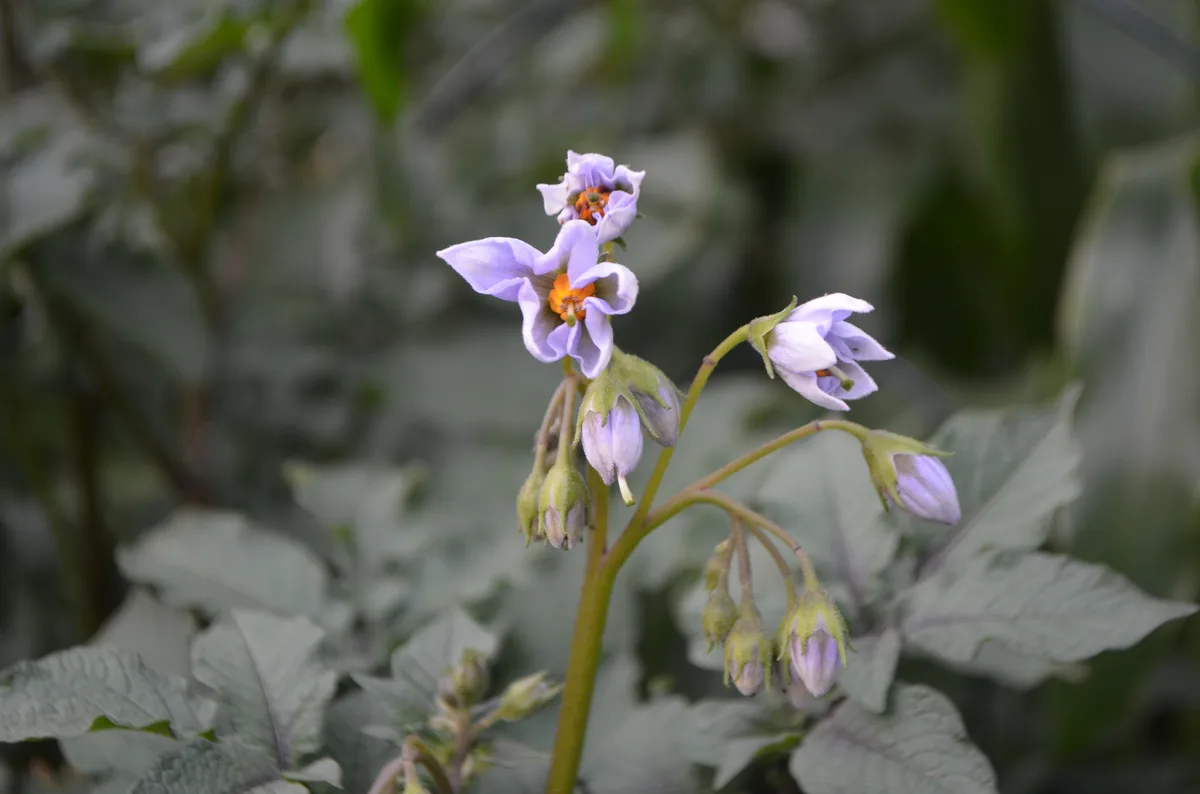

Potatoes at a glance


Weeks relative to last frost (LF). Colored weeks show when our ZIP planner schedules each step.
Jump to
Updated
Plant certified seed potatoes as 1- to 2-inch pieces with at least one eye, cut side down, about 3 to 5 inches deep and about 8 to 12 inches apart in rows 24 to 36 inches apart; hill soil over the stems as plants grow so tubers stay covered; keep about 1 inch of water a week while tubers form; dig new potatoes about 6 to 8 weeks after planting, or wait about 2 weeks after vines die for storage tubers, then cure before cool, dark, moist storage.
Planting dates for your ZIP: use the ZIP planting planner and planting calendars — plant when soil is workable and warmed (UMD: at least 45°F). We do not invent a national plant date.
Organic pests and diseases: see organic pest control for potatoes. Use any product as the label directs.
Seed-piece prep
Buy certified disease-free seed potatoes from a reputable grower or garden supplier (UMN, UMD, Clemson, Iowa State). Do not plant grocery potatoes — they may be treated to prevent sprouting and can carry disease. Saving last year’s garden tubers is generally not worthwhile.
- Small whole seed tubers about 1 to 1¼ inches across can be planted whole (UMN).
- Cut larger tubers into pieces: about 1½-inch cubes / 1½–2 oz with 1 to 3 eyes (UMD); 1¼-inch chunks with at least one eye, preferably two or three (UMN); 1- to 2-inch cubes with at least one good eye (Clemson); Iowa State: sections with 1 or 2 eyes.
- Heal cut surfaces before planting: UMD “Let pieces dry for a few days”; Clemson cut three to five days before planting; UMN place cut pieces at 60°F–70°F for a few days until a tough protective layer forms; Iowa State uses 60 to 70°F and about 85% RH for several days to callus.
- Plant “Plant tuber pieces cut side down” (UMN). Handle gently so sprouts are not rubbed off.
UMN Extension · UMD Extension · Clemson HGIC · Iowa State Extension
Planting depth and spacing
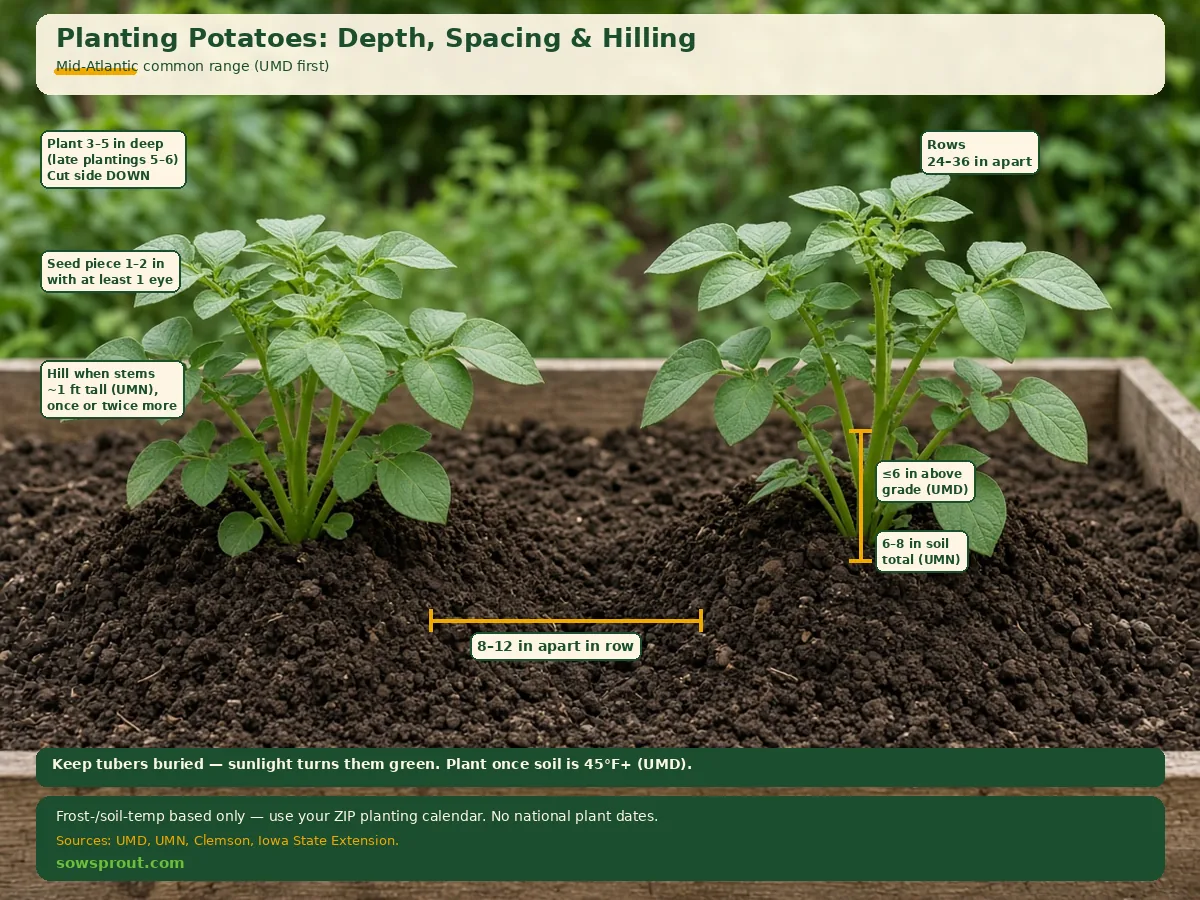
Plant seed pieces cut side down, 3 to 5 inches deep (5 to 6 inches for later plantings per UMD and Clemson), about 8 to 12 inches apart in rows 24 to 36 inches apart. Space closer for more new potatoes, wider for larger storage tubers. UMN: “cut side down, 10 to 12 inches apart and about three to five inches deep, in rows 30 to 36 inches apart”. UMD: “If you would like to mainly harvest new potatoes, space plants 9” apart. If large storage potatoes are your goal space plants as far as 20” apart.”
| Topic | Sourced range | Sources |
|---|---|---|
| Orientation | Cut side down | UMN, UMD, Clemson |
| Depth | 3–5 in (later crops 5–6 in) | UMN, UMD, Clemson; Iowa ~4 in furrow |
| In-row | About 8–12 in common; 9 in new; up to 20 in large storage (UMD) | UMD, UMN, Clemson 8–10, Iowa ~1 ft |
| Between rows | 24–36 in (UMN 30–36) | UMD, UMN |
Hilling
Hill so developing tubers stay covered — sun causes greening. UMN: “Start hilling plants when stems are about a foot tall, and once or twice more during the growing season.” By season’s end you will have hilled about six to eight inches of soil in total along the plants (UMN). UMD: when tops are fully grown, hill soil around the base; “The tops of the hills should not be more than 6-in. above grade.” Those are compatible descriptions (cumulative cover vs height above original grade) — not a single averaged height. Clemson finishes cultivation / “laying-by” just before tops get too large. Iowa State: cultivate shallowly (2 inches or less) so roots are not damaged. After hilling, UMD allows thick straw mulch to keep soil cool/moist and deter Colorado potato beetles (cultural note only).
Watering
About 1 inch of water per week (UMN, Iowa State). UMN: “Soak the soil thoroughly when watering, once or twice a week.” “One inch of rainfall per week is good.” Sandy soils need more frequent watering. Moisture is critical while tubers form / around blossom time (UMD, Clemson). UMD: “Too much or too little water is associated with many tuber disorders”; hollow heart ties to wet/dry swings (UMN, Clemson). Avoid overhead watering when possible. UMD: soil temperatures over 80°F inhibit tuber development — mulch after hilling helps.
Soil pH and potato scab
Do not average these bands. General growing pH: about 6.0–6.5 (UMN, UMD; Clemson maintain 5.8–6.5). Where common scab is a persistent problem, UMD recommends soil pH 4.8–5.8; Clemson recommends 5.0–5.3 to decrease disease in susceptible types. UMN: scab causes dark, rough, corky skin spots and does not rot tubers — ugly but edible after peeling/cooking as preferred. Iowa State: potatoes prefer slightly acid soils; adding organic matter may increase scab — test soil and follow extension guidance. No fertilizer product rates here.
Harvest cues
New potatoes: UMD “Small, tender “new” potatoes can be harvested 6 to 8 weeks after planting, usually once the plants have flowered.”; UMN about seven to eight weeks. Skins are thin and do not store well (Iowa State).
Storage potatoes: UMD “If you plan to store potatoes, leave tubers in the ground for 2 weeks after plants die back.” (Clemson same idea). UMN: “Harvest mature tubers after plants have dried.”. Dig on a dry day with a fork; avoid piercing, bruising, or washing before storage. Sort out damaged tubers and use first. Avoid long light exposure at harvest (Clemson: sun only about 1–2 hours for soil to dry and fall off).
Curing and storage
Curing (set skins, heal wounds): UMD cure 10 to 14 days at 50°F–60°F and high humidity; Iowa State 50 to 60°F and 85 to 90% RH for two weeks; UMN: if skins still rub off, hold warm (60°F–65°F), well-ventilated, dark for ten days or more — brush dried soil off, do not wash.
Storage temperatures disagree across extensions — label both, do not average. Mid-Atlantic / Iowa band: about 40°F–50°F (UMD, Clemson) or about 40°F (Iowa State) at ~90% RH, dark, for roughly 6–8 months. Iowa State: below 38°F can taste sugary (restore at room temp a few days); above 50°F sprouting in 2–3 months. UMN’s general home rule is colder: 32–40°F and 95% RH (e.g. refrigerator), with frying potatoes held at 40–50°F to avoid cold sweetening. Practical home target often lands near ~40°F and high humidity; keep UMN’s colder fridge band attributed separately.
Greening: cut away green parts; discard extensively green tubers (UMD, UMN, Clemson). Store in the dark. UMN: remove sprouts before cooking; do not eat sprouts.
Common failure reasons
| Problem | What extensions say |
|---|---|
| Green tubers | Sun on exposed tubers — hill / keep covered; store in dark (UMD, UMN, Iowa State, Clemson) |
| Small tubers | Close spacing; heat over 80°F soil (UMD); water stress early (UMN) |
| Misshapen / cracked / hollow | Uneven water (UMD, UMN hollow heart, Clemson) |
| Scabby skins | Common scab — more acid beds where it is a problem (UMD 4.8–5.8; Clemson 5.0–5.3); still edible |
| Seed piece rot / weak stand | Grocery or uncertified seed; cold wet soil without healing cuts |
| Poor storage life | Digging before skins set; storing injured/washed tubers; warm storage → sprouts |
Rotate away from tomatoes, peppers and eggplant for 3–4 years (UMN). Colorado potato beetle and other pests: cultural notes and organic options on the pest page — no spray recipes or product rates here.
Frequently asked questions
How do you prepare seed potatoes for planting?
Use certified seed potatoes. Cut large tubers into about 1- to 2-inch pieces with at least one eye (UMD, Clemson, UMN). Let cut surfaces dry or callus for a few days — Clemson says three to five days; UMN uses room temperature about 60°F–70°F — then plant cut side down. Do not plant grocery potatoes (UMN, UMD, Iowa State).
How deep and how far apart should you plant potatoes?
Plant 3 to 5 inches deep (5 to 6 inches for later plantings) and about 8 to 12 inches apart in rows 24 to 36 inches apart (UMN, UMD, Clemson). For mostly new potatoes UMD suggests about 9 inches; for large storage tubers, up to about 20 inches.
When and how high should you hill potatoes?
Hill after shoots are up so tubers stay buried. UMN starts when stems are about a foot tall and hills once or twice more, totaling about 6 to 8 inches of soil. UMD hills when tops are fully grown and keeps hill tops no more than 6 inches above grade. Hilling prevents greening from sunlight (UMD, Iowa State).
What soil pH do potatoes need, and what about scab?
Potatoes grow well around pH 6.0–6.5 (UMN, UMD; Clemson 5.8–6.5). Where common scab is a problem, extensions recommend a more acid bed — about 4.8–5.8 (UMD) or 5.0–5.3 (Clemson). Scab makes corky skin spots but does not rot the tuber (UMN). Do not average the scab bands into one number.
How much water do potatoes need?
About 1 inch per week; soak thoroughly once or twice a week (UMN, Iowa State). Keep moisture steady while tubers form; swings of wet and dry link to disorders (UMD, UMN).
When should you harvest potatoes?
New potatoes: about 6 to 8 weeks after planting, often after flowering (UMD, UMN). Storage potatoes: wait about 2 weeks after vines die so skins thicken (UMD, Clemson), then dig carefully on dry soil.
How do you cure and store potatoes?
Cure about 10–14 days (UMD) or two weeks (Iowa State) at roughly 50°F–60°F and high humidity, in the dark. Then store cool, moist, and dark — commonly about 40°F–50°F or ~40°F and ~90% RH (UMD, Clemson, Iowa State); UMN also cites 32–40°F and 95% RH. Those storage bands are not averaged. Do not wash before storage. Cut away green parts before eating.
Why are my potatoes turning green?
Light on the tubers. Hill soil (or deep mulch) to keep them covered, and store harvested potatoes in the dark (UMD, UMN, Iowa State, Clemson).
More grow guides: Garlic · Lettuce · Peppers · Beans · Tomatoes · Cucumbers · Squash · Broccoli · Cabbage · All grow guides
Sources
- University of Minnesota Extension: UMN Extension
- University of Maryland Extension: UMD Extension
- Clemson Cooperative Extension: Clemson HGIC
- Iowa State University Extension: Iowa State Extension