
How to Grow Cabbage: Planting, Spacing, Care & Harvest
Quick answer
Start cabbage indoors about 10 weeks before your last spring frost and set hardened transplants out about 3 weeks before that frost date (NDSU timing chart), or buy sturdy transplants. Space about 15 to 18 inches in the row with about 30 to 36 inches between rows (close spacing at 12 inches in the row makes smaller heads). Aim for about 1 inch of water a week and keep moisture even so heads stay firm and don’t split after a heavy rain; cut heads when they feel solid to hand pressure. For a fall crop, sow in summer (UMD often mid-July to early August for Mid-Atlantic transplants; UMN early July for direct seed farther north) so heads finish in cool weather. Use the ZIP planting calendar for local frost windows rather than a national plant date.
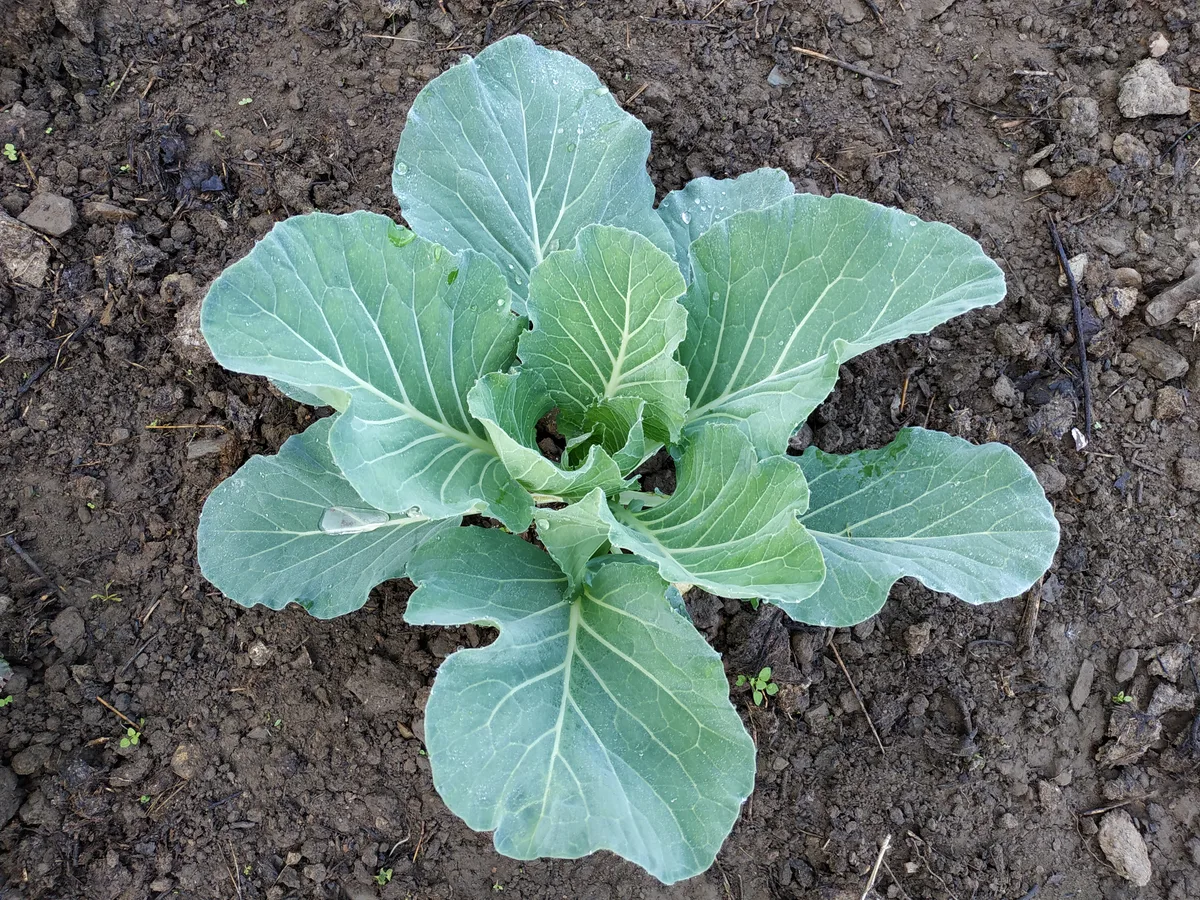

Cabbage at a glance


Weeks relative to last frost (LF). Colored weeks show when our ZIP planner schedules each step.
Jump to
Updated
Start cabbage indoors about 10 weeks before your last spring frost and set hardened transplants out about 3 weeks before that frost date (NDSU timing chart), or buy sturdy transplants. Space about 15 to 18 inches in the row with about 30 to 36 inches between rows (close spacing at 12 inches in the row makes smaller heads). Aim for about 1 inch of water a week and keep moisture even so heads stay firm and don’t split after a heavy rain; cut heads when they feel solid to hand pressure. For a fall crop, sow in summer (UMD often mid-July to early August for Mid-Atlantic transplants; UMN early July for direct seed farther north) so heads finish in cool weather. Use the ZIP planting calendar for local frost windows rather than a national plant date.
Planting dates for your ZIP: use the ZIP planting planner and frost dates / planting calendars. No national plant date. Related cool-season brassicas and greens: broccoli, lettuce, garlic, cauliflower.
Organic pests, diseases and fertilizer: see how to grow cabbage organically. Use any product as the label directs.
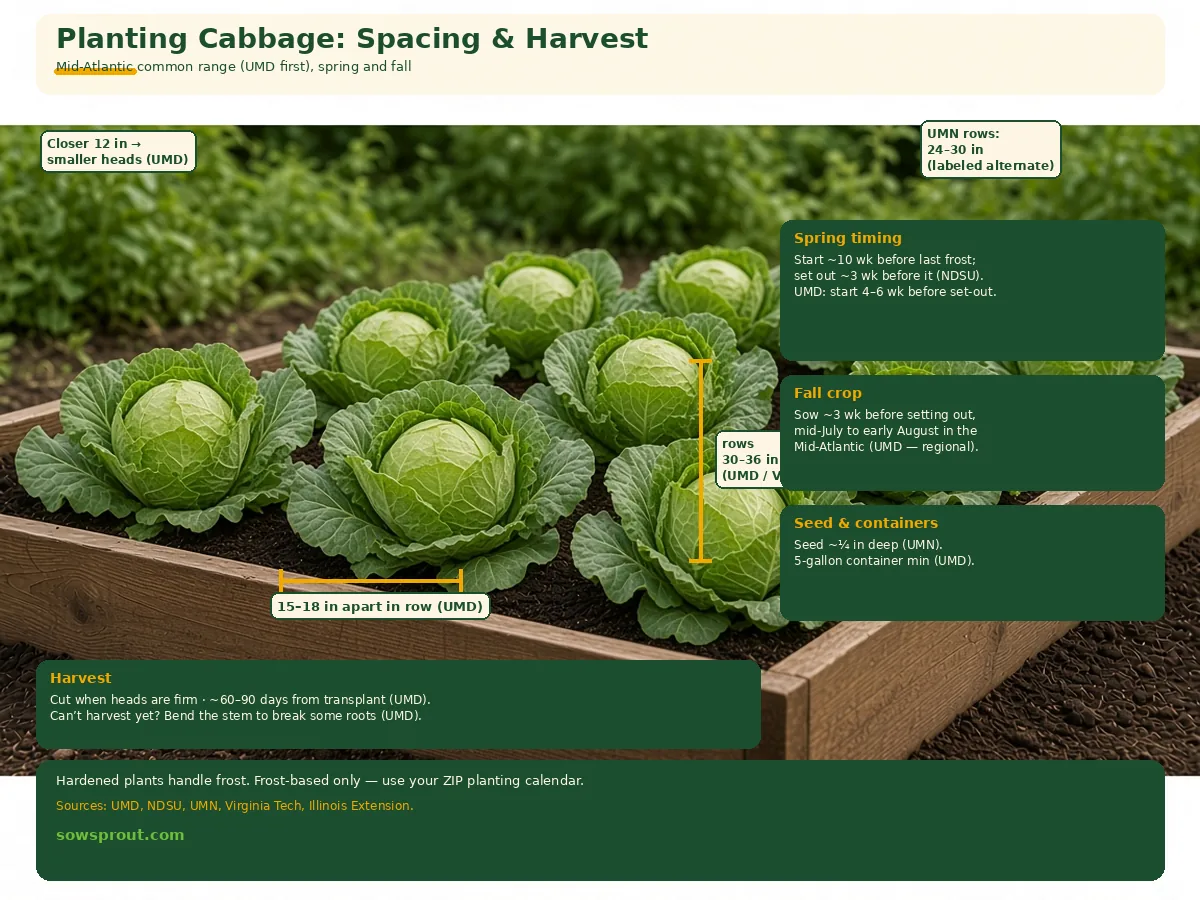
Spring vs fall timing
Indoor start frames disagree — do not average. NDSU H1139 (diagram main): start about 10 weeks before last frost, set out about 3 weeks before that frost (NDSU H1139). UMD / Virginia Tech describe starting 4 to 6 weeks before the set-out date (a different frame than weeks-before-frost). Penn State often wants transplants about 5–6 weeks old, or seeds 6–8 weeks before outdoor plant. Lead with the NDSU frost countdown; show Mid-Atlantic 4–6 weeks-before-set-out as a labeled alternate.
Cool-season crop: UMD notes cabbage can withstand heavy frosts in spring and fall. UMN: if you sow late, the crop will mature in summer heat and quality suffers. Harden off; UMN bring plants indoors if nights drop below 40°F.
Fall crop (regional — attribute, link ZIP tools): UMN “For a fall crop, plant seed directly in the garden in early July.”. UMD “Fall crop: sow seeds about 3 weeks prior to setting out plants in garden (mid-July to early August depending on cultivar and location).”. Those month windows are Mid-Atlantic / northern regional, not a national calendar date.
Transplants
Buy or grow sturdy plants (Penn State: five or six weeks old, hardened, not leggy). UMN: plant at the same depth as in the pot. Rotate away from cabbage-family crops for about three to four years (UMN / Penn State). Starter fertilizer language points to a soil test — no product rates here.
Spacing
Lead with Mid-Atlantic UMD / VT; attribute other row bands — do not average. UMD: “15" - 18" in-row x 30" - 36" between rows.” “Close spacing (12 inches apart in the row) produces small heads.”. UMN: “Place the seedlings 15 to 18 inches apart” “Leave 24 to 30 inches between hand-cultivated rows”. Virginia Tech matches the 15–18 × 30–36 Mid-Atlantic band. Broader sourced bands: Illinois / Penn State 12–24 in-row by head size; Rutgers often 18 × 24; Clemson 9–12 in-row for small heads with wider rows. Mid-Atlantic banner rows = 30–36 in; UMN 24–30 is a labeled alternate, not blended into one number.
Watering
UMN: “One inch of rainfall per week is enough water.” “Cabbage needs good soil moisture.”. Keep moisture even from establishment through head fill (UMD, Illinois, Clemson). Penn State: irregular watering drives splits. Mulch about 3–4 inches (UMN); cultivate carefully — roots are shallow (UMD).
Splitting, bolting, and blindness
Splitting: Illinois “When heads are mature, a sudden heavy rain may cause heads to crack or split wide open.”. Cut when “when they are solid (firm to hand pressure) but before they crack or split”. UMD: “If unable to harvest at maturity, bend the stem over to break part of the roots to reduce the incidence of head-splitting.”. UMN / VT / Clemson describe a quarter-turn twist or root-prune for the same idea.
Bolting: Illinois “Cabbage plants "bolt" (form premature seedstalks) when they are exposed to low temperatures (35 to 45 degrees F) for extended periods.”. Clemson cites a related chill band (~35–50°F for 10+ continuous days) — labeled separately, not averaged.
Blindness (no head): Utah State “Plants fail to form flower head, curd, or head.” “It is likely to be induced by cold temperatures after transplanting, injury by insects, or some other posttransplanting stress event” (Utah State Extension).
Harvest
UMD: harvest “When heads become firm; size will vary with variety, fertility, and spacing.”. UMN: “Cabbage takes between 60 and 100 days to mature.”. Days-to-maturity bands also include UMD 60–90 from transplant, Clemson 60–80 after transplant, VT 70–100 — publish as a band. Mature heads can hold on the plant about 2 weeks in summer, 3–4 weeks in fall (UMD / VT). Optional stump sprouts after a spring cut (Illinois). Storage: fridge for short holding; very cold moist storage for longer (UMD).
Containers
UMD lists 5 gallons as the minimum container volume for cabbage (UMD Extension). Keep moisture steady — pots dry fast. In-ground sun: at least 6 hours; prefers 8–10 (UMD).
Common failure reasons
| Problem | What extensions say |
|---|---|
| Heads split / crack | Sudden rain on mature heads; irregular watering (Illinois, Penn State, UMN, UMD) |
| Bolt (seedstalk) | Extended chill ~35–45°F (Illinois) or ~35–50°F for 10+ days (Clemson) |
| No head / blind | Cold after transplant, insect injury, growing-point damage (Utah State, UMN) |
| Small heads | Close spacing by design (UMD, VT) |
| Heat-poor spring crop | Crop matures in summer heat (UMN, Illinois) |
Pests (cabbageworms, flea beetles, clubroot, etc.): cultural notes only here — full IPM on organic cabbage. No fertilizer product rates. UMD Extension · UMN Extension · Illinois Extension · Virginia Tech SPES-792 · Clemson HGIC
Frequently asked questions
Why is my cabbage splitting?
Sudden heavy rain on mature heads can crack them open (Illinois). Irregular watering also drives splits (Penn State). Harvest when heads are solid but before they crack. If you cannot cut on time, bend the stem to break part of the roots (UMD), or twist / root-prune to reduce water uptake (UMN, VT, Clemson).
Why are my cabbages not forming heads?
Cold after transplanting, insect injury to the growing point, or other stress can cause “blindness” — plants fail to form a head (Utah State; UMN). Bolting from extended chill can also divert the plant into a seedstalk instead of a solid head (Illinois).
When should you plant cabbage for a fall harvest?
UMN: plant seed directly in the garden in early July for a fall crop. UMD: sow about 3 weeks before setting plants out (often mid-July to early August in the Mid-Atlantic, depending on cultivar and location). Link your ZIP frost dates — do not use a national calendar date.
How far apart should you plant cabbage?
About 15 to 18 inches in the row and 30 to 36 inches between rows (UMD, VT). UMN uses 15 to 18 inches in-row and 24 to 30 inches between hand-cultivated rows. Close spacing at 12 inches in the row produces small heads (UMD, VT). Do not average those row bands.
Can you grow cabbage in a pot?
Yes. UMD lists 5 gallons as the minimum container volume for cabbage. Keep moisture steady — pots dry fast.
When should you start cabbage indoors?
NDSU’s timing chart: about 10 weeks before the last spring frost, then set out about 3 weeks before that frost. Mid-Atlantic guides often describe starting 4 to 6 weeks before the outdoor set-out date (UMD, VT) — a different frame, not averaged with the NDSU frost countdown. Use frost dates, not a fixed month.
How much water does cabbage need?
About 1 inch a week (UMN). Keep moisture even from establishment through head fill (UMD, Illinois, Clemson). Uneven water hurts quality and invites splitting near maturity.
When is cabbage ready to harvest?
When heads become firm; size varies with variety, fertility, and spacing (UMD, VT). Illinois: cut when solid to hand pressure but before they crack. Many guides land around 60 to 100 days depending on start method and type (UMD 60–90 from transplant; UMN 60–100 days to mature).
Do cabbage plants need full sun?
UMD: full sun — at least 6 hours direct light a day; prefers 8 to 10. Another Mid-Atlantic extension guide notes full sun; light shade can slow maturity but may help in warm weather.
More grow guides: Broccoli · Lettuce · Garlic · Tomatoes · Peppers · Beans · Potatoes · Cucumbers · Squash · All grow guides
Sources
- North Dakota State University Extension: NDSU H1139
- Utah State University Extension: Utah State Extension
- University of Maryland Extension: UMD Extension; UMD Extension
- University of Minnesota Extension: UMN Extension
- University of Illinois Extension: Cabbage
- Virginia Cooperative Extension (Virginia Tech): Virginia Tech SPES-792
- Clemson Cooperative Extension: Clemson HGIC