
How to Grow Garlic: Depth, Spacing, Care & Harvest
Quick answer
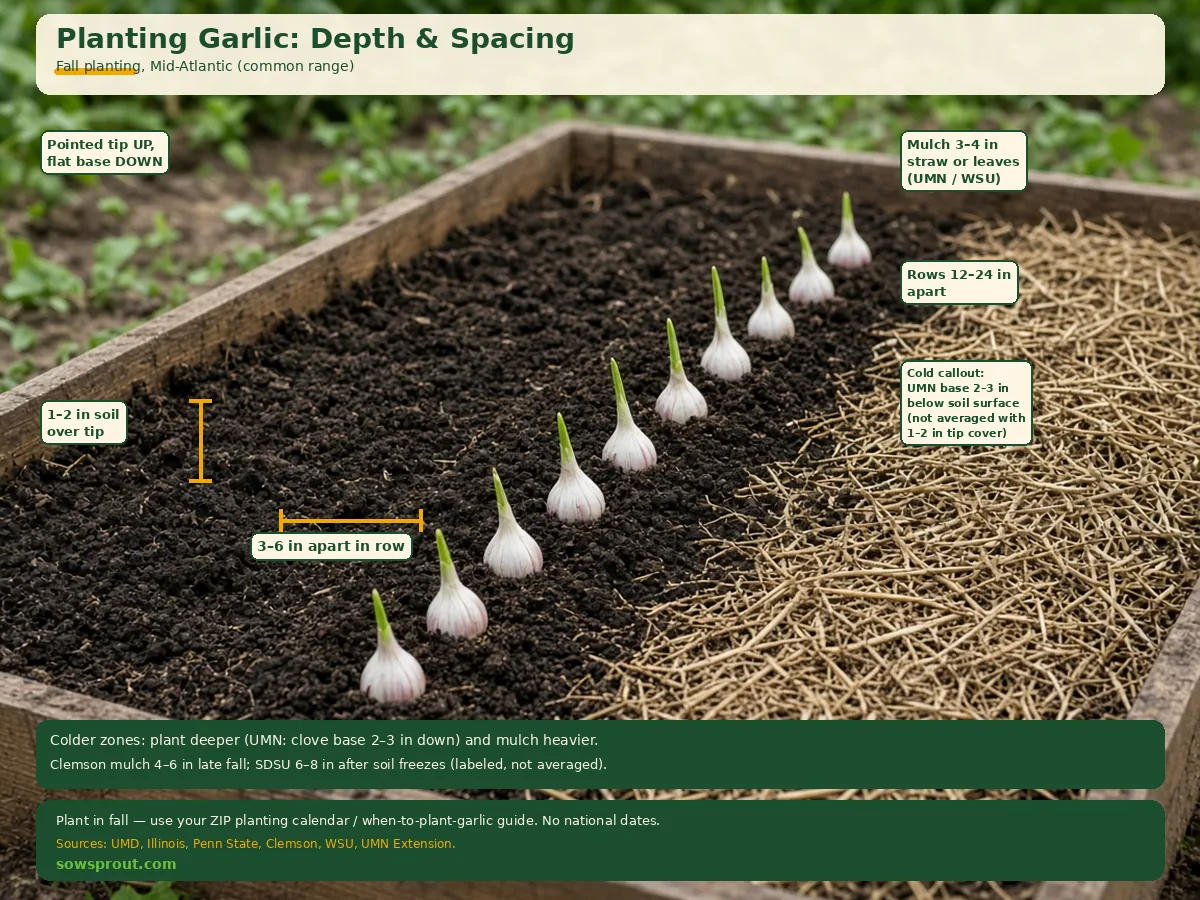
Plant garlic cloves pointed end up in fall, about 1 to 2 inches deep in most regions (or with the base of the clove 2 to 3 inches down in cold climates), space them about 3 to 6 inches apart in the row with about 12 to 24 inches between rows, mulch for winter, remove hardneck scapes so bulbs size up, water about 1 inch a week until near harvest, then lift when roughly half the leaves brown and cure the bulbs in a warm, shady, airy place before cool dry storage.

Garlic at a glance


Weeks relative to last frost (LF). Colored weeks show when our ZIP planner schedules each step.
Jump to
Updated
Plant garlic cloves pointed end up in fall, about 1 to 2 inches deep in most regions (or with the base of the clove 2 to 3 inches down in cold climates), space them about 3 to 6 inches apart in the row with about 12 to 24 inches between rows, mulch for winter, remove hardneck scapes so bulbs size up, water about 1 inch a week until near harvest, then lift when roughly half the leaves brown and cure the bulbs in a warm, shady, airy place before cool dry storage. Calendar timing by zone is on When to plant garlic by zone.
Organic pests and diseases: see organic pest control for garlic. Use any product as the label directs.
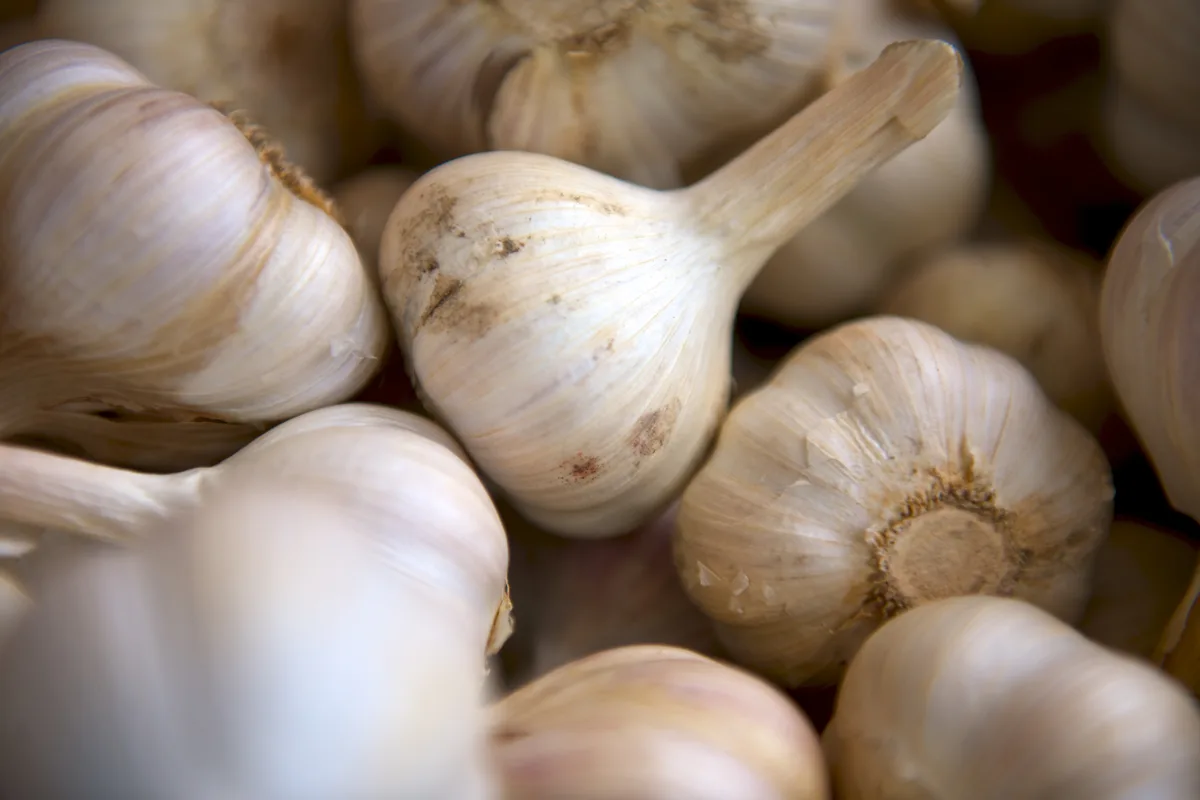
Hardneck or softneck
- Hardneck (stiffneck): Forms a flowering stalk (scape). Penn State: “Stiffneck (hardneck) varieties grow best. They are more cold-hardy than the softneck types that are used for braiding.”. WSU: hardneck “is the most cold-hardy of the garlics”. UGA: hardnecks “generally prefer the cold winters and long, cool springs of more northern climates”. Illinois prefers hardneck; softneck is less cold hardy.
- Softneck: Typically no flowering stalk (climate can change this — UMN). Good for braiding and longer storage. Clemson: soft-necks “tend to keep longer than hard-neck types”. UGA: soft-necked types “are well-adapted to the more temperate climate of the South”. NC State: “Softnecks don't have the cold requirements of the hardnecks and do better in warmer climates.”
- Grocery bulbs: Do not plant grocery garlic. UMD: “Never plant garlic from a grocery store. It may be a symptomless disease carrier.” UMN and WSU also advise against it (disease risk; poor performance).
- Elephant garlic: Not true garlic (a leek relative), per UMD, WSU, Clemson, UGA and Ohio State. Treat culturally like garlic where sources say so; do not assume the same spacing.
WSU FS162E · UGA C854 · NC State · Penn State Extension · UMD Extension · Clemson HGIC
Planting depth and spacing
Orientation: pointed tip up, basal plate down. UMD: “Plant cloves bottom-side down and pointy tip-up.” Ohio State: “Planting the clove upside down or sideways will result in small or misshapen cloves.”
Tip cover vs base depth (do not average): Mid-Atlantic and most-region guides measure soil over the tip — about 1 to 2 inches (Illinois “Plant cloves 1-2 inches deep”; Penn State 1 to 2 inches; UMD “Each clove should be covered with 1 to 2 inches of soil”; Clemson about 1 inch; WSU tops about 2 inches below the soil line). Cold-climate UMN measures to the base of the clove: “with the base of the clove two to three inches from the soil surface.”. SDSU plants “four-to-six inches deep” with heavier mulch. Those are different measurement points, not a single national depth.
| Topic | Sourced range | Sources |
|---|---|---|
| Orientation | Pointed tip up, basal plate down | UMD, Illinois, Ohio State, Clemson, UMN, WSU |
| Depth (most regions) | About 1–2 in soil cover / tip depth | Illinois, Penn State, UMD, Clemson (~1 in), WSU (tops 2 in below) |
| Depth (cold) | Base of clove 2–3 in (UMN); 4–6 in deep (SDSU) | UMN; SDSU |
| In-row spacing | About 3–6 in (sources span ~2–7 in) | UMD 3–6; Illinois 4–5; WSU 4–6; Clemson 3–5; UMN 6; Penn State 6–7 |
| Between rows | About 12–24 in | WSU, Clemson 12–24; Illinois 15–18; Penn State 1 ft; UGA 12–14 |
Space cloves about 3 to 6 inches apart in the row, with about 12 to 24 inches between rows. UMN bed layout: “Plant cloves in double rows, six inches apart. Center the rows on beds, 30 inches apart.” (UMN Extension). Closer spacing tends toward smaller bulbs; wider toward larger (University of Maine Extension).
Mulch
- UMN: “Cover beds with three to four inches of leaf or straw mulch to prevent fluctuating temperatures during the winter and early spring, and to help control weeds.”
- WSU: about 3–4 inches for cold protection, water conservation and weeds.
- Ohio State: four inches of clean straw (not weedy hay); rake off emerging plants in spring and leave between rows.
- Clemson: “Mulch with weed-free straw to a depth of about 4 to 6 inches in late fall.”
- SDSU: “When the soil has frozen, put six-to-eight inches of straw or leaf mulch on top.”
- Penn State: lightly mulch with straw to prevent winter heaving. UMD: shredded leaves or straw optional.
Scapes (hardneck only)
Hardneck produces a scape; softneck usually does not. Remove scapes to favor bulb size: UMD “Pinch it back to increase bulb size. The scapes can be used in place of scallions.”; Penn State removes while young to improve bulb size; Illinois removes flowering scapes for large bulbs. Clemson: if you do not top stiff-neck garlic, bulb size “will be reduced by an average of 30 percent”. When: UMN “just after they start curling”; WSU when they begin to curl; Penn State before they begin to straighten and become stiff. Scapes are edible.
Watering
UMN: “Soak the soil thoroughly when watering, to a depth of at least one inch each week during the growing season.” “Sandy soils require more frequent watering.” “Stop watering two weeks before harvest to avoid staining bulb wrappers and promoting diseases.” WSU: about 1 inch per week in spring/early summer; stop when tops begin to fall over, about “two to four weeks before harvest”. UGA: about 1 in. per week with good drainage; do not irrigate once tops begin to fall and dry. Clemson: consistent moisture during bulbing; near maturity somewhat dry soil is best. UMD: water less often as harvest approaches.
Harvest cues
UMN: late June to late July by variety/climate; begin when lower leaves brown and “half or slightly more than half of the upper leaves remain green” — too early → small bulbs; too late → cloves pop from bulbs. UMD: lift when about ½ of foliage turns brown (Central Maryland often around July 1 as a regional example, not a national date). Penn State: early to mid-July; “Harvest when the leaves begin to brown and at least 4 leaves are still partly green.”; do not pull by the stem. Illinois: when half the leaves have turned yellow; dig, do not over-clean. Clemson: when leaves begin to yellow in early summer; lift carefully; do not wash. WSU: after leaves on the lower third yellow.
Curing and storage
Curing (dry with tops on, shade, air) until necks are dry and wrappers papery (Clemson readiness cue). Sources disagree on length — publish the range, not one universal week count: UMD about 7–14 days; Clemson / Ohio State about two to three weeks; UMN “warm, dry, airy place for three to four weeks”; Illinois 4–6 weeks; WSU several weeks with tops intact.
Storage (only where extension gives numbers): UMD “Cool (32°–38°F), dry (65% RH) conditions are best”; bulbs “typically keep for 6-9 months after harvest when stored in a cool, dry basement”. Ohio State: after curing, store above freezing but not higher than 40°F and no more than 75% humidity; not in plastic — net bags or open containers. Clemson: most varieties keep six to eight months after proper cure; softnecks generally keep longer than hardnecks.
Common failure reasons
| Problem | What extensions say |
|---|---|
| Small bulbs | Harvested too early (UMN, Penn State); scapes left on hardneck (UMD; Clemson ~30% size cut; Illinois; WSU); spring planting / not enough foliage (UMD); dry soil (Clemson, UGA); late planting |
| Split / popped bulbs | Harvested too late (UMN cloves popping; Penn State bulb will split) |
| Misshapen cloves | Planted upside down or sideways (Ohio State); compacted soil (Clemson, UGA) |
| Poor overwinter / heaving | Insufficient mulch / frost heave (Penn State, Illinois, SDSU) |
| Disease risk from seed | Grocery garlic (UMD, UMN, WSU); use firm healthy cloves from reputable sources |
| Stained wrappers / storage disease | Watering too late / incomplete cure (UMN stop 2 weeks before harvest; WSU / Clemson cure thoroughly) |
Pests and diseases beyond cultural prevention are out of scope here. We do not invent fertilizer rates or name varieties.
Frequently asked questions
Are garlic plants hardneck or softneck — which should I grow?
Hardneck (stiffneck) types are more cold-hardy and produce edible scapes; softneck types usually braid and store longer and suit milder winters (Penn State, WSU, UGA, Illinois, Clemson). Buy planting stock from a garden supplier, not the grocery aisle (UMD, UMN, WSU).
How deep and how far apart should I plant garlic cloves?
Pointed tip up. Most extension guides use about 1 to 2 inches of soil over the clove and about 3 to 6 inches between cloves, with rows about 12 to 24 inches apart (Illinois, Penn State, UMD, WSU, Clemson). In cold climates UMN plants with the base of the clove 2 to 3 inches down; SDSU uses 4 to 6 inches deep with heavier mulch. Tip cover and base depth are different measurements — do not average them.
Should I mulch garlic?
Yes in most guides: about 3 to 4 inches of leaf or straw after planting (UMN, WSU), up to 4 to 6 inches in Clemson’s late-fall guidance, or 6 to 8 inches after the soil freezes in SDSU’s cold-climate advice. Mulch limits heaving, buffers temperature swings, and helps with weeds.
Do I remove garlic scapes?
On hardneck types, yes — remove the scape after it starts curling to put growth into the bulb (UMN, UMD, Penn State, Illinois, WSU). Clemson reports leaving stiff-neck scapes on cuts bulb size by about 30 percent on average. Softnecks usually do not make a scape.
How much water does garlic need?
About 1 inch of water per week during active growth (UMN, WSU, UGA). Stop or cut back watering about two weeks (UMN) to two to four weeks (WSU) before harvest so wrappers stay clean and disease pressure drops.
When is garlic ready to harvest?
When roughly half the leaves have browned or yellowed and some green remains (UMN, UMD, Illinois; Penn State wants at least 4 leaves still partly green). Calendar windows are local — often late June to July in northern/Mid-Atlantic guides. Lift with a fork; do not yank the stem (Penn State, Illinois).
How do I cure and store garlic?
Cure in a warm, shady, well-ventilated place until necks are dry and skins papery — sources say from about 1–2 weeks (UMD) to 2–4 weeks (UMN, Clemson, Ohio State) or 4–6 weeks (Illinois). Then store cool and dry: UMD cites 32°–38°F and about 65% relative humidity for roughly 6–9 months; Ohio State allows up to 40°F and no more than 75% humidity. Softnecks usually keep longer than hardnecks (Clemson, UMD).
Why are my garlic bulbs so small?
Common extension causes: harvesting too early (UMN, Penn State), leaving hardneck scapes on (UMD; Clemson ~30% loss), planting in spring without enough cool exposure/foliage (UMD), or dry / compacted soil (Clemson, UGA).
More grow guides: Lettuce · Peppers · Beans · Potatoes · Tomatoes · Cucumbers · Squash · Broccoli · Cabbage · All grow guides
Sources
- Washington State University Extension: Growing Garlic in Home Gardens
- University of Georgia Extension: Garlic Production for the Gardener
- NC State Extension: Softneck Garlic
- Penn State Extension: Growing and Using Garlic
- University of Maryland Extension: UMD Extension
- Clemson Cooperative Extension: Onion, Leek, Shallot & Garlic
- University of Minnesota Extension: Growing garlic in home gardens