
How to Grow Peppers: Planting, Spacing, Care & Harvest
Quick answer
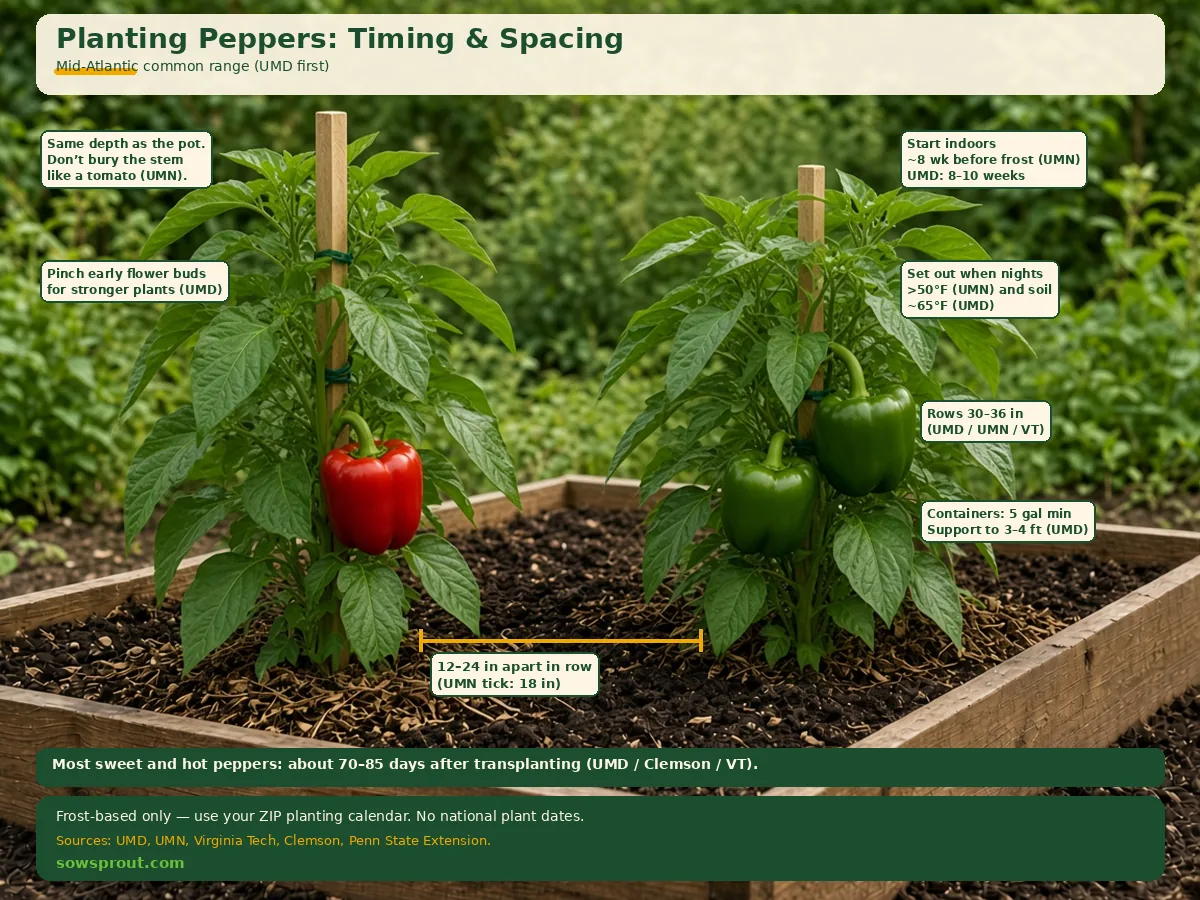
Transplant peppers after frost risk is past, the soil has thoroughly warmed, and nighttime lows stay above about 50°F; start seed indoors about 8 weeks before the last frost (some Mid-Atlantic guides use 8 to 10 weeks) and set plants out about 2 weeks after that frost date. Space about 12 to 24 inches in the row with about 30 to 36 inches between rows (about 18 inches in-row is a common Midwestern figure; double staggered rows in 2-foot-wide beds also work well). Pinch early flower buds and tiny fruits after transplanting for stronger plants; keep soil evenly moist at about 1 inch of water a week (more on sand); avoid excess nitrogen that makes bushy leafy plants slow to fruit; and pick sweet peppers at full size green or leave them to color on the plant. Use the ZIP planting calendar for local frost windows rather than a national plant date.

Peppers at a glance


Weeks relative to last frost (LF). Colored weeks show when our ZIP planner schedules each step.
Jump to
Updated
Transplant peppers after frost risk is past, the soil has thoroughly warmed, and nighttime lows stay above about 50°F; start seed indoors about 8 weeks before the last frost (some Mid-Atlantic guides use 8 to 10 weeks) and set plants out about 2 weeks after that frost date. Space about 12 to 24 inches in the row with about 30 to 36 inches between rows (about 18 inches in-row is a common Midwestern figure; double staggered rows in 2-foot-wide beds also work well). Pinch early flower buds and tiny fruits after transplanting for stronger plants; keep soil evenly moist at about 1 inch of water a week (more on sand); avoid excess nitrogen that makes bushy leafy plants slow to fruit; and pick sweet peppers at full size green or leave them to color on the plant. Use the ZIP planting calendar for local frost windows rather than a national plant date.
Planting dates for your ZIP: use the ZIP planting planner and frost dates / planting calendars. No national plant date. Rotate away from recent tomatoes, potatoes, peppers and eggplant (UMN 3–4 years).
Organic pests and diseases: see organic pest control for peppers. Use any product as the label directs.
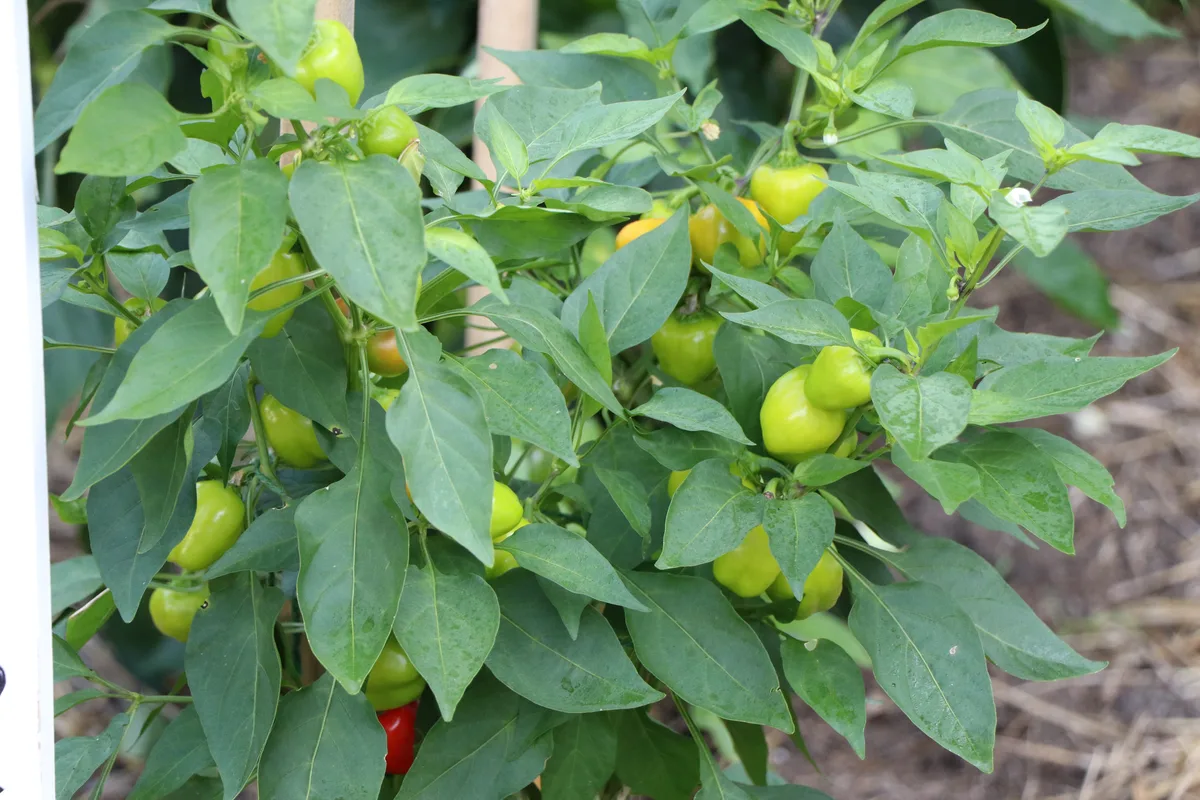
Pepper types
Sweet / mild (bell, banana, frying types, pimiento) and hot / chile types (jalapeño, cayenne, habanero and related). UMD: “All fruits are green in color at first and ripen to a variety of colors, like red, orange, yellow, brown, green, and purple”. No named cultivars on this page. Capsaicin heat sits in seeds and whitish membrane (UMN).
Timing and transplants
Start-week bands disagree — do not average. UMN / NDSU: about 8 weeks before outdoor planting (NDSU H1139 sets transplants about 2 weeks after last frost). UMD / Penn State: 8 to 10 weeks (some types 12). Clemson / VT often set out 6- to 8-week-old transplants started 6–8 weeks before the outdoor date. Attribute each; do not invent one national start week.
UMN: “Transplant outdoors after nighttime low temperatures are above 50°F.” UMD: set out after soil has thoroughly warmed; planting before about 65°F makes plants “just sit there.” Penn State: soil above about 60°F; temps below 50°F impair growth. Planting depth: same soil line as in the pot (UMN) — peppers are not buried like tomatoes. Choose sturdy plants up to about a foot tall with pencil-thick stems (UMN); avoid starts already flowering heavily (Penn State).
Spacing and beds
Lead with UMD; attribute others — do not average. UMD: “12"- 24" in-rows x 30"- 36" between row; double, staggered rows in 2-ft. wide beds also works very well.”. UMN: “Space pepper plants 18 inches apart, in rows 30 to 36 inches apart.”. VT about 18–24 × 30–36; Clemson often 12 in-row (pimento 18–24) with rows about 3 ft; Penn State about 18 in; Rutgers planning table 15 × 15 for intensive spacing. Support brittle stems with cages or short trellises (UMD); plants can reach 3–4 ft.
Pinching early buds
UMD: “Pinch out early flower buds and small fruits to produce stronger, more prolific plants.”. UMN: pinch flower-bud clusters while still indoors until just before garden set-out.
Watering
Water bands disagree — publish both. UMN: “If the plant does not receive one inch of rain weekly, soak the soil thoroughly at least once a week.”. UMD: “Uniform soil moisture is the goal when watering. Dry conditions can cause blossom drop, small fruit, and blossom end rot.”. Penn State cites about 1 to 2 inches a week. Prefer drip/soaker; mulch; avoid light surface sprinkles.
Heat, blossom drop, and fruit set
Night-heat thresholds disagree by source — attribute, do not average. UMD: “Very hot temperatures, especially when evening temperatures are above 75 degrees F., will slow or stop pod production”. UMN: dry soil, days above 90°F, or nights below 60°F or above 70°F can weaken growth. Penn State: daytime above about 95°F aborts blossoms. Keep watering; plants usually resume when nights cool. Afternoon shade can help.
Nitrogen / leafiness
UMN: “Too much nitrogen fertilization will lead to plants that are bushy, leafy and slow to bear fruit.”. Soil test and compost; no fertilizer product rates on this page.
Blossom-end rot
Lead with even moisture, mulch, and soil pH from a test. UMD BER page: calcium shortage in enlarging fruit; long pepper fruits are especially prone. Maintain soil pH about 6.3–6.8; remove affected fruit.
Gypsum (UMD only): When soil calcium is low, UMD allows about ¼ cup gypsum mixed into each planting hole before transplanting. Do not present gypsum as a universal UMN rule. No calcium-chloride spray recipes here.
Sweet vs hot cross-pollination
UMD: peppers are “largely self-fertile but insects may be responsible for considerable crossing”. “will not make the sweet peppers hot” when sweet types grow next to hot — crossing shows up if you save seed unless plants are screened or widely separated.
Harvest
UMD: “Harvest sweet peppers when they reach full size.” “Peppers can be harvested green or allowed to ripen and change color on the plant.” Vine-ripened sweet types are sweeter and higher in vitamins A and C; they do not ripen further after harvest (UMD). Cut pods rather than pull. Before a killing frost, pull entire plants and hang upside down indoors to finish. Days to maturity about 70–85 from transplant for many types (UMD, Clemson, VT) — a band, not one number. Store medium-cool about 45°–50°F for roughly 1–3 weeks depending on source.
Containers
UMD minimum 5 gallons for peppers; warm-season sun about 6–8 hours; pots dry fast. Cages still useful for taller plants.
Common failure reasons
| Problem | What extensions say |
|---|---|
| No / few fruit; blossom drop | Hot days / warm nights (UMD evenings >75°F; Penn State days >95°F); dry soil |
| All leaves, little fruit | Excess nitrogen (UMN, Clemson, VT) |
| Small fruit / BER | Uneven moisture; low pH/Ca; excess N (UMD) |
| Plants “just sit” | Soil too cool (<65°F UMD) |
| Brittle broken branches | Pulling fruit instead of cutting; no cage |
UMD Extension · UMN Extension · Clemson HGIC · Virginia Tech SPES-684 · UMD blossom-end rot
Frequently asked questions
How far apart should you plant peppers in a raised bed?
About 12 to 24 inches in the row and 30 to 36 inches between rows (UMD). UMN uses 18 inches in-row and 30 to 36 inches between rows. UMD also says double staggered rows in 2-foot-wide beds work very well. Rutgers' planning table lists 15 by 15 inches for intensive spacing. Attribute those bands — do not average them.
How much water do peppers need per week?
About 1 inch a week — if rain doesn't supply it, soak thoroughly at least once a week, and more often in sandy soil (UMN). Penn State cites about 1 to 2 inches. Keep moisture even; dry swings cause blossom drop, small fruit, and blossom-end rot (UMD).
When should you harvest peppers?
Sweet peppers at full size — green for yield, or left to change color on the plant for sweeter fruit and more vitamins A and C (UMD, Clemson, VT). Cut the stem rather than pull. Before a killing frost, entire plants may be pulled and hung indoors to finish (UMD, Clemson, VT).
Why are my peppers not turning red?
Every pepper starts green. Fruits ripen to a variety of colors, like red, orange, yellow, brown, green, and purple (UMD). The fruit may still be immature, or the type may finish a color other than red. Bell fruit may need about 2 to 3 weeks past mature-green to fully ripen on the plant (UMD).
Why are my peppers not producing fruit / not flowering?
Heat: very hot temperatures, especially when evening temperatures are above 75°F, will slow or stop pod production (UMD). Dry soil causes blossom drop (UMD). Too much nitrogen makes plants bushy, leafy and slow to bear fruit (UMN).
Why are my peppers so small?
Uneven or dry soil moisture. UMD: uniform soil moisture is the goal; dry conditions can cause blossom drop, small fruit, and blossom end rot. Prefer drip or soaker hoses (UMD).
Will planting hot peppers next to sweet peppers make the sweet ones hot?
No — not this season's fruit. UMD: planting sweet next to hot will not make the sweet peppers hot. Crossing shows up if you save seed unless plants are screened or widely separated.
When should you transplant peppers outdoors?
After frost danger is past, soil has warmed, and nights stay above about 50°F (UMN). UMD waits for thoroughly warm soil (~65°F). NDSU's chart sets transplants about 2 weeks after the last frost when seeds were started about 8 weeks before that frost. Use the ZIP planting calendar.
Should you pinch the first pepper flowers?
Yes for stronger plants. UMD: pinch out early flower buds and small fruits. UMN: pinch indoor flower clusters until just before garden set-out.
Can you grow peppers in a pot?
Yes. UMD minimum container volume for peppers is 5 gallons. Give warm-season sun (about 6–8 hours) and check moisture often — pots dry fast.
More grow guides: Garlic · Lettuce · Potatoes · Tomatoes · Beans · Cucumbers · Squash · Broccoli · Cabbage · All grow guides
Sources
- North Dakota State University Extension: NDSU H1139
- University of Maryland Extension: Growing vegetables containers and salad tables; UMD Extension; UMD blossom-end rot
- University of Minnesota Extension: UMN Extension
- Clemson Cooperative Extension: Clemson HGIC
- Virginia Cooperative Extension (Virginia Tech): Virginia Tech SPES-684