
How to Grow Lettuce: Planting, Spacing, Care & Harvest
Quick answer
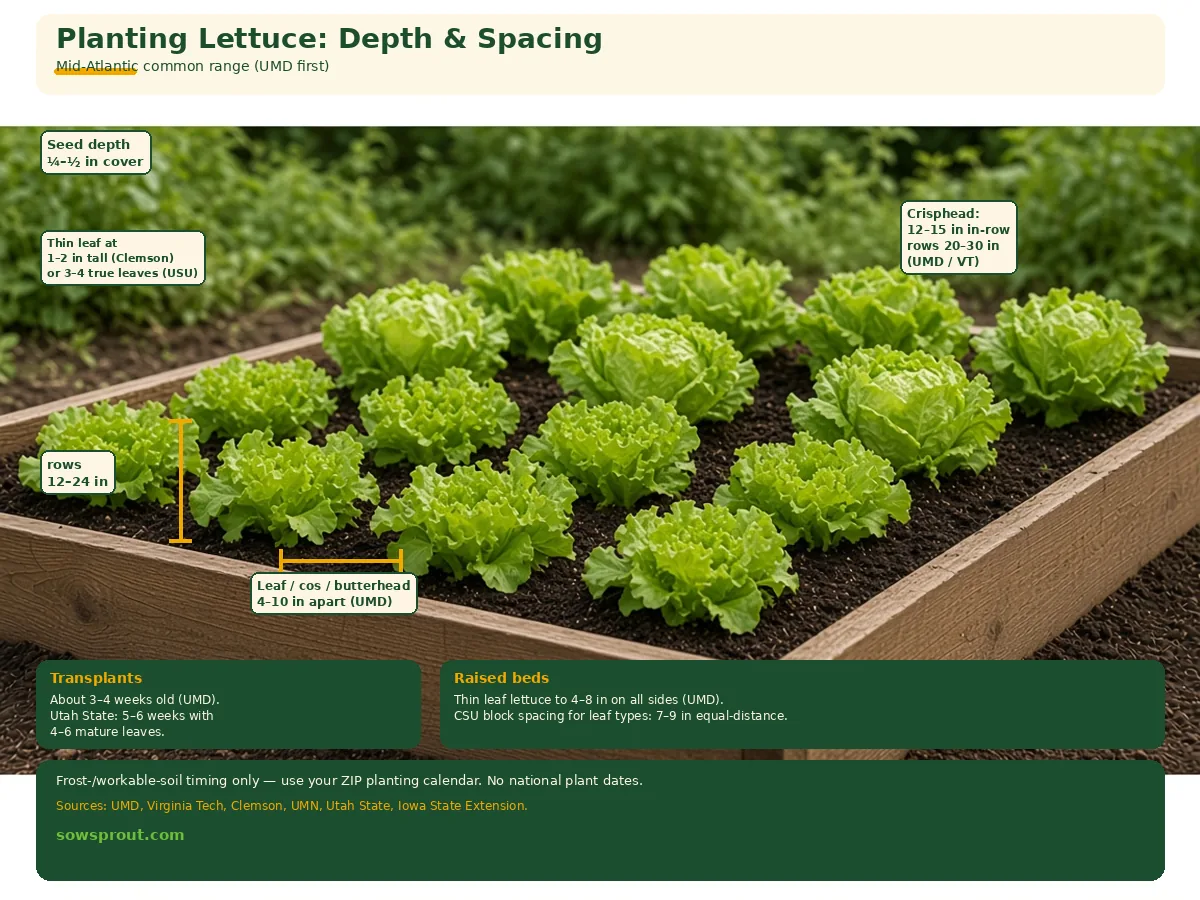
Sow lettuce seed about ¼ to ½ inch deep as soon as the soil can be worked in spring (or again in late summer for fall), thin leaf, cos, and butterhead plants to about 4 to 10 inches apart in the row with rows about 12 to 24 inches apart, give crisphead more room (about 12 to 15 inches in-row and 20 to 30 inches between rows), keep soil evenly moist with frequent light watering (about 1 to 2 inches a week depending on soil and heat), and harvest outer leaves or cut-and-come-again baby greens before summer heat triggers bolting and bitterness—or start again for a fall crop using frost dates from the ZIP planting calendar.

Lettuce at a glance


Weeks relative to last frost (LF). Colored weeks show when our ZIP planner schedules each step.
Jump to
Updated
Sow lettuce seed about ¼ to ½ inch deep as soon as the soil can be worked in spring (or again in late summer for fall), thin leaf, cos, and butterhead plants to about 4 to 10 inches apart in the row with rows about 12 to 24 inches apart, give crisphead more room (about 12 to 15 inches in-row and 20 to 30 inches between rows), keep soil evenly moist with frequent light watering (about 1 to 2 inches a week depending on soil and heat), and harvest outer leaves or cut-and-come-again baby greens before summer heat triggers bolting and bitterness—or start again for a fall crop using frost dates from the ZIP planting calendar.
Planting dates for your ZIP: use the ZIP planting planner and planting calendars for frost-based windows. Re-sow about every 7–14 days in cool weather (sourced succession band) — we do not invent a national plant date or a succession-tool URL that is not live.
Organic pests and diseases: see organic pest control for lettuce. Use any product as the label directs.
Lettuce types
- Leaf (loose-leaf): Easiest for most gardens; fast; cut outer leaves or whole plants (UMD, Clemson, Virginia Tech, UMN, Iowa State).
- Butterhead (Bibb / Boston): Loose heads; thicker leaves. UMD: “Bibb lettuce becomes bitter under high summer temperatures”. Clemson: bitterness readily above about 75°F.
- Romaine / cos: Upright heads; relatively easy (UMD, Clemson, Virginia Tech).
- Crisphead (iceberg): Tight firm heads; needs a long cool stretch; hardest for many gardeners as heat rises (UMD, Clemson, Virginia Tech, Iowa State). Prefer transplants and cool spring or fall windows.
No named cultivars on this page. Escarole, endive and chicory are treated much the same as lettuces (UMD) — not expanded here.
Planting and timing
Cool-season crop. UMD: “Sow leaf or butterhead types as soon as soil can be worked in the spring, or in late summer. Crisphead and cos (Romain) types may be transplanted in early spring and fall.” Growth bands differ by source (Clemson about 55–65°F; Virginia Tech 60–70°F; UMN ideal nights ~50°F, days ≤~68°F) — attributed, not averaged. Utah State: soils from about 40°F; seed 2–3 weeks before last frost. Fall: UMN sow about three months before the average first fall frost. Use your ZIP frost tools for local windows.
Transplants vs direct sow
Transplant ages disagree — do not average. UMD: “3 to 4 week old transplants can produce earlier harvests, eliminate the need for thinning, and increase garden productivity.”. Utah State: generally 5–6 weeks with 4–6 mature leaves. UMN: start indoors about four weeks before transplanting. Iowa State leafy greens: start two to three weeks before the anticipated transplant date. Lead with UMD for Mid-Atlantic pages; attribute Utah/UMN/Iowa when citing them. Clemson prefers transplants for head lettuce.
Spacing and thinning
Lead with UMD / Virginia Tech; attribute other bands — do not average. UMD leaf, cos or butterhead “4"- 10" in-row x 12"- 24" between rows”; crisphead “12"- 15" in-row x 20"- 30" between rows”. Virginia Tech matches those leaf/cos/butterhead and crisphead bands. Other extensions differ (Rutgers often 6–8 × 15; Clemson leaf 6–10 in rows 1–2 ft, head 12 in × 3 ft; Iowa leaf 4–6 / crisphead 12–14 × 18–24; Utah 8–12 × 12–18) — show them as alternate sourced ranges, not a blended national spacing.
CSU: “Close-row or block-style planting works well for raised bed gardening” (CSU Extension). UMD wide beds: thin leaf lettuce to about 4 to 8 inches on all sides. Clemson: thin leaf lettuce when plants are 1 to 2 inches tall. Utah: thin when plants have 3–4 true leaves. UMD: “Initial and eventual spacing (after thinning) depends on intended harvesting stage.”
Watering
Water bands disagree — publish both. Utah State: “Water lettuce regularly supplying 1-2 inches per week. Water requirements depend on soil type and temperatures.”. UMN, Iowa State and Clemson’s garden watering page often use about 1 inch a week. Clemson: “Shallow-rooted vegetables will have a greater demand for water than deep-rooted crops”; “A few shallow-rooted crops include lettuce”. Prefer frequent light watering; morning overhead only; mulch helps. Moisture swings favor tipburn and off-flavors.
Heat, bolting, and bitterness
UMD: “Increasing day-length and high summer temperatures usually cause seedstalk formation (bolting) and bitter flavor.” Many crops “produce flower stalks in response to cool or hot temperatures and long days” (UMD Extension, bolting). Clemson / Virginia Tech: summer heat → bolting and bitterness. Prefer spring/fall cool windows, shade from tall crops or shade cloth, steady moisture, and succession sowings. Once a flower stalk forms, Iowa State says pull plants and re-sow in cooler weather. Prefer slow-bolting or heat-resistant types (trait only — no cultivar names).
Row covers and season extension
UMD: “Row covers are useful in promoting rapid growth in the early spring and minimizing slug and other pest feeding.”. Floating covers or cold frames extend fall; shade cloth helps summer trials. Containers are OK (UMD) — no unsourced pot recipes here.
Harvest
UMD / Virginia Tech days to maturity: “40 - 80, depending on the type”. Leaf is often faster; Clemson’s about 75 days for leaf is one sourced figure among others — keep the 40–80 banner.
Leaf / cut-and-come-again: UMD usable at 5 to 6 inches; take older outer leaves first. UMD “Cut and Come Again Harvesting” — sow thickly; cut just above ground at 6 to 10 inches; re-grows if kept watered; ready again in 2–3 weeks. Iowa State often picks leaves about 4 to 6 inches long.
Heads: Bibb / butterhead cups into a loose head; romaine / cos forms an elongated overlapping head about 4 inches wide at the base and 6 to 8 inches tall (Virginia Tech); UMD: “Crisphead is mature when leaves overlap to form a compact and firm head.”
Storage (brief): UMD about 32°F, 95% RH, roughly 2–3 weeks (leaf/Bibb longer if dry when bagged); Utah ~1–2 weeks refrigerated; Iowa ~two weeks cool moist. Harvest dry; do not wash before storage; keep away from ethylene (apples/pears).
Common failure reasons
| Problem | What extensions say |
|---|---|
| Bitter leaves | Heat, water stress, approaching bolt (UMD, Clemson, VT, Utah State, UMN, Iowa State) |
| Bolting | Long days + heat; close spacing can encourage (UMD, Clemson, UMN) |
| Tipburn | Moisture swings / dry-then-wet (Utah State, UMN, Clemson) |
| Poor stand / crusting | Seed too deep or soil crust over tiny seed (UMN, Clemson) |
| Soft rot / leaf disease | Overwatering; wet foliage overnight — morning overhead only |
| Failed crisphead | Heat before head firms; needs long cool stretch |
UMD Extension · Virginia Tech SPES-785 · Clemson HGIC · Utah State Extension · UMN Extension · Clemson watering · CSU Extension
Frequently asked questions
How far apart should you plant lettuce in a raised bed?
Leaf, cos, and butterhead about 4 to 10 inches in the row; crisphead about 12 to 15 inches (UMD, Virginia Tech). CSU: close-row or block planting works well for raised bed gardening (leaf types often ~7–9 inches equal spacing). UMD wide beds: thin leaf lettuce to about 4 to 8 inches on all sides. Other extension bands differ — do not average them.
When should you harvest lettuce leaves?
About 40 to 80 days depending on type (UMD, Virginia Tech). Leaf usable at about 5 to 6 inches tall (UMD, Clemson); Iowa State often picks at 4 to 6 inches. UMD cut-and-come-again: cut at 6 to 10 inches, re-grow in about 2 to 3 weeks. Crisphead: leaves overlap into a compact, firm head (UMD).
How much water does lettuce need per week?
About 1 to 2 inches depending on soil and temperature (Utah State). UMN, Iowa State, and Clemson’s garden watering page often use about 1 inch a week. Lettuce is shallow-rooted, so water more often than deep-rooted crops (Clemson). Steady moisture limits tipburn and off-flavors. Do not collapse 1 in and 1–2 in into one averaged figure.
Why is my lettuce bitter?
Heat and stress. UMD: Bibb lettuce becomes bitter under high summer temperatures, and long days plus high summer heat usually cause bolting and bitter flavor. Clemson: Bibb turns bitter readily above about 75°F. Utah State: avoid water stress and temps above about 80°F; chilling harvested leaves can soften some bitterness.
Why is my lettuce growing tall / flowering?
Bolting. UMD: flower stalks form in response to cool or hot temperatures and long days — common in lettuce. Stick to cool spring/fall windows, steady moisture, shade or succession plantings (UMD, Virginia Tech, Iowa State).
Should I start lettuce from seed or transplants?
Both. Direct sow leaf/butterhead as soon as soil can be worked (UMD, Virginia Tech). Transplants about 3 to 4 weeks old speed harvest and skip thinning (UMD); Utah State uses about 5 to 6 weeks / 4–6 leaves — those ages are not averaged. Crisphead and cos are often transplanted early spring and fall.
How deep should I plant lettuce seed?
About ¼ to ½ inch (UMN, Utah State). Clemson and Iowa State often use about ¼ inch — tiny seed fails if buried too deep or under a crust (UMN, Clemson).
Can I grow lettuce in summer heat?
Cool-season crop. Prefer spring/fall, shade from taller crops or shade cloth, and frequent light watering; heat drives bolting and bitterness (UMD, Clemson, Virginia Tech, UMN). UMD allows baby leaf in brighter shade in summer — do not promise Mid-Atlantic midsummer crispheads.
Related: endive
More grow guides: Garlic · Potatoes · Peppers · Beans · Tomatoes · Cucumbers · Squash · Broccoli · Cabbage · All grow guides
Sources
- Colorado State University Extension: CSU Extension
- University of Maryland Extension: UMD Extension, bolting; UMD Extension
- Virginia Cooperative Extension (Virginia Tech): Virginia Tech SPES-785
- Clemson Cooperative Extension: Clemson HGIC; Clemson watering
- Utah State University Extension: Utah State Extension
- University of Minnesota Extension: UMN Extension