
How to Grow Cucumbers: Planting, Spacing, Care & Harvest
Quick answer
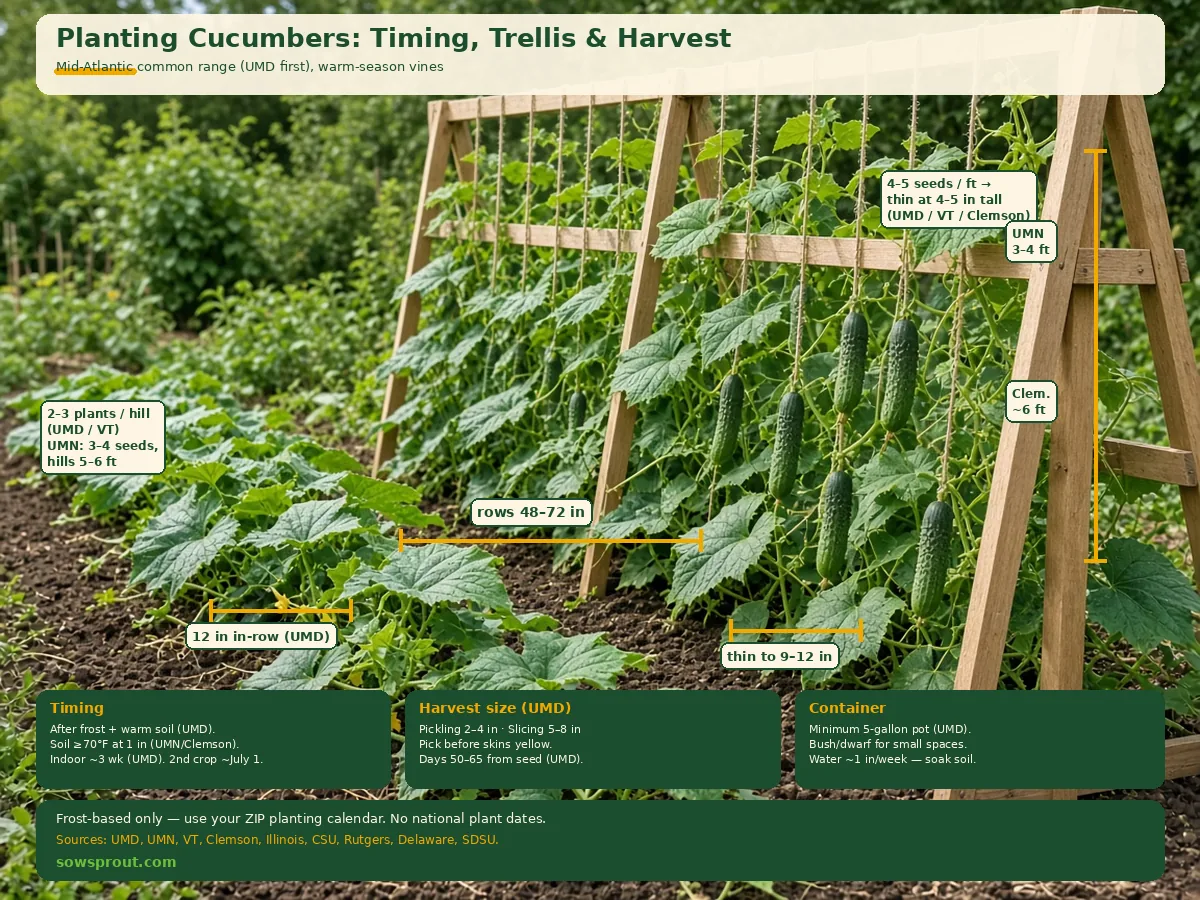
Cucumbers are a very tender warm-season vine. Sow seed after frost danger has passed and the soil has warmed, or set out plants started indoors about 3 weeks before planting time (UMD). Space about 12 inches in the row with 48 to 72 inches between rows, or plant two to three plants per hill; on a trellis, thin to 9 to 12 inches after plants are 4 to 5 inches high. Give about 1 inch of water a week, soak the soil rather than spraying the leaves, and water more often once fruit starts. Pick pickling types at about 2 to 4 inches and slicing types around 5 to 8 inches (UMD), before skins turn yellow. In the Mid-Atlantic, a second sowing around July 1 often has fewer disease problems than stretching one early planting until frost. Use the ZIP planting calendar for your local frost date — not a national plant month.

Cucumbers at a glance


Weeks relative to last frost (LF). Colored weeks show when our ZIP planner schedules each step.
Jump to
Updated
Cucumbers are a very tender warm-season vine. Sow seed after frost danger has passed and the soil has warmed, or set out plants started indoors about 3 weeks before planting time (UMD). Space about 12 inches in the row with 48 to 72 inches between rows, or plant two to three plants per hill; on a trellis, thin to 9 to 12 inches after plants are 4 to 5 inches high. Give about 1 inch of water a week, soak the soil rather than spraying the leaves, and water more often once fruit starts. Pick pickling types at about 2 to 4 inches and slicing types around 5 to 8 inches (UMD), before skins turn yellow. In the Mid-Atlantic, a second sowing around July 1 often has fewer disease problems than stretching one early planting until frost. Use the ZIP planting calendar for your local frost date — not a national plant month.
Planting dates for your ZIP: use the ZIP planting planner and frost dates / planting calendars. No national plant month. Related warm-season guides: tomatoes, peppers, beans. Cool-season brassicas: cabbage, broccoli.
Organic pests, diseases and fertilizer: see how to grow cucumbers organically. Use any product as the label directs.
Timing (frost and warm soil)
Indoor-start weeks disagree — do not average. UMD lead: plants grown indoors about 3 weeks before planting time (UMD Extension). VT / Illinois often use 3 to 4 weeks. UMN: start no earlier than 4 weeks before last frost. Clemson / CSU often cite 2 to 3 weeks transplant age. Lead with UMD 3 weeks; attribute the band.
Very tender warm-season crop: frost injures top growth (UMD); light frost can kill plants (Clemson). Direct sow after frost danger has passed and soil has warmed (UMD). UMN wants soil at least about 70°F at 1-inch depth; Clemson likewise about 70°F (seeds will not germinate below about 50°F). CSU lists cucumbers as Tender, sown around the average last spring frost (CSU Extension).
Second crop (regional): UMD and Virginia Tech both suggest planting a second crop around July 1 in the Mid-Atlantic — VT notes that later planting often has fewer disease problems than stretching one early crop until frost. Illinois: a second planting for fall harvest in mid- to late summer. Those month windows are regional; link ZIP frost tools.
Direct seed vs transplants
Direct seeding is the default (UMN, Illinois). Vine crops dislike root disturbance (CSU). If you transplant, use peat pots or plantable containers and disturb roots as little as possible (UMN, UMD). Thin extras by snipping with scissors rather than pulling (UMD). Seed depth about ½ inch (UMN); Illinois / CSU often ½–1 inch — labeled band. Row covers warm air and block pests, but remove them once flowering begins unless the type is seedless, so bees can reach flowers (UMN). Starter fertilizer language points to a soil test and organic cucumbers — no product rates here.
Spacing, hills, and trellis
Lead with Mid-Atlantic UMD; attribute hill / trellis / planning-table bands — do not average. UMD: “12" in-row x 48" - 72" between rows.” “or plant in a hill (two to three plants per hill).”. VT about 12–18 × 48–72 in rows. UMN: thin seedlings to 8–12 inches; hills of 3–4 seeds about 5–6 feet apart. Clemson non-trellis often 8–10 inches in rows about 5 feet apart. Illinois: one plant every 12 inches, or three plants every 36 inches in hills. Rutgers planning table (36 × 30) is a labeled planning-table alternate, not blended into the Mid-Atlantic main.
Trellis: UMD “Plant four to five seeds per foot, thinning to a 9- to 12-inch spacing when plants are 4- to 5-inches high.”. VT / Clemson use the same thin rule. Trellised rows can sit closer (VT about 30 inches; Clemson about 3 feet). Trellis height cues: UMN about 3–4 feet; Clemson about 6 feet — labeled separately.
Watering
UMN: “Cucumbers need about one inch of water from rainfall or irrigation each week during the growing season.” Soak thoroughly; water sandy soil more often with less each time; trellised vines may need water more often. “Do not use a sprinkler or spray the plants with a hose.” UMD: keep the root zone moist; water more frequently when fruits begin to develop. Clemson: moisten soil to at least about 6 inches; uniform moisture is critical during fruit set. Do not work wet vines (UMD, Illinois, VT).
Bitterness and pollination
Bitterness: NC State lists stress that raises bitter cucurbitacins — lack of water, uneven watering, heat or cool, wide temperature swings, low fertility, or low pH — and notes misshapen fruit from poor pollination can also be bitter (NC State Extension). UMN: bitterness is stronger near the skin and worst at the blossom end. Clemson / VT also flag temperature swings over about 20°F; Clemson notes bitterness may show more toward the stem end — both ends labeled, not merged.
Pollination: Separate male and female flowers on the same plant. First flowers are usually male and drop without fruit — normal (UMN, Illinois, Clemson). Female flowers show a tiny swelling behind the petals. UMD: about 8 to 12 bee visits per flower for a straight, full-size fruit. Cool, rainy, or cloudy weather cuts bee activity and set. Misshapen fruit often means poor pollination — remove those young fruit (VT, Clemson, Illinois).
Harvest: pickling vs slicing
Harvest-size bands disagree — lead with UMD; do not average. UMD: “Pickling cucumbers should be 2 to 4 inches long.” “Slicing cucumbers should be 5 to 8 inches long depending on the variety.”. Illinois / Clemson / VT publish overlapping but different bands (pickles as small as about 2 in; slicers / burpless often into the 6–10 in range) — attribute, do not blend into one number.
Stop before yellow: VT says harvest any size before fruit begin to turn yellow. Illinois: “Do not allow cucumbers to turn yellow”. UMN: over-large fruit show large seeds and yellowish skins. Clemson: pick before skins begin to yellow. SDSU: very ripe cucumbers turn deep yellow with spongy flesh and hard seeds (SDSU Extension). Pick often — at least every other day in peak season (Illinois). Days to maturity: UMD 50–65 from seed; VT / Clemson about 50–70 — publish as a band.
Containers
UMD lists 5 gallons as the minimum container volume for cucumbers (UMD Extension). Warm-season sun about 6–8 hours; keep moisture steady — pots dry fast. Bush types fit containers best.
Common failure reasons
| Problem | What extensions say |
|---|---|
| Bitter fruit | Uneven water, heat/cool swings, low fertility or pH, poor pollination, overmature fruit (NC State, UMN, Clemson, VT) |
| Misshapen fruit | Poor pollination or low fertility (VT, Clemson, Illinois) |
| Blossoms drop / no fruit | First flowers male (normal); few bees; rainy/cool/cloudy weather (UMN, Illinois, UMD, VT) |
| Yellow fruit | Overmature — left on the vine too long (VT, Illinois, UMN, Clemson, SDSU) |
| Poor germination | Cold soil below about 60–70°F (UMN, Clemson, CSU) |
Pests and diseases (cucumber beetles, bacterial wilt, mildews, etc.): cultural notes only here — full IPM on organic cucumbers. No fertilizer product rates. UMD Extension · UMN Extension · Illinois Extension · Virginia Tech SPES-779 · Clemson HGIC · SDSU Extension
Frequently asked questions
When should I plant cucumbers?
Sow after frost danger has passed and the soil has warmed (UMD). Many guides want soil near 70°F (UMN, Clemson). Or set out transplants started indoors about 3 weeks before planting time (UMD) — VT/Illinois often 3–4 weeks, UMN no earlier than 4 weeks before last frost, Clemson/CSU often 2–3 weeks. Do not average those indoor-start frames. Use your ZIP frost dates.
Should I plant a second cucumber crop?
In the Mid-Atlantic, UMD and Virginia Tech both suggest a second sowing around July 1. VT notes that later planting often has fewer disease problems than trying to stretch one early planting until frost. Illinois: a second planting for fall harvest in mid- to late summer. Regional only — link ZIP frost tools.
How far apart should you plant cucumbers?
UMD: 12 inches in the row and 48 to 72 inches between rows, or two to three plants per hill. UMN: thin to 8 to 12 inches; hills 5 to 6 feet apart. Sources differ — do not average row, hill, or planning-table bands.
How far apart should you plant cucumbers on a trellis?
UMD: plant four to five seeds per foot, thinning to 9 to 12 inches when plants are 4 to 5 inches high. VT and Clemson use the same thin rule; trellised rows can sit closer (VT about 30 inches; Clemson about 3 feet).
Why are my cucumbers bitter?
NC State: environmental stress — lack of water, uneven watering, high heat or cool conditions, wide temperature swings, low soil fertility, or low soil pH — raises bitter cucurbitacins. Misshapen fruit from poor pollination can also be bitter. UMN: bitterness is stronger near the skin and worst at the blossom end. Clemson/VT also flag temperature swings over about 20°F.
Why are my cucumbers turning yellow?
Most often they are overmature. VT: harvest any size before they begin to turn yellow. Illinois: do not allow cucumbers to turn yellow — remove missed fruits so young ones keep developing. UMN: over-large fruit show large seeds and yellowish skins. Clemson: pick before skins begin to yellow. SDSU: very ripe cucumbers turn deep yellow with spongy flesh and hard seeds.
Why do cucumber blossoms drop without fruit?
The first flowers are usually male and will not set fruit (UMN, Illinois, Clemson). Female flowers have a tiny swelling at the base. After bees pollinate those, fruit develops. Cold, rain, or cloudy weather can cut bee activity and reduce set (UMN, VT, Illinois).
How long does it take cucumbers to grow from seed to harvest?
UMD: 50 to 65 days from seed. VT and Clemson: about 50 to 70 days. Publish as a band — do not invent one national day count.
How much water do cucumbers need?
UMN: about one inch a week; soak thoroughly; water sandy soil more often with less each time; do not use a sprinkler or hose spray on the plants. UMD: water more frequently when fruits begin to develop.
Can you grow cucumbers in a 5-gallon bucket?
Yes. UMD lists 5 gallons as the minimum container volume for cucumbers. Keep moisture steady — pots dry fast.
When is a cucumber ready to harvest?
Pick at the size you want before seeds harden or skins yellow. UMD: pickling 2 to 4 inches; slicing 5 to 8 inches depending on variety. Other guides publish overlapping bands — do not average them into one number. Pick often — at least every other day in peak season (Illinois).
Related: cantaloupe
More grow guides: Tomatoes · Peppers · Beans · Cabbage · Broccoli · Lettuce · Garlic · Potatoes · Squash · All grow guides
Sources
- University of Maryland Extension: UMD Extension; UMD Extension
- Colorado State University Extension: CSU Extension
- NC State Extension: Frequently asked questions vegetables
- South Dakota State University Extension: SDSU Extension
- University of Minnesota Extension: UMN Extension
- University of Illinois Extension: Cucumber
- Virginia Cooperative Extension (Virginia Tech): Virginia Tech SPES-779
- Clemson Cooperative Extension: Clemson HGIC